




December 25, 2018
Merry Mopar Christmas 2018
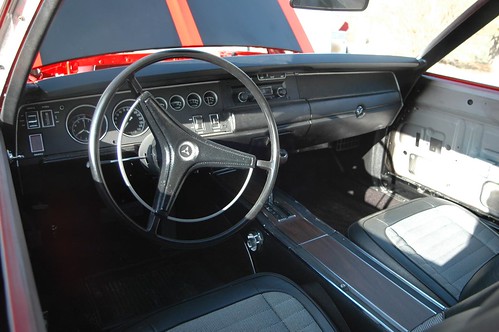
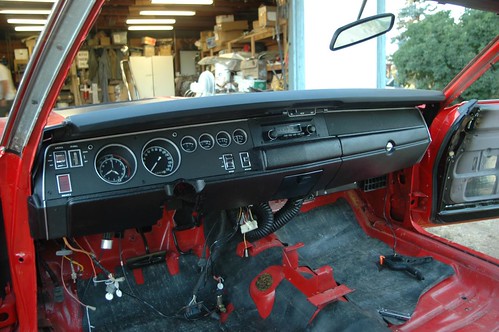
This year for Christmas my wife splurged and bought me a new reproduction replacement Tic-Toc-Tac for my Charger. The original clock never worked since I had owned it, and some time ago the tachometer got erratic and stopped working too. (after almost 50 years who could fault it?)
The new one fit right in, and connected just like the original. While I had the cluster out, I replaced all the instrument panel lights with new LED units I bought online.
The end result was a VAST improvement and it is SO COOL to have both the clock and tachometer working. Merry Christmas everyone!
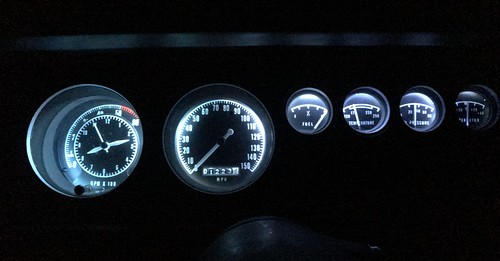
And I must say thanks so much to my lovely wife for such an awesome gift!
Posted in 2004-present | Family Helpers | RESTORATION | interior | wiring | link to this page | | Comments (0)
September 07, 2016
Our other Mopars
I have owned many Mopars in the past, including a 1965 Polara 4dr with a 383, a 1966 Polara 4dr with a 383, a 1972 D100 2wd long-bed pickup with a 318, and a 1964 Plymouth Barracuda with a 273. My very first car was the '65 Polara mentioned above. I enjoyed that car and it was tough enough to survive my learning many of my first automotive maintenance lessons on it. Since then, I have preferred and promoted classic MoPars of every stripe everywhere I've gone.
With my first car and in the early days of my Charger, I held a fairly uniform appreciation of all American-made muscle-car era automobiles. I found that many of the GM and blue-oval devotees received my praise of their vehicles but had nothing but uninformed condemnation for my own cars. I found this to be true even when their cars could not beat mine in a race. Later on, I met other Mopar owners and found many of them had had the same experiences. It is with these people that I have enjoyed the camaraderie and pride of owning Mopar vehicles over the years.
This may be the only picture I still have of my first car. My trusty 1965 Dodge Polara police car. I was almost 16 in this picture. This is the car that started my love for all things Mopar!
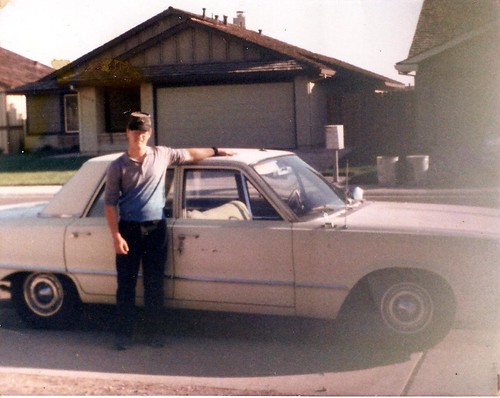
On this page I will feature Mopars currently in our family's fleet.
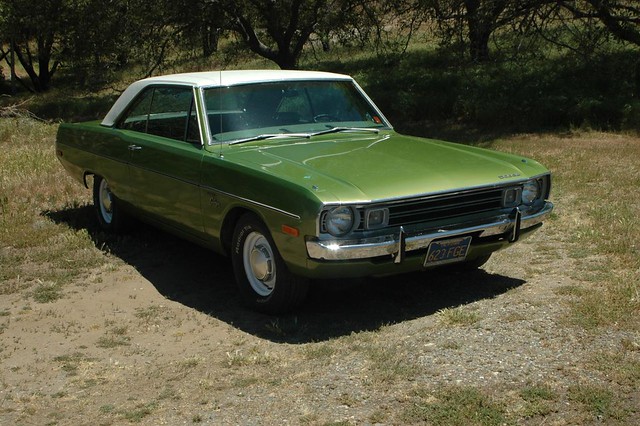
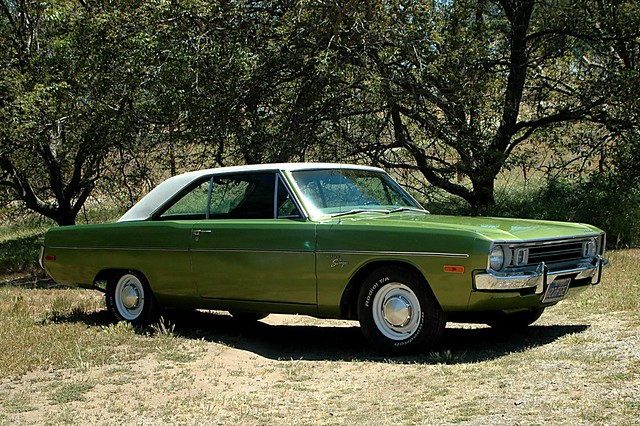
This is my wife's 1972 Dodge Dart Swinger. It has a new 360 CID engine and it runs like a top. We love this car, my wife especially. We bought it in the summer of 2006 from its original owner, a sweet little lady (really) who had kept every scrap of paperwork pertaining to the car all the way back to her original dealership purchase receipt, and who had taken the car in every six months for a checkup or whenever it needed it, whichever was oftener. Other than the new 360, a paint job and new vinyl top in 2004, this car is completely original, and it's virtually immaculate inside and out. The original 318 was great, but after 35 years of service it finally needed to be replaced or rebuilt. This car gets a great deal of well-deserved attention wherever we go in it.
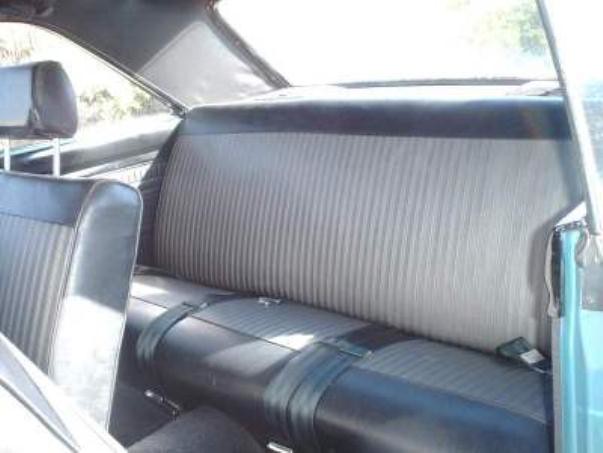
In 2004, I started looking for an economical-to-drive cool-looking older Mopar for regular transportation. I am quite sure we scored a good deal on this 1969 Dodge Dart Western Special. The car is very solid, and needs only a few cosmetic finishing touches. Even in its current unrestored state, this clean, original car still gets us a lot of compliments. Powered by what I believe to be its original 225 CID slant-six, backed up by a 3-speed manual column-shifted transmission, it does very well on gas and doesn't embarrass me going up our local hills. When I restore this car for my daughter, I hope to redo the exterior of the car in its original Q5 Bright Turquoise Metallic paint, with a new vinyl top, and maybe a black tail stripe, and probably install a small block and auto transmission, or maybe I'll just leave it stock. It is still cool, and there aren't too many of these still sporting their original drive train these days.
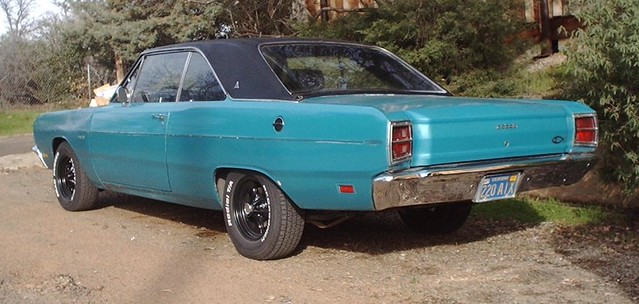
The famous "leaning tower of power" The "Charger 225"

The interior is in great shape and is original!
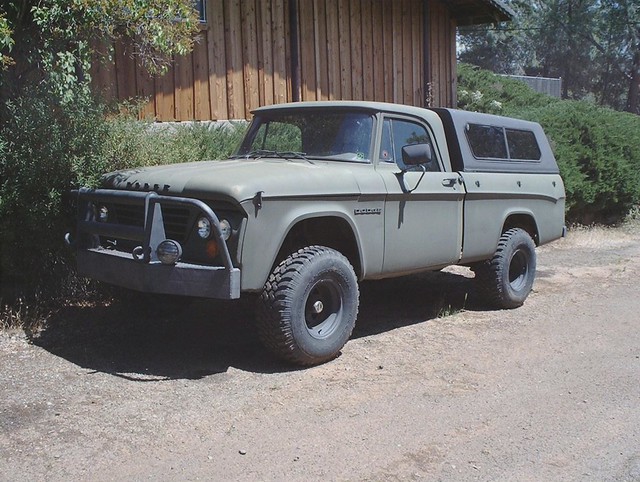
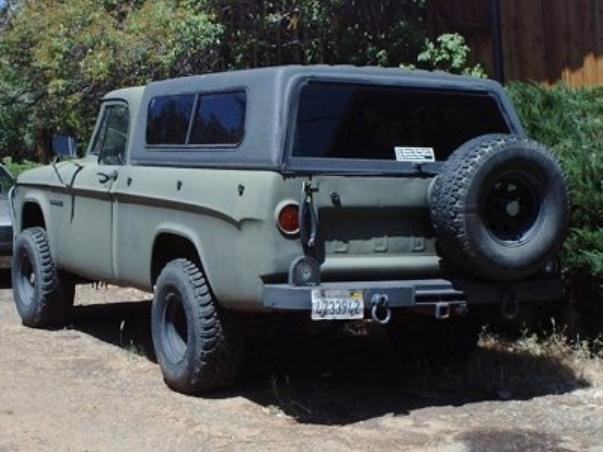
The story of my 1963 D100 probably warrants its own webpage. My buddy and I completely changed the nature and purpose of this vehicle. It started out as a D100 SWB 6-cyl 4spd with manual steering, 2wd, and manual drum brakes all the way around. Over the course of 18 months, we transformed it into what you see in these pictures: a 383 2bbl, 727 auto and an MP205 divorced transfer case Dana 44 front end and 8 3/4 rear from a '74 Power wagon with 3:55 gears were initially used. Since these pictures were taken I have updated both front and rear axles. I beefed up my truck with a Dana 44 front end from an '86 W350 with Warn manual hubs, a Dana 60 rear end (also from the '86 W350) with 4:10 gears all the way around. The steering column with the automatic shifter and floor pan are from a 1969 D200. The brake booster and master cylinder assembly are also from the'86 W350. The front and rear bumpers are custom-made by my friend and myself.
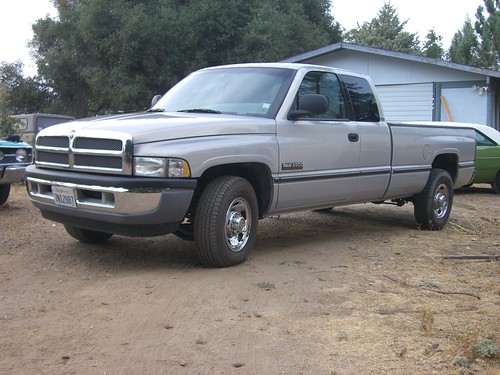
The workhorse of the bunch is my '97 Dodge Ram 2500 with the awesome 5.9l Cummins. I REALLY love this truck!
In 2003, I was able to acquire this complete, running, driving 1967 Plymouth Satellite 2dr HT. It has a 318 4bbl which runs quite well. The interior has bucket seats and an automatic console shift. My son (who was seven years old at the time) is the owner of this car. It had long been my plan when my Charger was done for the two of us to begin restoration of his Satellite together.
You can see some of the major restoration progress we made on my son's '67 Satellite before he headed off for college at his Satellite restoration page here Tolley's 1967 Satellite Restoration Blog

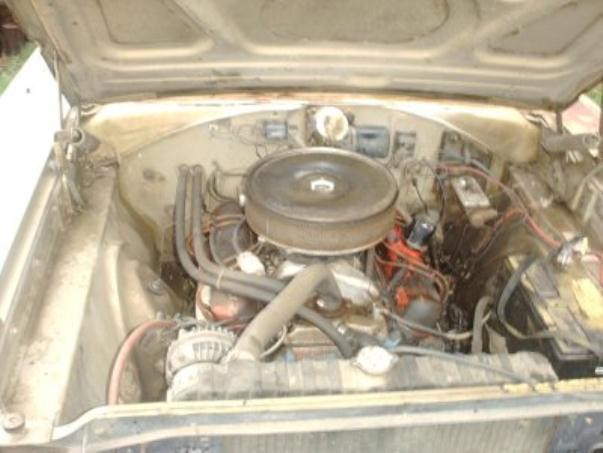
The paperwork that came with the car indicates that this 318 should be the original engine and was overhauled a number of years ago, which could explain why it runs so well. The engine has an after-market aluminum 4bbl intake and an Edelbrock (Carter AFB) carburetor. I have a 1971 440 4bbl engine that has been reserved for my son's future power needs. Unless he continues with his plan to put a HEMI in it one day!
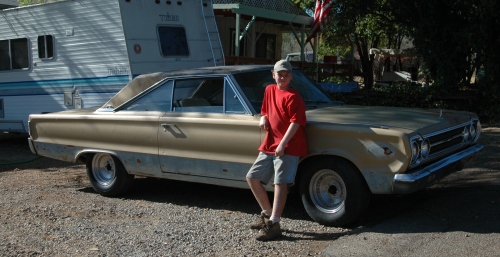
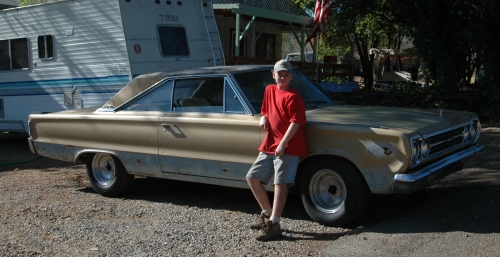
Here's a picture from 2007 with my son leaning against his Satellite, he is 6'4" tall now so he's changed even more than his car has!
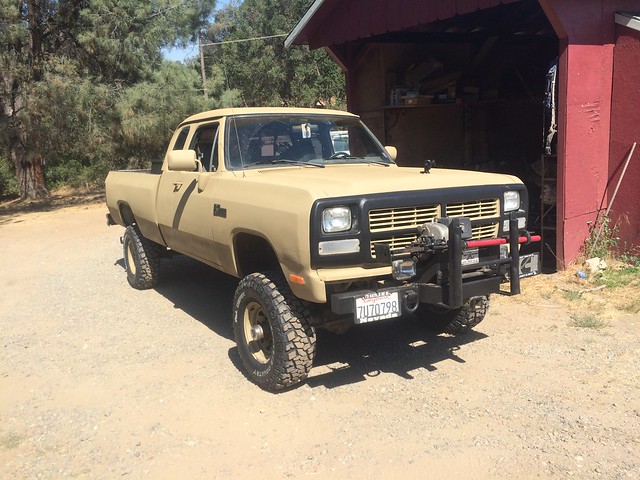
My son is a grown man now and sought out something cool, tough, and practical for his work and daily driver use. He scored with the 1993 Dodge W250 Cummins equipped Power Wagon. It came with a utlity bed which he sold and promptly replaced with a good long bed we had at home. It has a 4" lift and 285/75R16 tires on American Racing spoke wheels. The paint is military surplus desert sand. Everything works perfectly. This thing is an awesome beast!
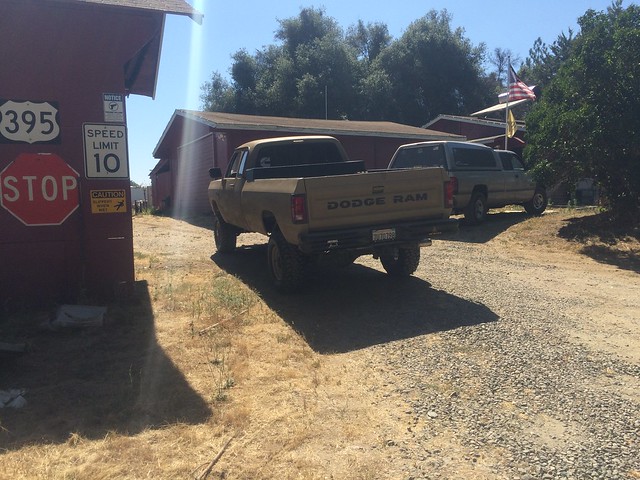
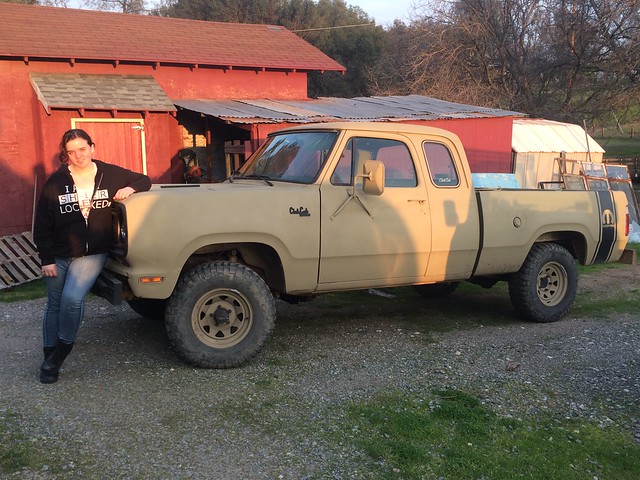
For nearly 20 years my barber and I had an arrangement. I worked on his '76 Power wagon whenever needed and he would cut my family's hair. Well a couple years ago he lost a battle with cancer. His widow insisted that the truck come to live with me. When my daughter wanted something cool to drive to school her first choice was the Barber's old '76 Power Wagon. We cleaned it up, did a tune up and a little maintenance together, (she got her own Craftsman tools for Christmas) and then I painted it like as my son's '93 Power Wagon using the same military surplus paint. I updated the wheels with some American Racing 16 x 6.5" units with 265/75R16's. Came out pretty cool looking and my daughter certainly loved driving the truck she calls "beast".

Posted in Family Helpers | RESTORATION | link to this page | | Comments (0)
September 20, 2014
"ON THE ROAD AGAIN!"
Cue the Willie Nelson... :)
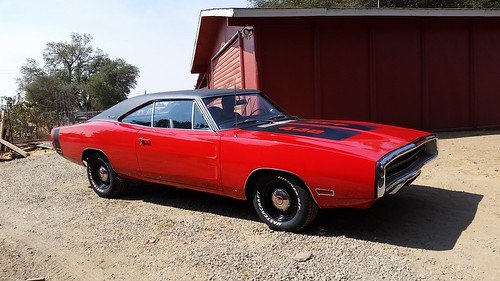
Yep, My Charger is on the road again! Ten and a half years after I started the restoration process I am complete enough to warrant registration and insurance.
Remember, you can click on my photos if you want to see one in a larger size.
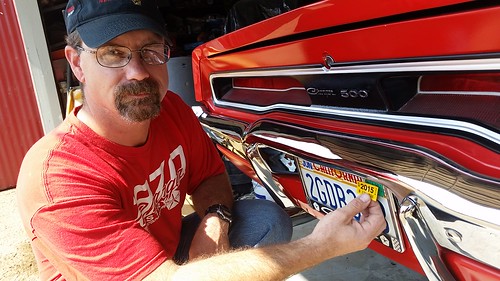
Here is the 2015 tag going on over the 1996 one. (I non-op'd my Charger in 1996 but did not start to restore it until 2004)
Here my wife and I are getting ready to head out on the maiden voyage.
This video (which I forgot we had taken on my wife's phone) is of the VERY first drive of my restored Charger on paved roads since 2004 right before I began to take my Charger apart.
After a quick trip to town, it was time for fuel and a front end alignment appointment... I was very nervous about putting fuel in, I really did not want to spill on the paint.
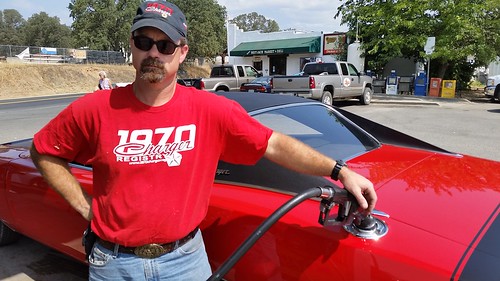
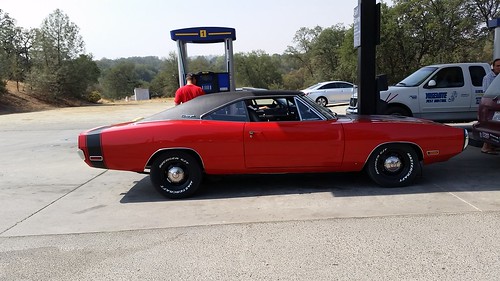
Here is a video of a quick burn-out in the parking lot of the building where our Church meets.
What a great day, long awaited and lots of fun, I hope to enter a couple of nearby car shows in October.
Stay tuned...
Posted in 2004-present | Family Helpers | RESTORATION | link to this page | | Comments (0)
June 08, 2014
DRIVING my Charger out into the sun!
For the first time in more than 10 years I drove my Charger today. It still needs shocks, tires, insurance etc so I did not go far, but far enough to get my Charger out into the sun for a round of nice pictures. Thanks to my wife for taking the video and photos, and my son for spotting for me.
Into the sunshine!
Down the driveway
If you like, join me on a quick walk around my Charger.
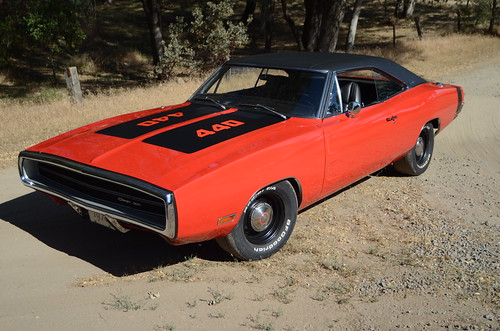
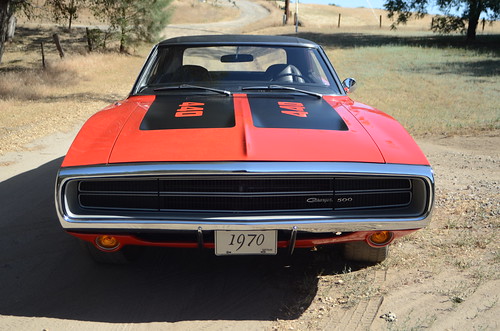
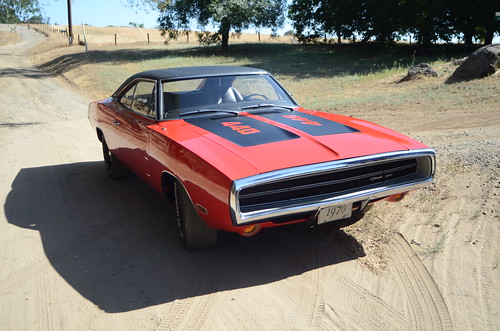
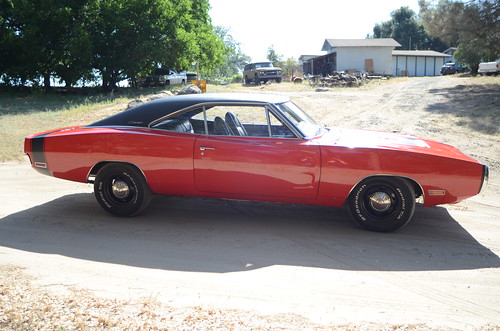
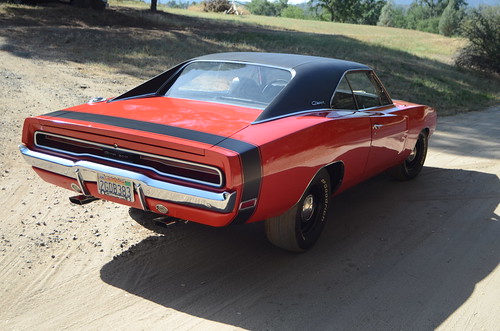
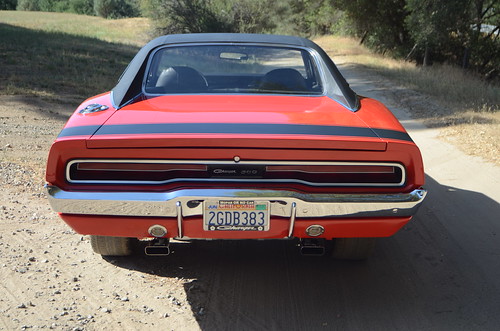
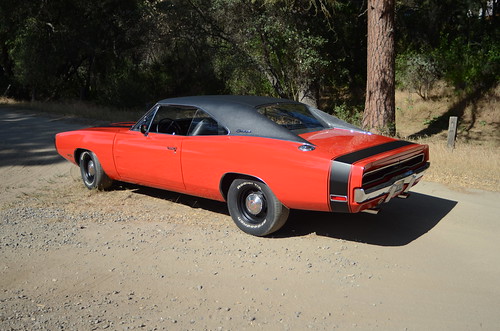
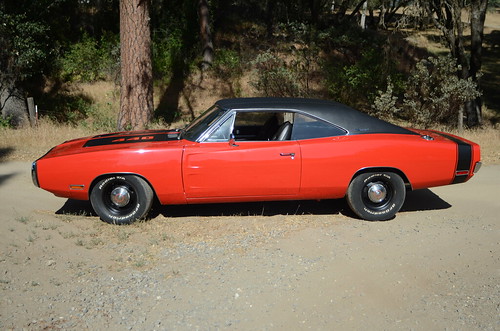
The to-do list is getting shorter and shorter, and my Charger is getting closer to being ready to take to it's first car show, probably in October.
Posted in 2004-present | Family Helpers | RESTORATION | Reassembly | body | engine | glass | suspension, brakes, tires, and wheels | link to this page | | Comments (0)
October 15, 2013
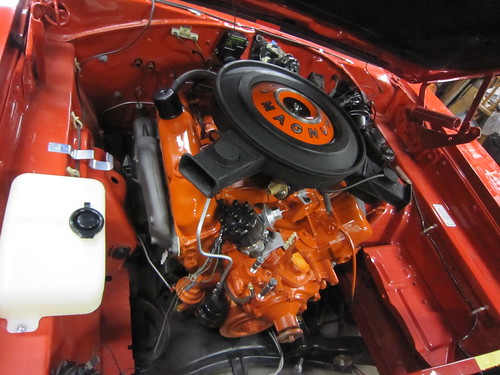
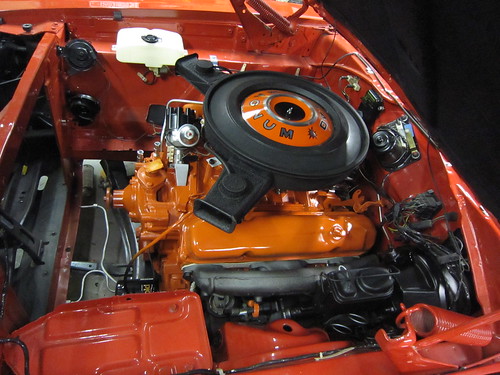
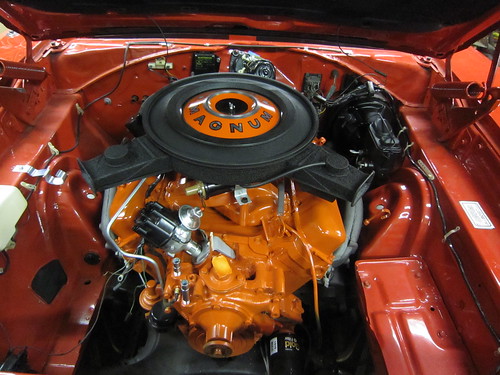
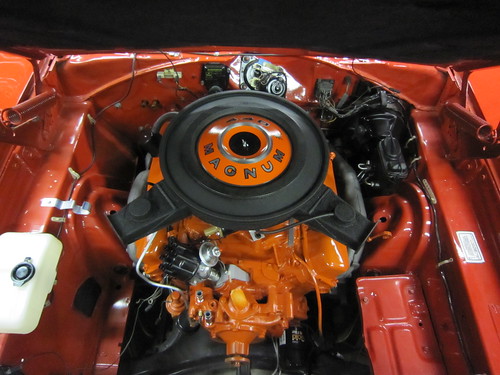
Exhaust manifolds are on!
I had some time this evening and put the manifolds and spark plug wire holders on. Now I can start sorting out the pulleys and brackets for the front, and get the drive line ready to go in.
Everything came out very nicely I think.
Posted in 2004-present | RESTORATION | Reassembly | engine | link to this page | | Comments (0)
September 12, 2013
Problem solved
OK, so after some other work my son and I had to do, I decided it was time to pull the CH4B and lay it right next to a stock '69 intake I had.
There was not much difference! (about what I had read online, less than 1/2"). So I tried the stock manifold with my carburetor and air cleaner, the hood was still hitting something, so then out comes the hood insulation pad. Still hitting something.
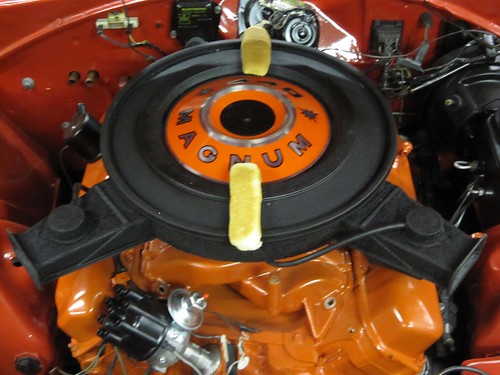
Then I started searching for something that would indicate to me exactly where the contact was. I looked for some soft clay, but the clay my daughter has is really stiff. My son tries pieces of blue masking tape sticky side up, but no go. Then I get a great idea. Hot-Dog buns! They will leave a record of being smashed cut etc and not make a big mess. So I put hot dog buns on the air cleaner housing, I try to close the hood, still there is contact somewhere, then I try the same thing with the carburetor on, but no air cleaner, going nice and slow, I am still coming in contact with something... My son then spots it looking through the grill, the hood is barely contacting the wiper motor in the back. We make some adjustments to the hood (VERY slight I must say) and then everything is OK. Put the air cleaner back on, the hood closes and no squished buns.
Next, I put the aluminum intake back on, carburetor, air cleaner hot dog buns, the hood closes no squished buns.
So, all along a tiny hood misalignment was causing some very minor contact with the wiper motor. When the air cleaner was off and I knew I had tons of room I'd just shut the hood quickly and never noticed the issue. Then when I was being super cautious I would notice the contact and stop.
It never was the air cleaner! So now I'll change the intake gasket, bolt the CH4B back on, and move forward again. Happy ending to a weird story! Thank you Lord!
I was finally able to add a picture this is what our troubleshooting looked like!
Stay tuned!
Posted in 2004-present | Family Helpers | RESTORATION | Reassembly | engine | link to this page | | Comments (0)
August 17, 2013
Drive train day!
OK, I just got back in the house (7 PM ) after being in the garage since about 9 AM. My son, one of his friends and I managed to get a few things done on my Charger.
First we rolled the Charger back, removed the hood, jacked it up, and put the transmission in.
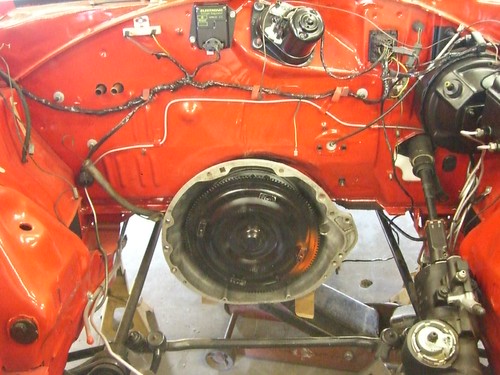
Next we filled the engine with 6 qts of oil and some zinc additive, then we primed the oiling system.
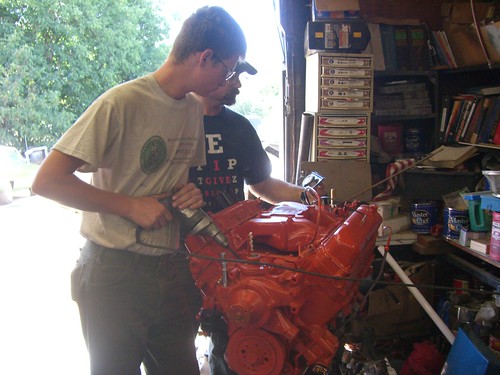
Next we grabbed the engine, got it off the stand, and put the flex-plate on.
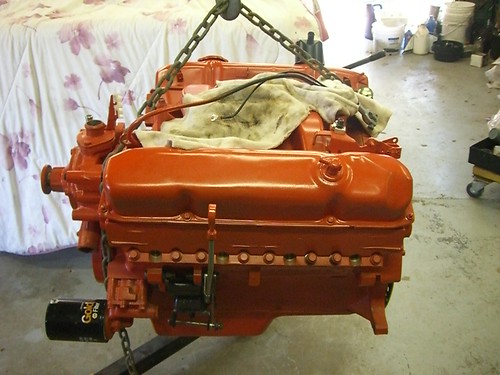
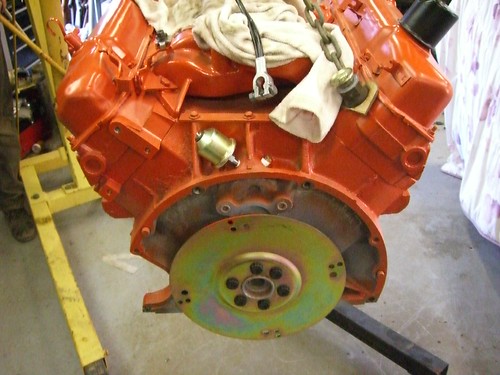
Then it was time to put the engine in! YAY!
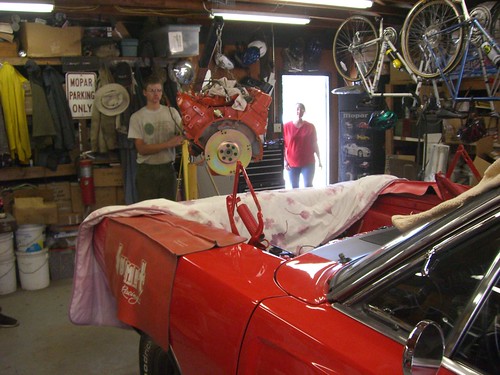
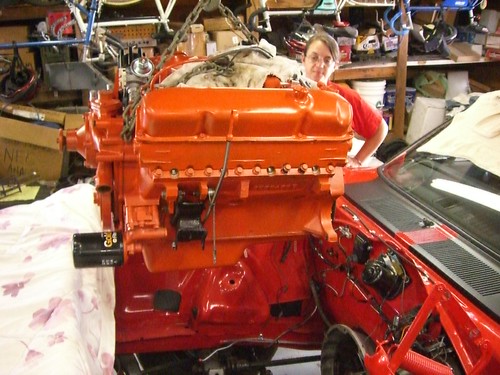
Engine in, and bolted to the transmission, NOTE here, we dropped the transmission back a bit to help get the engine on its mounts.
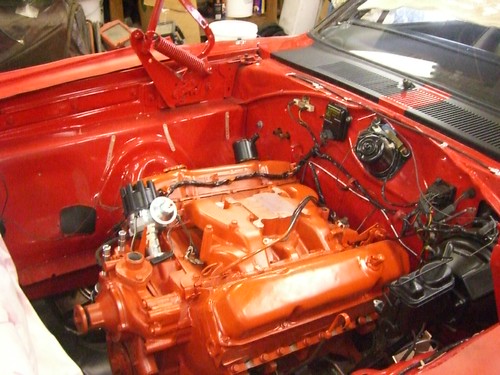
I spent a while hooking things up underneath, installing the transmission cooler lines, flex plate bolts etc.
Then I installed the new distributor, routed some of the wires, and put the new carburetor on. The carburetor is an 800 CFM Edelbrock Thunder AVS series with electric choke option.
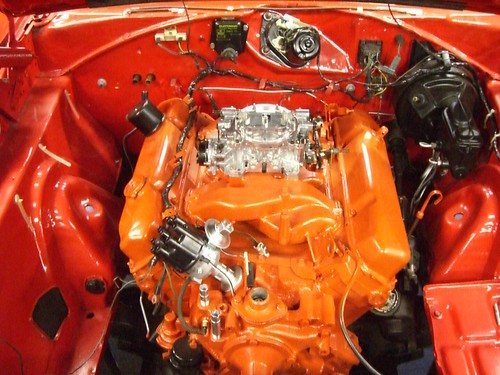
Then the final touch. (- or so I thought)
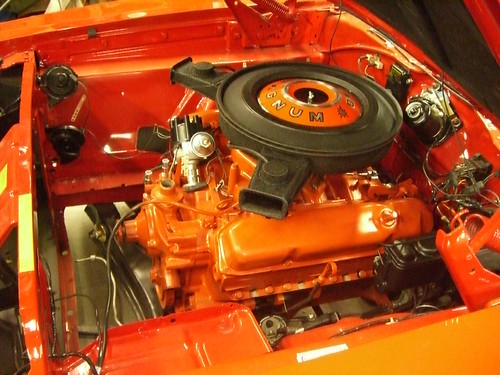
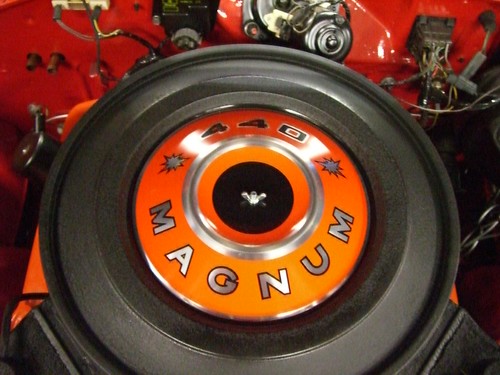
The problem is, it seems the CH4B may be too tall (something is too tall anyhow) I thought it was supposed to be fine (everything I read online said so...) but I can't close the hood because it contacts the air cleaner. At this point, I am thinking I may have to go back to a stock cast iron intake. However I am going to study the problem, and see if I can find an answer first...
Great day, but it ended a bit differently than I expected. I am very thankful that my prayers were answered, and we did the entire job without scratching any part of the Charger, and that we were able to get the hood alignment perfect again when we put it back on. Thank you Jesus!
Stay tuned!
Posted in 2004-present | Family Helpers | RESTORATION | Reassembly | engine | link to this page | | Comments (0)
August 16, 2013
727 Transmission overhaul
Tonight my son and I completed a project we began a week ago (I had to wait for some parts to arrive)
We overhauled the 727 transmission for my Charger. I used red Alto clutches, with Kolene steels, new red Alto front band and a Kevlar rear band, a street Hemi torque converter from PTC (2,800-3,000 stall) and all new seals and bushings etc. And a new poly-loc rear mount.
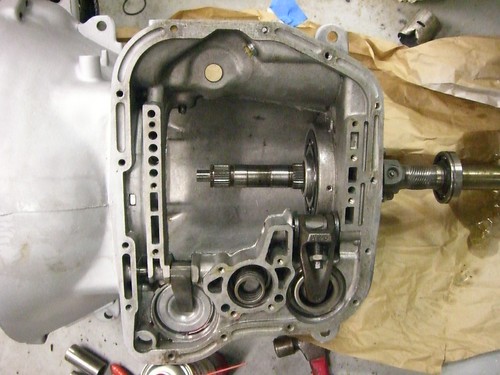
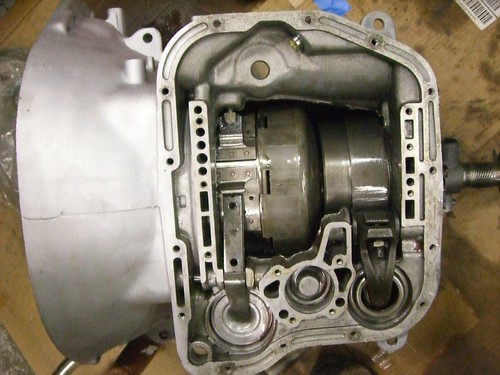
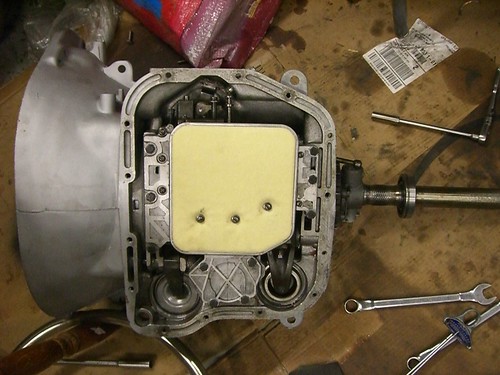
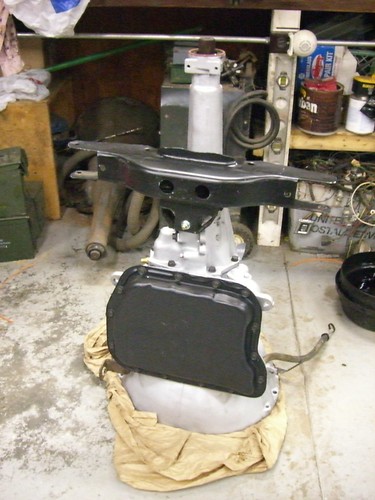
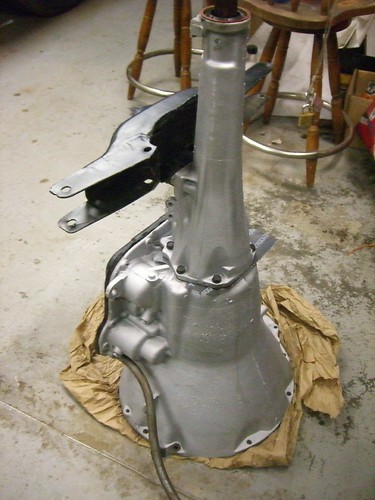
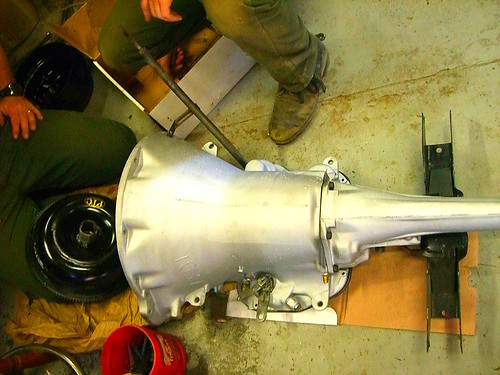
Tomorrow should be a great day, the drive train should go back in my Charger!
Posted in 2004-present | Family Helpers | RESTORATION | Reassembly | engine | link to this page | | Comments (0)
March 26, 2013
A Special Guest!
Something I've been encouraging my son to do for a long time is to create a web presence about the ongoing restoration of his 1967 Plymouth Satellite.
Well the last merit badge he needs to finish before he can submit his Eagle Scout package is Communications. One of the ways to meet one of the requirements is to design a web site. The requirements state you do not even have to post it, and it does not have to be more than a few paragraphs of information. However, with a little nudge from his Dad (and Assistant Scoutmaster) he put it on the web.
Here he is at age 7 when I bought him his first Mopar! (he is almost 17 yrs old now and 6'3" tall)
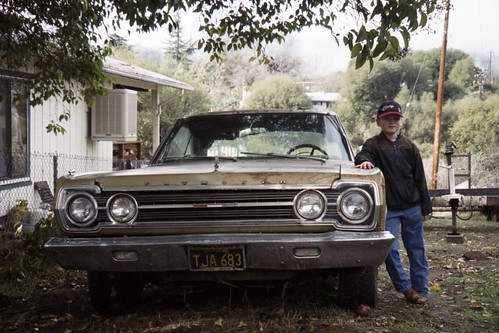
It is basic, and he'll be adding to it as we go, we have many hundreds of photos, but most are references for when we put it back together.
It is a blog, so just like my Charger blog, the newest posts are on top, you scroll down to see older stuff - all the way back to the beginning.
Here is a link to see it... Tolley's Satellite Restoration
Let him know what you think, or if there is anything any of you want to know.
Posted in 2004-present | Family Helpers | RESTORATION | disassembly | glass | interior | primer and paint | rust & rust repair | sandblasting | sanding | sheet-metal replacement | link to this page | | Comments (0)
March 17, 2013
Final engine assembly!
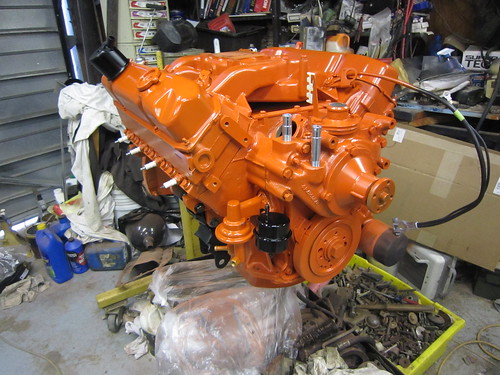
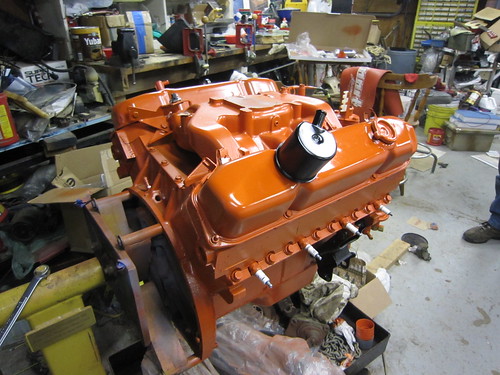
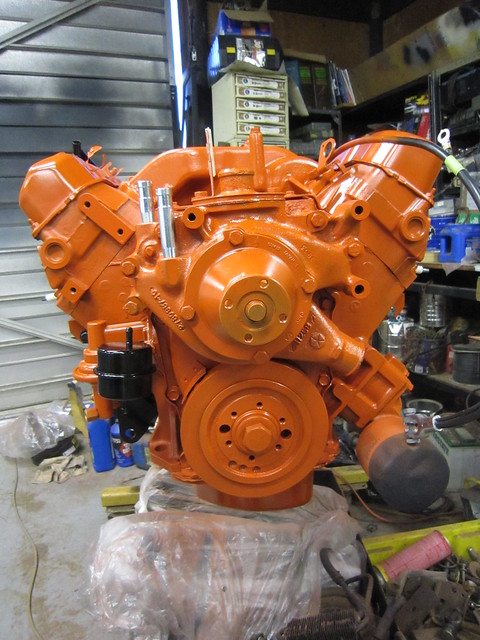
Well, I believe everything is right and torqued and and all the pieces are as correct as my son and I can get them to be, so it was finally time to prime and paint the engine!
I used Duplicolor Chrysler Hemi orange, on top of Duplicolor gray engine primer. then once the orange was done I used Duplicolor clear engine paint on everything to help with durability, and ease of cleaning the engine in the future.
I bought all from a local auto parts store. It took four cans of the orange to get the coverage I was after, but one can of primer, and one can of clear were plenty.
Now I will start cleaning, checking, and painting all my brackets and pulleys Stay tuned!

Posted in 2004-present | Family Helpers | RESTORATION | Reassembly | engine | primer and paint | link to this page | | Comments (0)
March 14, 2013
More Engine Assembly
A few more pieces on... Everything is "permanently" attached except the valve covers which are just on for the picture.
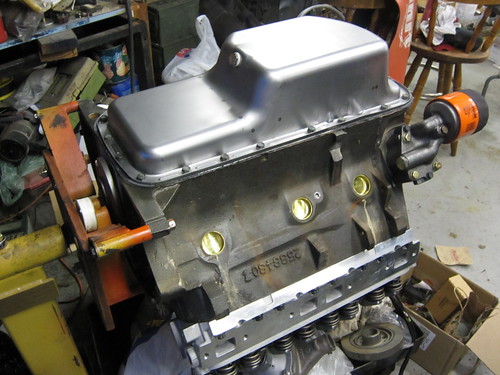
Factory windage tray, new 440 source pickup (which I had to heat and bend just a little to clear the windage tray, and have adequate pan clearance still).
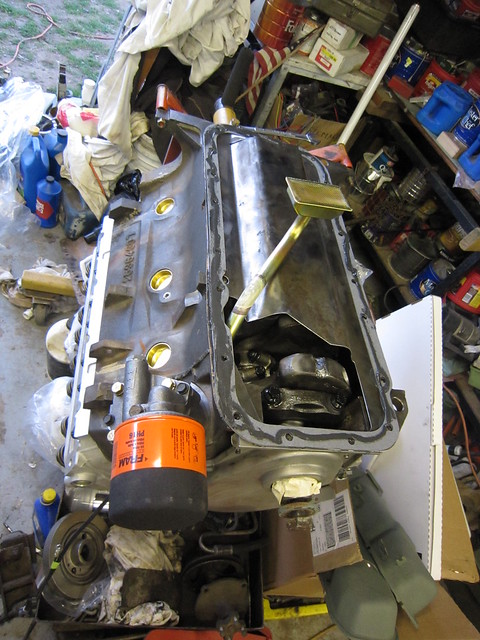
This is the 440 Source 6 Qt. Hemi oil pan for Mopar B/E bodied muscle cars. it has it's own baffles inside too. It looks like a nice pan to me, it fit perfectly and you can't beat the price...
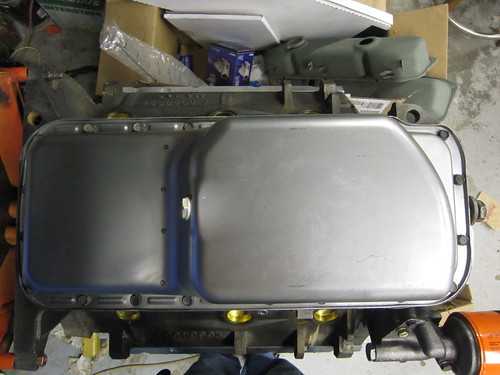
Here it is turned back over, now the intake manifold, and the items that attach to it, as well as the timing chain cover are back home where they belong.
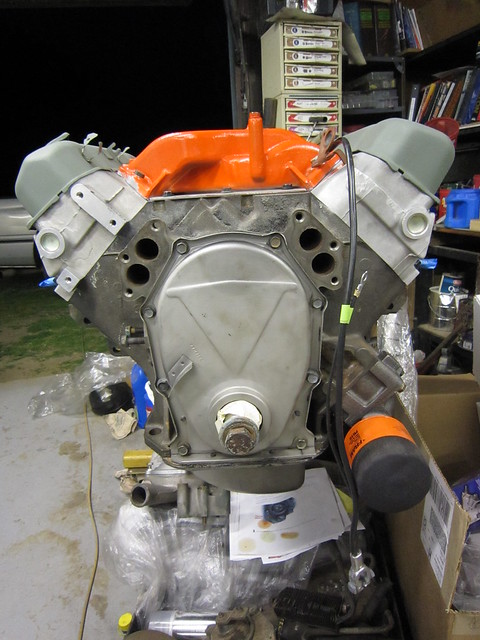
I hope to finish assembly and paint it sometime in the next week... Stay tuned!
Posted in 2004-present | Family Helpers | RESTORATION | Reassembly | engine | link to this page | | Comments (0)
March 06, 2013
Engine Assembly continued
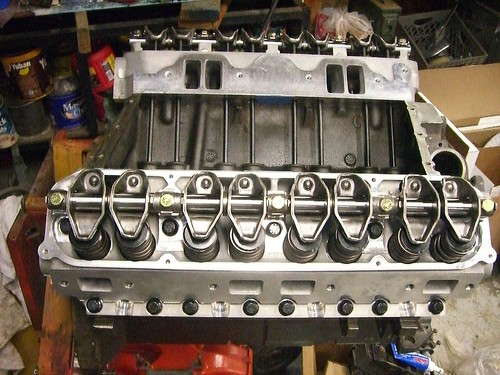
Well, I got my heads back from the shop and I have managed to squeeze a little engine assembly time between all the other things I've had going.
Here are a few pics, not done yet, but it looks good to me!
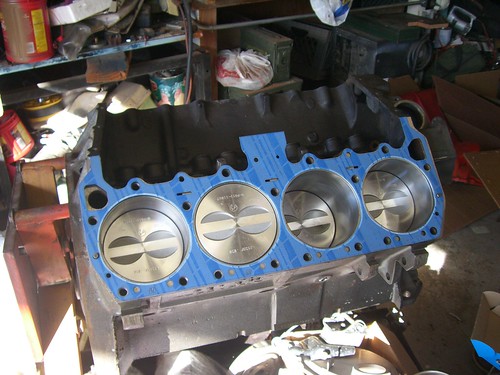
The 440Source Stealth aluminum heads going on...
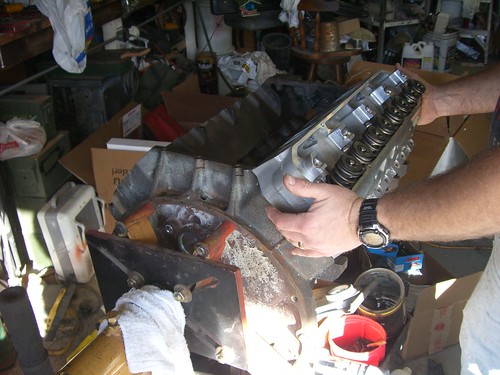
All the valve train parts are new, and lubed with ZDDP zinc laden assembly lube to keep them safe.
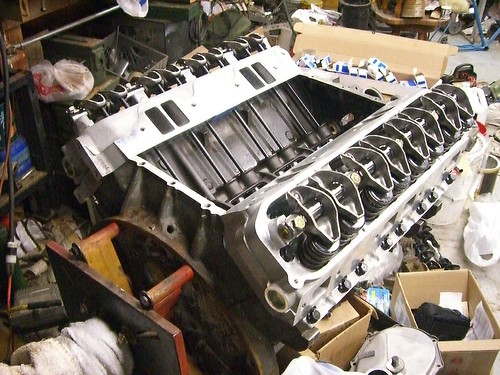
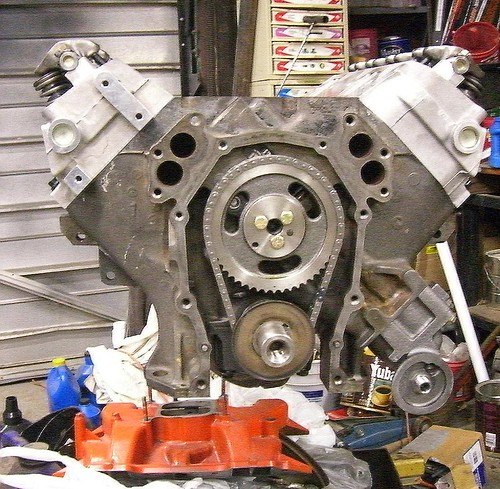
Hopefully it will not be too much longer before I am done and the whole thing gets painted Orange!
Posted in 2004-present | RESTORATION | Reassembly | engine | link to this page | | Comments (0)
February 06, 2013
Engine progress ahead!
OK, the stalemate between my budget and my engine has ended for now, so here is the rest of my engine!
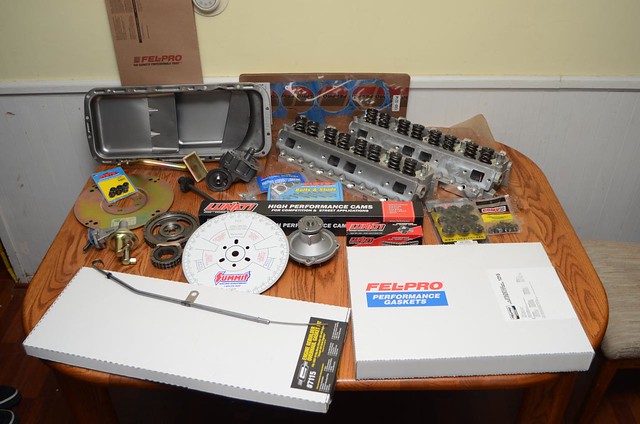
From 440 source
440 Source Stealth aluminum heads
ARP head bolt set
Fel Pro head gaskets
Comp cams 10 deg locks and retainers
6 qt reproduction Hemi style pan
new 3/8 deep pan pick up tube
Melling HV oil pump
New dip stick and tube
New heater hose nipples
New SFI approved flex plate
From Summit
Lunati 60303 cam and lifter set
Summit true roller 3 bolt timing chain set
Carter 4845 fuel pump
Milodon high volume aluminum water pump
ARP flex plate bolts
ARP assembly lube
Mopar performance oil pump priming shaft
Milodon hardened oil pump drive shaft
Summit camshaft degree wheel
Felpro intake gasket set ( FEL-1215 with heat crossover blocked)
Mr. Gasket engine gasket kit
Extra Felpro oil pan gasket
I had some items arrived after I took the picture above, this is the rest.
From Mopar Ed at The Mopar Shop
Reproduction negative battery cable
Correct type PCV valve, and grommet
Correct type breather grommet
Items from other sources
Reproduction vapor separator
New Elgin rocker arms and shafts
Throttle return spring bracket
Mancini racing chromoly HD push rods
A huge thank you to all those who have helped guide my parts selection. I will soon have the heads looked over (the valves) and change out the locks - retainers, then I will start carefully bolting things together!
stay tuned...
Posted in 2004-present | RESTORATION | Reassembly | engine | link to this page | | Comments (0)
December 19, 2012
Brake booster and Steering wheel
Some more progress while I wait for the rest of my engine money...
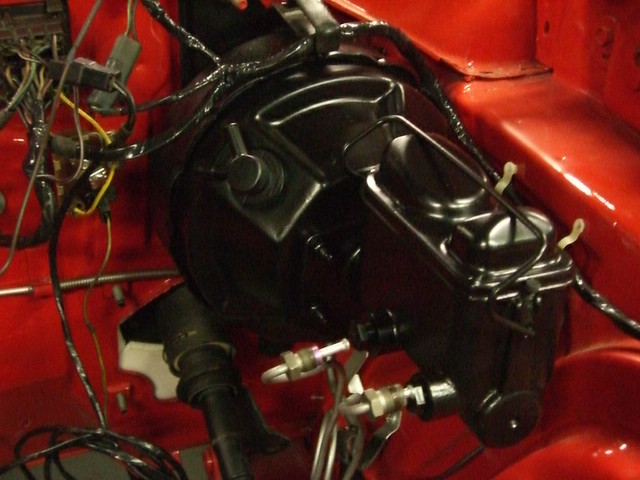
I got one of my Bendix boosters rebuilt by Booster Dewey In Portland Oregon, it arrived in great shape yesterday...
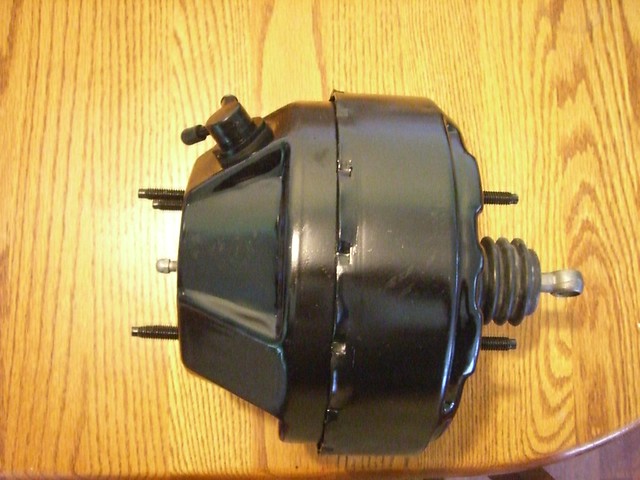
I got it installed today... Should be bleeding it soon, and begin tidying up the engine bay.
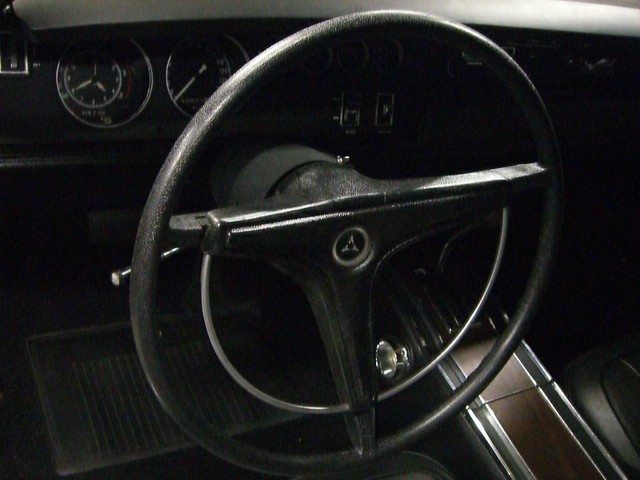
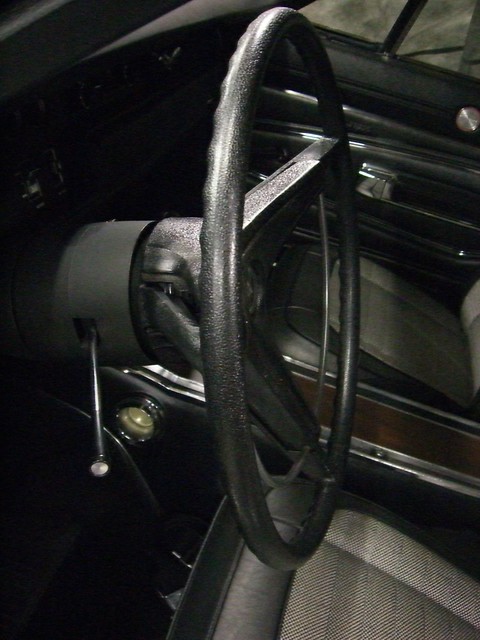
As much as I was stoked to have an original steering wheel that was in such perfect shape for my Charger, it turns out it wasn't for my Charger! (It will however be a beautiful addition to my son's '67 Satellite) So I ordered a new reproduction one from PG Classics, it arrived today and I put it on. Much better, now I have a textured wheel and I can't see my turn signal switch anymore.
This is the wheel I took out today, the wheel is for a '67-'69 with my '70 center put on it.
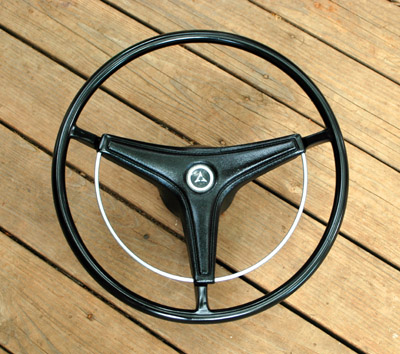
This is the correct wheel which I installed today also.
I'll keep working on my windshield trim too, it is getting close.
Posted in 2004-present | RESTORATION | Reassembly | interior | suspension, brakes, tires, and wheels | link to this page | | Comments (1)
December 14, 2012
The last glass - Windshield installation
Well, once my electrical systems check was completed successfully I started planning to get my windshield installed.
I arranged to once again have a local businessman, George Sgambellone, owner and operator of Mariposa Auto Trim, about installing my windshield (he came to my house and installed my vinyl top and let me help and learn). He was willing to come to my house and put the windshield in, showing me step-by-step how he was doing everything. The job went very smoothly, took an hour, maybe less, and once again, his rates were EXTREMELY reasonable. I have again decided to place an image of his business card here at the end of this post in case any people in my area need this sort of work done. I highly recommend George.
Here are a progression of pictures from the windshield installation. The first image shows George and myself working together putting the gasket in , then the progress forward.
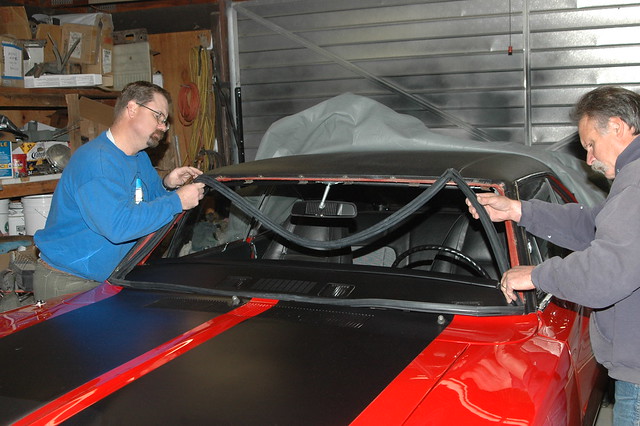
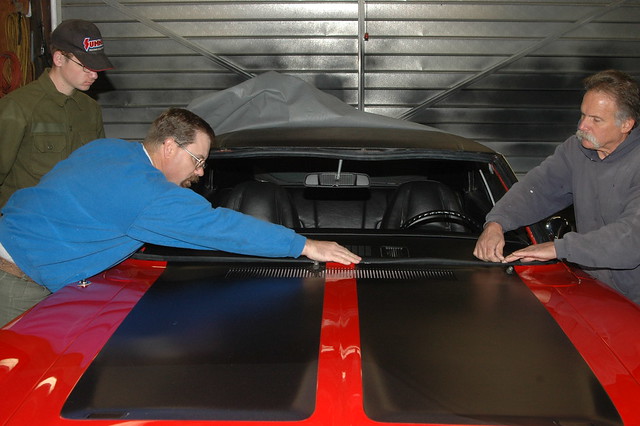
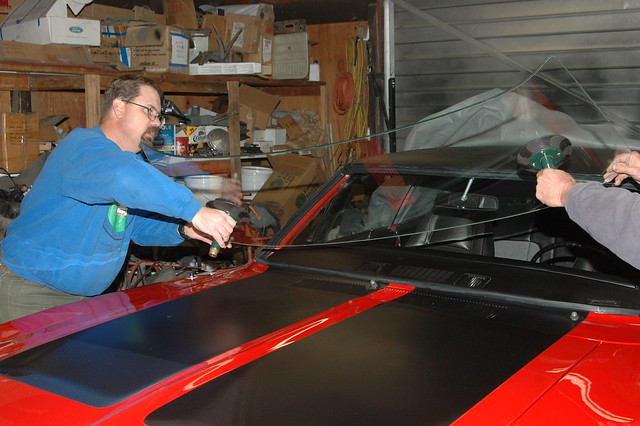
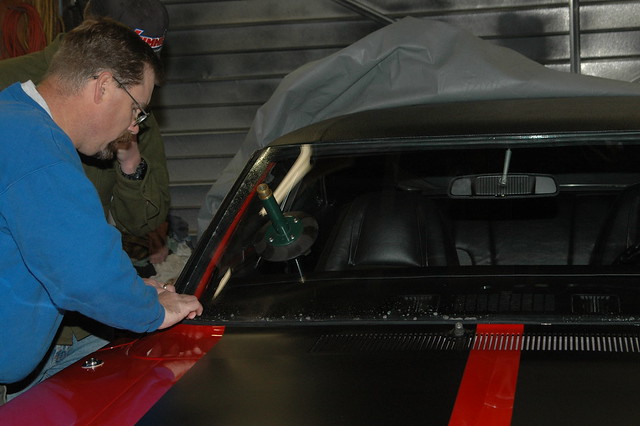
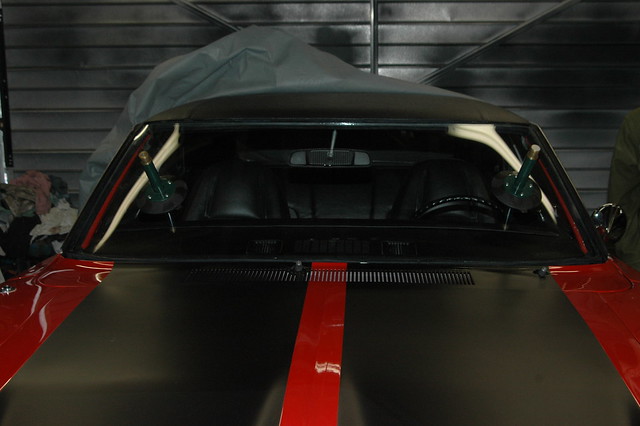
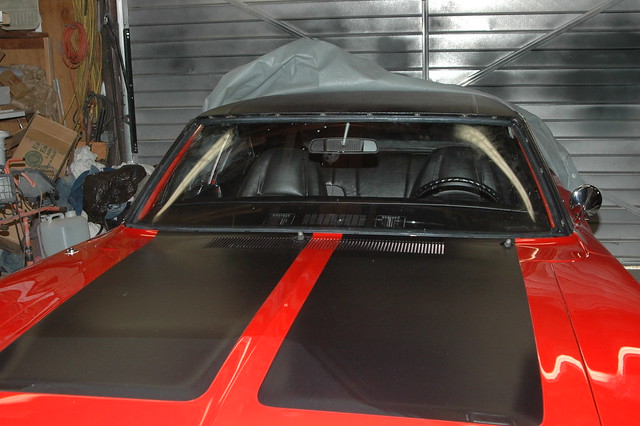
Yay! The glass is complete -The car wlll be much easier to keep clean inside now!
I have begun the process of cleaning and straightening the stainless steel windshield moldings and hope to finish polishing them and get them installed over the next week.
Here is a well deserved plug for George and Mariposa Auto Trim

Posted in 2004-present | Family Helpers | RESTORATION | Reassembly | body | glass | trim | link to this page | | Comments (0)
December 11, 2012
CH4B Intake manifold
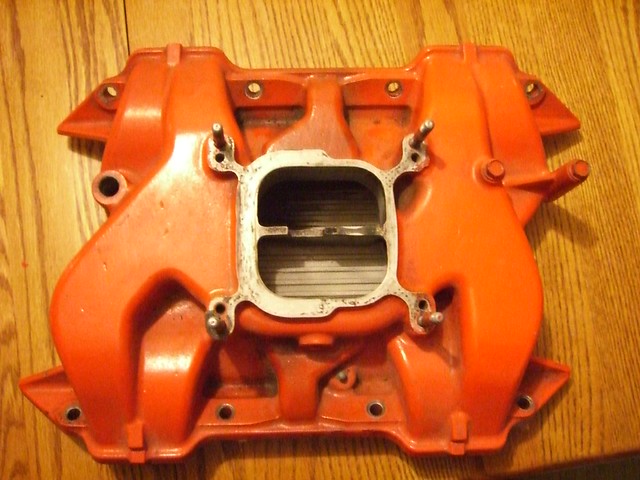
One more piece of the puzzle! I have been trying to buy a CH4B manifold for over a year and a half. I have been continually out-bid on Ebay, or too late finding them in the classifieds. But finally I found a nice one with a buy it now / best offer option. They accepted my offer and it arrived today!
This one had already been painted Mopar High Performance orange, which is fine because I was going to do that anyway. As is frequently done by restorers using this manifold, the Edelbrock logo and Mopar part numbers have been removed also which helps with the stock look.
In case you are no familiar with te Edelbrock CH4B it is a very good performing, basically stock profile aluminum intake manifold made back in the 70's by Edelbrock and sold through Mopar dealers. It is still a top performing dual plane intake manifold, (if not the top performing dual plane) and will guarantee my dual snorkel air cleaner will easily clear the hood.
If you'd like to read more about why this is the intake I was looking for you might enjoy this Mopar Muscle article.
Early Christmas for my Charger!
Posted in 2004-present | RESTORATION | Reassembly | engine | link to this page | | Comments (0)
August 02, 2012
Interior progress (finally!)
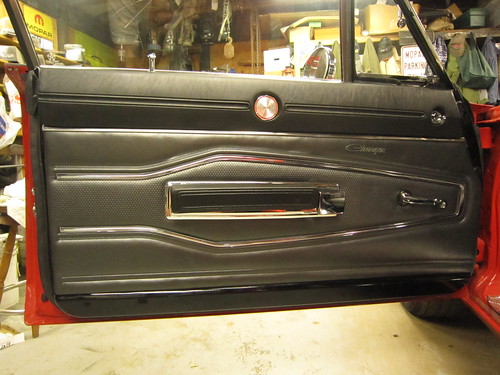
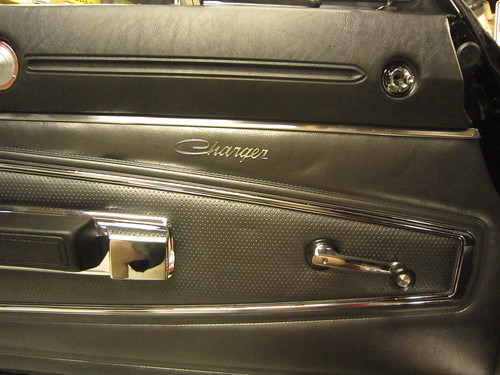
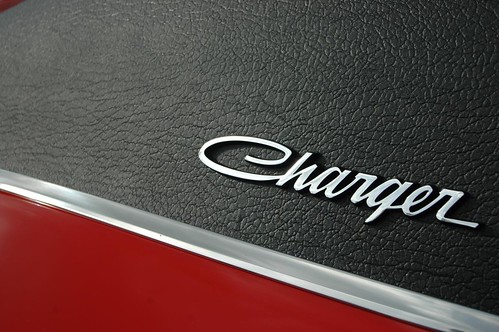
Well, I finally have some progress to report. Now that I have found a satisfactory solution to my door panel Charger script dilemma,( I found a guy who makes self adhesive Charger scripts in custom sizes on Ebay) At long last I could install the front door panels, trim, and hardware.
My son and I did both doors in an evening.
This was our starting point...
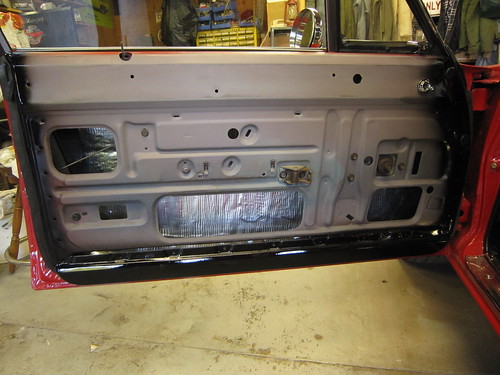
Then we sealed the door off factory style with barrier plastic held in place by a thin string of butyl tape I had left over after doing the rear window installation.
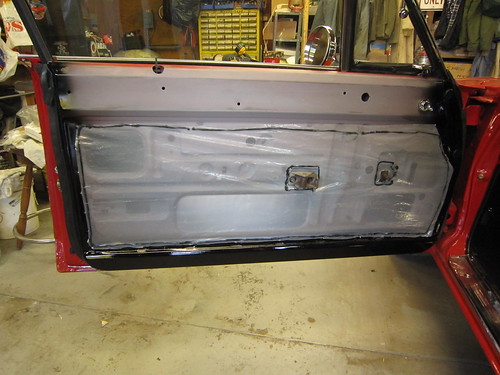
The the door panel trim, new Legendary Interiors door panels, arm rest bases, arm rests, inside door handles, and window cranks were installed. (everything but the trim itself was new).
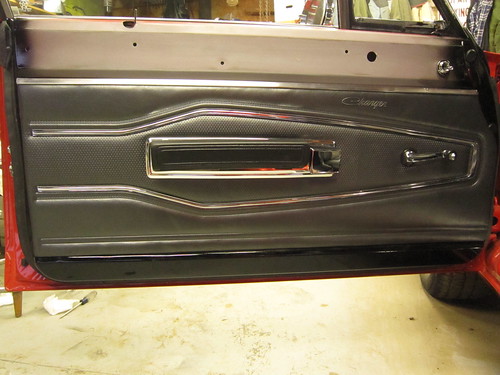
Here is the completed door, the upper door pads are exceptionally nice used ones I bought last year. I treated them to a couple coats of correct Charcoal interior paint from Herb's Parts.
Here is a close-up of the rather nice Charger Script I had made to the same size as the hard to find original pieces.
Both sides are looking sharp as a tack now.
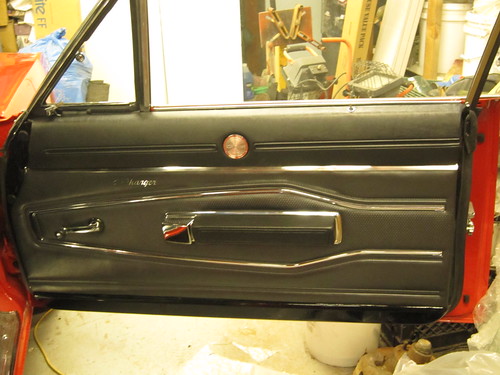
Here is a view of the completed interior,
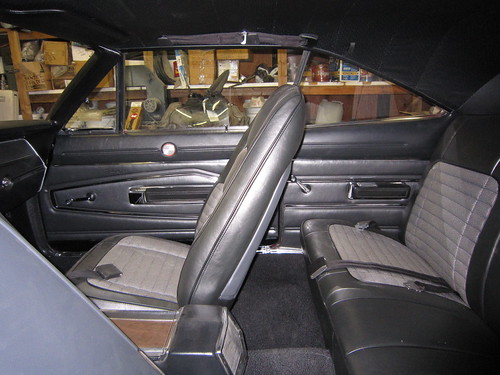
Posted in 2004-present | RESTORATION | Reassembly | body | interior | trim | link to this page | | Comments (0)
April 19, 2012
Interior progress
It has been a while since I was able to spend much time on my Charger but finally I have something to report.
Once I was finally happy with the adjustments of the side glass, I was able to begin installing the interior items that have been boxed up for many years now.
The following pictures reveal the fun as it happened!
First the insides had to be sealed with a plastic barrier material.
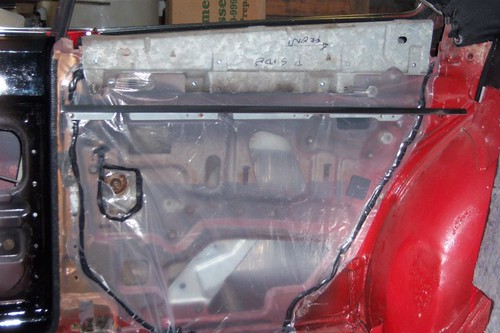

Then the restored upper door pads, and the new Legendary lower door panels could go on.
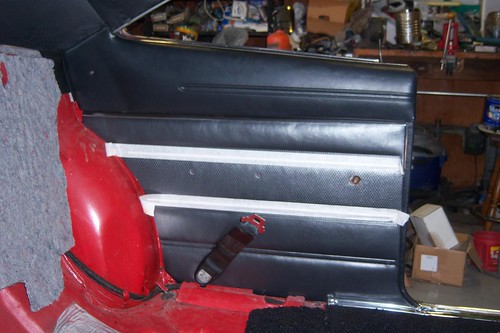
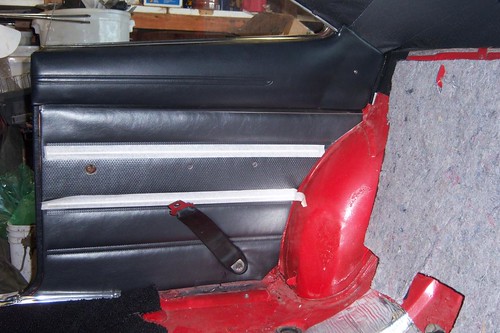
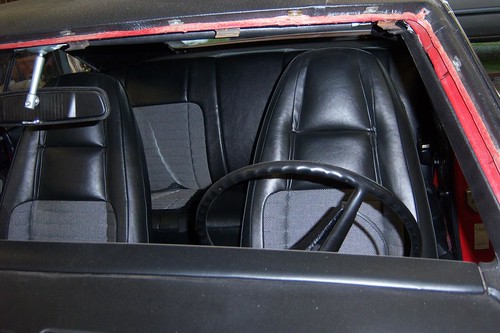
Then at long last the seat!
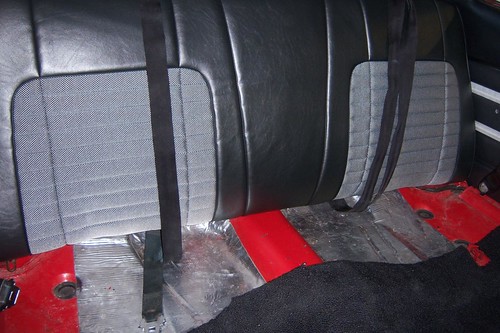
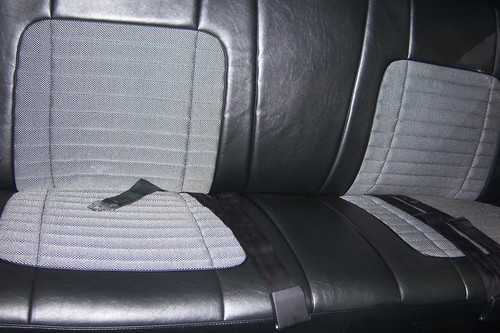
And all the rest too.
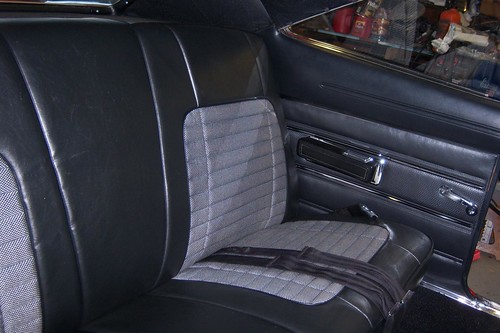
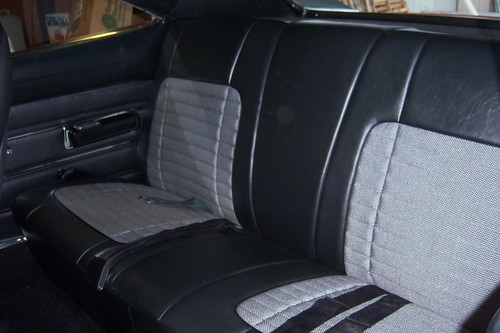
And a couple of over all views...
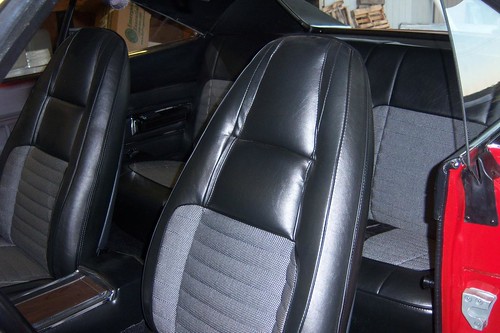
Next I will install a couple more small items, and the door panels themselves. Check back soon!
Posted in 2004-present | RESTORATION | Reassembly | glass | interior | trim | link to this page | | Comments (0)
March 10, 2012
Side glass going in
My vent window glass showed up at my house Wednesday, so this weekend I was able to start putting the side glass in m Charger.
Got the passenger side vent window frame assembled into the re-chromed part. (I did the driver's side some months ago before I knew my glass was badly scratched) Here the pieces are being "peened" together.
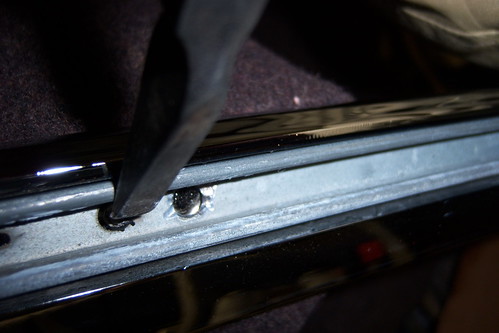
Installed the new vent window glass into the channel pieces using inner tube as the gasket... It trims up very nicely and really holds on the the glass well.
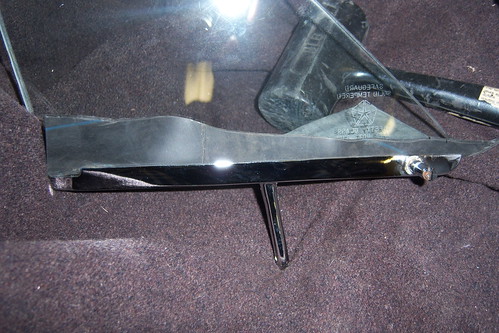
After this the rubber gets trimmed very closely with a new razor blade, and it looks really good. Then the vent windows get installed into the vent window frames. Then it is time to put the rest together.
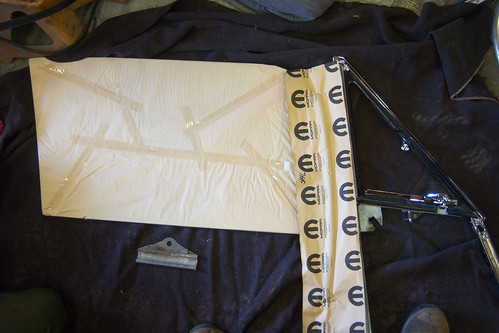
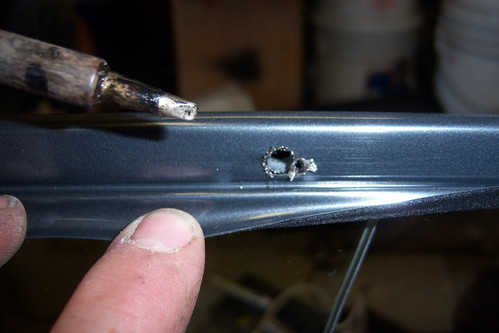
At the front edge of the door glass there is a fairly expensive (like $45 each) piece of molded plastic covered in felt. There are a pair of plastic guides that go at the top and the bottom of the door glass through holes in the door glass. The plastic guides go inside the outer edge of the felt covered plastic. The "problem" is the holes are not in the felt covered plastic. So to make a clean hole that would not "spread" and wreck my new piece, I melted a clean hole in just the right spot with my soldering iron.
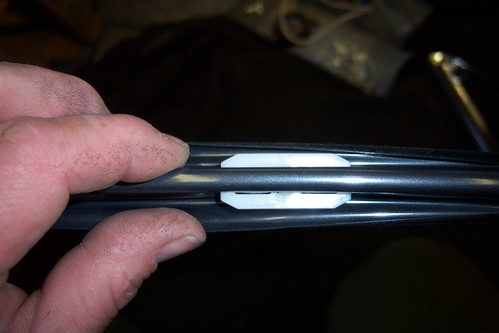
Once these are all together the assembly starts to take shape...
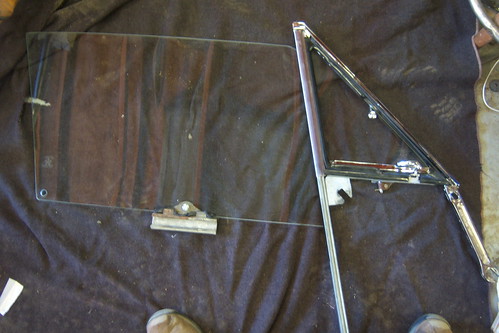
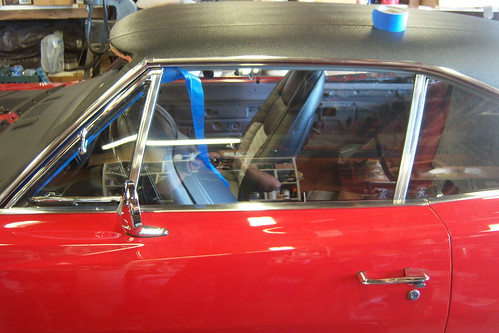
With the help of my son and nephew, we installed the side glass in both doors. After a couple hours of adjustments, I am happy with the results thus far. Once I am totally sure that I do not want to change anything with the adjustments, I will be able to continue the interior re-assembly.

In making the adjustments I found a good summary in the book Project Charger on pages 136-137. If you are restoring a Mopar, especially a Charger, I highly recommend this book.
Posted in 2004-present | Family Helpers | RESTORATION | Reassembly | glass | link to this page | | Comments (0)
March 04, 2012
New glass going in - part 1
Well even though a week ago it was snowing here, today it was in the low 70's and sunny. Great weather for the butyl tape to work, so my son, my nephew and I put the new AMD rear glass in my Charger.
Here I am putting down the 5/16" tape.
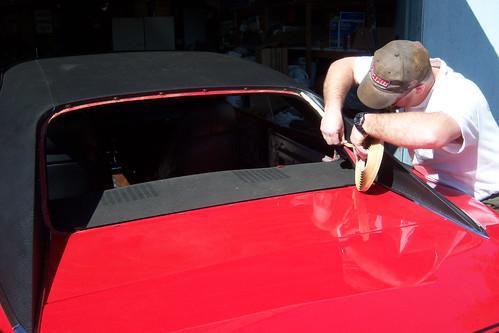
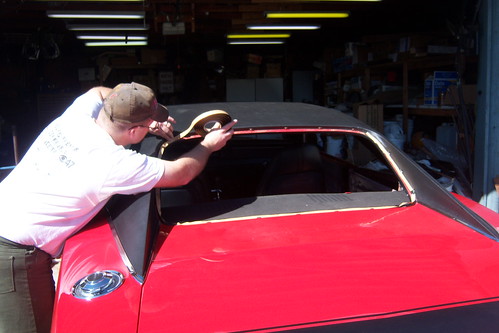
Here is the glass in, trim on. The lower passenger side corner really gave me a hard time, had to work the piece over some, but after sufficient frustration leading to prayer, and hard work, I got it on OK. (Thank you Lord!)
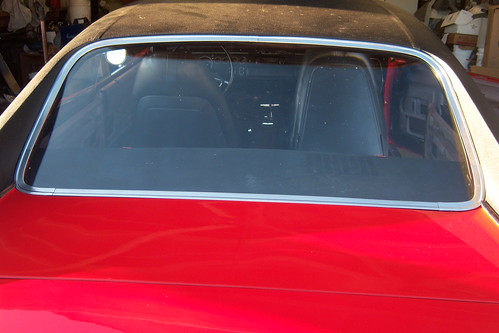
I like that the glass has the Pentastar logo on it, I think that is a nice touch.
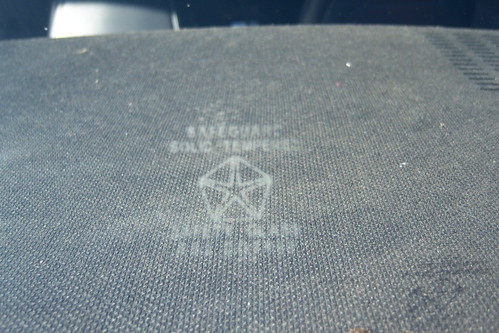
I put the new quarter window glass in too. It seems pretty good, but one of the holes (passenger side) seemed to be a little off so I had to modify the bushing that goes around the bolt. The driver's side was fine though. I'll know more about how well it fits when I have the door glass in and try to get everything adjusted. About a week ago Mopar Ed told me that the vent glass (which AMD forgot to put in the box) was on its way. So maybe soon I can get the door glass in.
Keep checking back!
Posted in 2004-present | Family Helpers | RESTORATION | Reassembly | glass | trim | link to this page | | Comments (0)
February 25, 2012
Box-O-Glass!
Well after being on back ordered for a while due to the windshield being out of stock. Today I was able to go pick-up my new Charger glass!
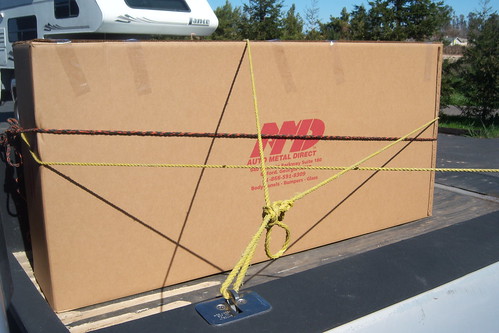
A very large, very well packed box full of reproduction goodness was waiting for me a Mopar Ed's when I got there.

The glass looks great, soon I'll see how it fits. One unfortunate thing though, it appears AMD forgot to put the vent windows in the box, so they will have to come separately.
I hope to be installing the rear glass and quarter windows very soon.
Stay tuned...
Posted in 2004-present | RESTORATION | Reassembly | glass | link to this page | | Comments (0)
December 28, 2011
Christmas goodies
OK, well I have not made much progress on my Charger lately, been busy saving every penny for my set of all new glass which I plan to buy in February. But for Christmas, I got an assortment of Charger care & beautification items I had requested from my wife and kids.
I got a waxing kit with Meguiar's Ultimate Liquid Wax, an applicator and buffing cloth, a "California Car Duster", and an assortment of car washing, and detailing supplies.
So, today since it was nice outside, we pushed my Charger outside and started in. It had gotten fairly dusty since I have never washed it since it was painted about a year ago. It is covered, and indoors, but everything here outside is dirt, or gravel, so over time dust creeps on to everything.
First thing we did, was very carefully give my Charger a proper bath, I dried it off with a large micro-fiber towel I got with my goodies. Then my son and I applied the "Ultimate Wax", and then buffed it off by hand with the Meguiar's micro-fiber buffing cloth from the kit.
It really came out nice. The pictures below are quite good, and taken by my wife, but even she says they really aren't as stunning as the car is in person. As always, you can click on each image to see it larger.
It was a lot of fun bring the shine out, and knowing the finish is now protected somewhat, is nice too.
It has been a very merry Christmas for my Charger indeed. (and me!)
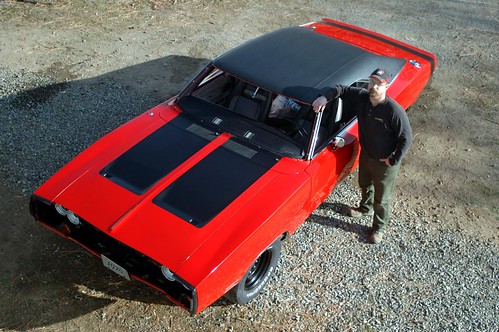

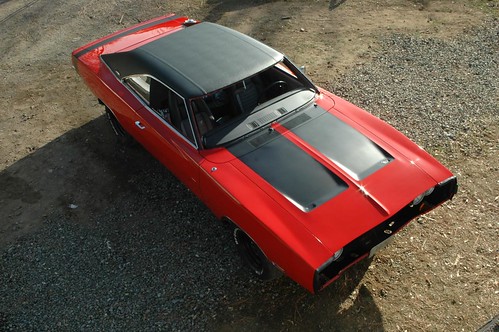

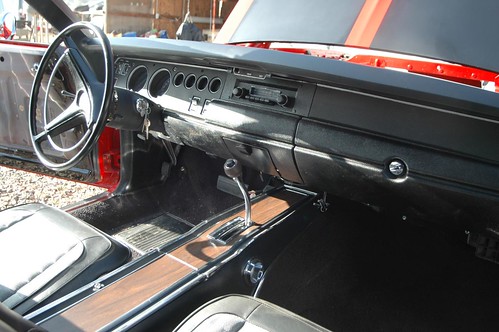
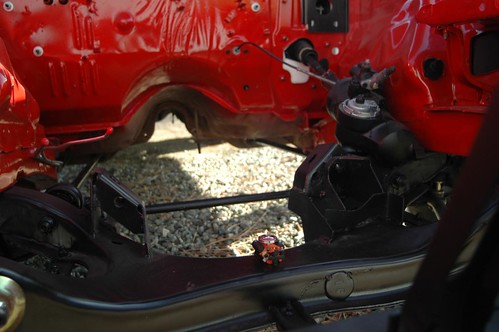
Oh, and since all my buddies, and everyone in my family keep asking me about the engine, I dropped in an engine today too. And YES, It's a HEMI!
I need to finalize the engine mounts, but check it out!
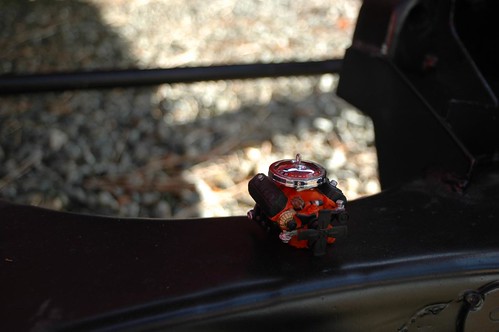
Well, on second thought, I guess I'll have to keep the "Holy Hemi" on our Christmas tree, and wait to overhaul my 440.
Posted in 2004-present | RESTORATION | body | engine | interior | primer and paint | link to this page | | Comments (0)
December 03, 2011
Fuel tank and lines are in!
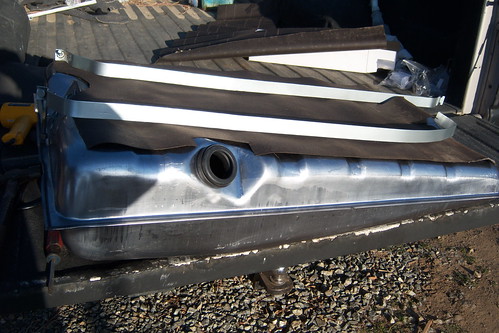
Today, my son and I also put in the new Fuel tank, a new 3/8" sending unit (with 1/4" vapor return fitting) we will mate this to the new reproduction steel fuel lines and clips he and I installed earlier this week. (again new 3/8 feed with a 1/4 return)
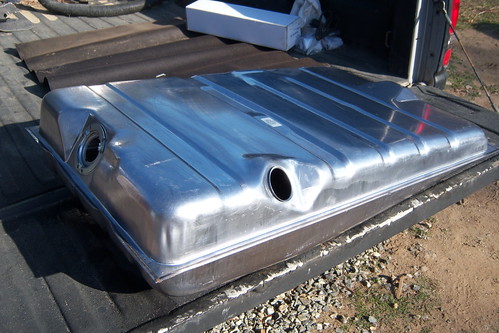
Here's the tank with pads, sending unit, and new fuel fill seal installed.
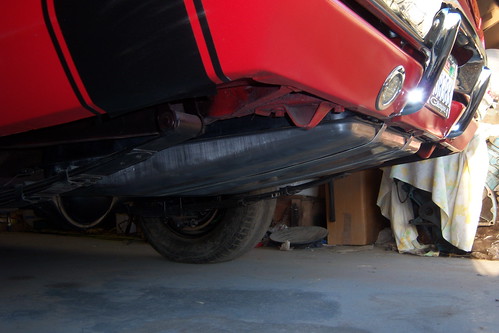
And here it is all tightened down in its permanent home!
More to come.
Posted in 2004-present | RESTORATION | Reassembly | body | engine | link to this page | | Comments (0)
Front Bumper Parts ready
Well, I had a chance to get a few things done today.
Finished sand blasting the metal parts that surround the grille, then got them primed, and painted. Now when I get time, I can reassemble the grill, bumper etc, and install them!
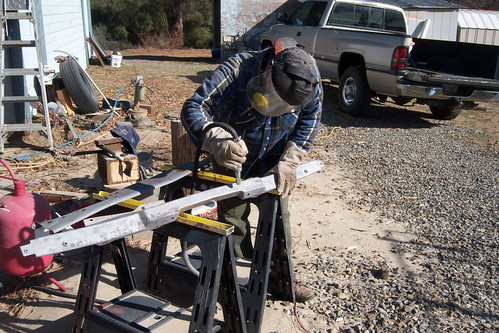
Here they are after being primed, and painted...
Looking forward to finishing the front!
Posted in 2004-present | RESTORATION | Reassembly | body | rust & rust repair | sandblasting | trim | link to this page | | Comments (0)
November 26, 2011
Hit a snag!
Well, it happens to everyone from time to time, now it is my turn (again)...
After cleaning my various windows really well this weekend, I realized that I am in dire need of replacement glass. My door glass, and rear window especially are scratched beyond belief! I guess all those years driving it, I never noticed (or cared)? Heck back then if my car had glass I thought I was "good to go!"
What that means is the glass installation will not happen right away, the newly chromed vent window frames and such will have to stay packed away, and the re-assembly of my interior will be on hold too. This is because I need to have the side glass all in and adjusted prior to putting the door panels on, and the rear door panels have to be on prior to the installation of the rear seat.
... Oh well, something else to save up for. I'll have to find other things to do on my Charger for a while. That should not be too hard!
Posted in 2004-present | RESTORATION | Reassembly | glass | interior | link to this page | | Comments (0)
November 02, 2011
Re-Chromed Rear bumper - On!
Well, my son and I have found time to install the new wheel lip mouldings, and to re-assemble and install the re-chromed rear bumper.
I blasted the bumper brackets and hardware, shot them with self-etching primer, painted all satin black and put it together with new bumper bolts, and my brand new but several years old," Mopar or No Car" Charger script license plate frame I bought from Mopar Collector's Guide.
Here's a preview; my wife took a picture for me this afternoon while I was at work...
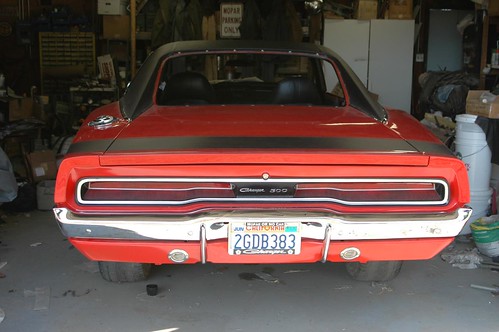
Stick around, more on the way!
Posted in 2004-present | RESTORATION | Reassembly | body | sandblasting | trim | link to this page | | Comments (0)
August 23, 2011
Carpet, console, and front seats
Well, Finally getting some time to start putting a few more things together.
I got the tailight and dash wiring all in and connected. Using my little "jump-start" box, I was able to make all the lights tun on, which was fun and gratifying!
With the wiring in I was able to proceed with completing the installation of sound deadener on the floor pan, and move on to the carpet. With help from my buddies at the 70 Charger Registry forum, the carpet install went pretty smoothly.
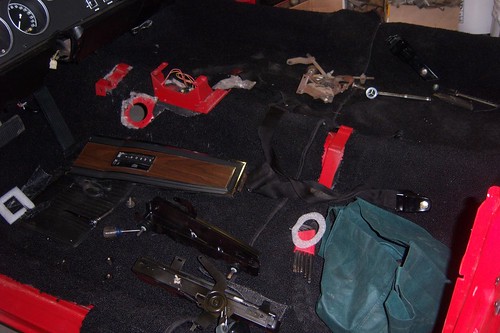
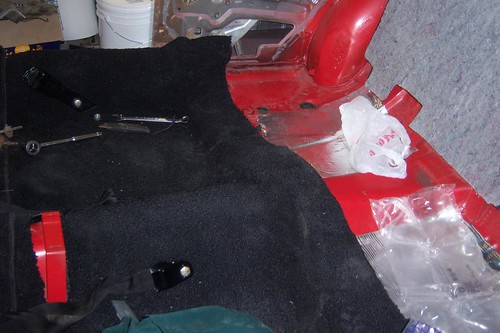
Here's the carpet in, with the console in position.
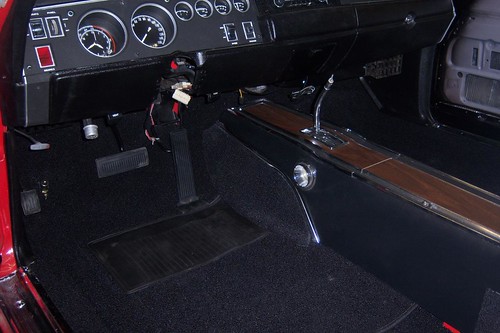
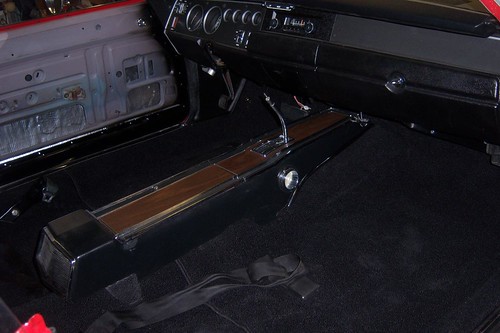
Before installing the driver's side front seat, I installed the steering column and steering wheel, since having the seat out made rolling around on the floor of the Charger much easier.
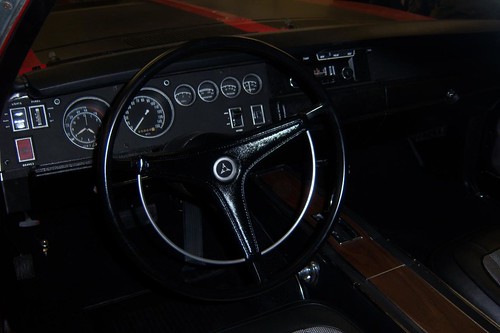
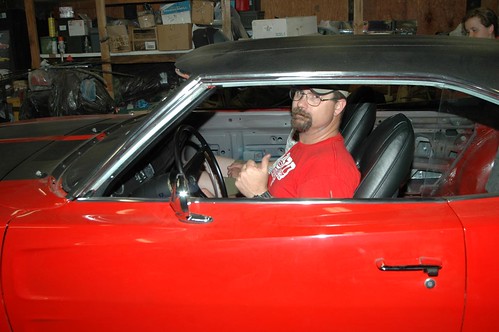
Steering column, and wheel are in and connected. Front seats are in! I have not sat in my Charger since 2004, happy days!
The rear seat is waiting until all my side glass is in, which is waiting on rechroming my vent window frame parts (hopefully in October) Once all the glass is in, and is adjusted correctly, then the door panels will go on, and the rear seat will go in.
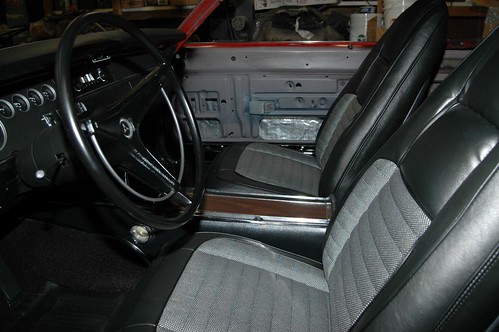
Posted in 2004-present | RESTORATION | Reassembly | interior | trim | wiring | link to this page | | Comments (0)
July 26, 2011
Dash installation
After completing the restoration and assembly of the dash, it was time to install it in my Charger. The dash pad was new from PG Classics, as was the radio bezel. The radio knobs are mint originals. I repainted the other dash bezels by hand. Everything was screwed together and ready to go.
I rolled the car outside to give us plenty of room to work. My wife took the overhead shots from the garage roof!
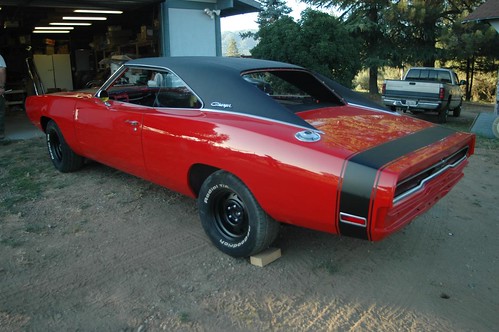
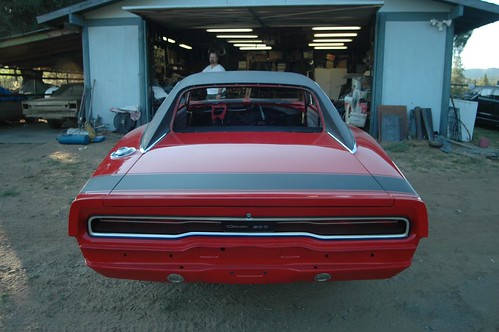
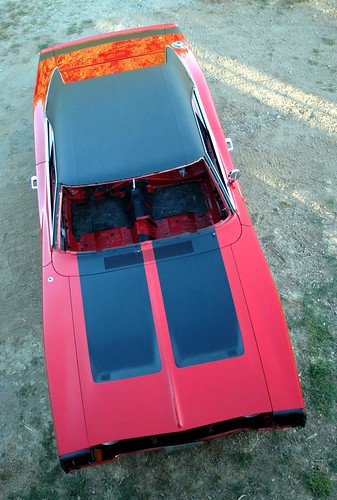
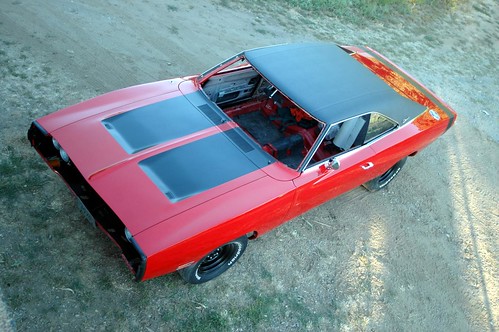
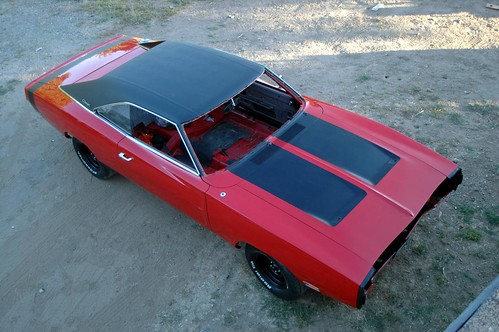
This is me with my son (taller) and my nephew, working together to mount the dash in the car. The dash is large and relatively heavy, and you certainly don't want to scratch anything, so having some extra hands is a really good idea. My nephew had wanted to be a part of this part of the project, so we chose an evening when he was over to make use of his willing assistance.
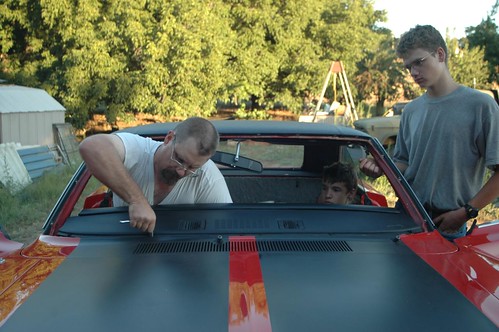
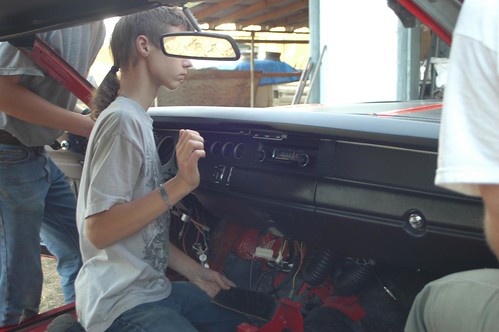
Mission accomplished!
Posted in 2004-present | RESTORATION | Reassembly | interior | trim | link to this page | | Comments (0)
July 23, 2011
Dash and trim progress
Finally had a moment to upload some photos of some recent progress.
First, my son and I have been working in our "extra" time to finish the dash assembly, here are some pictures.
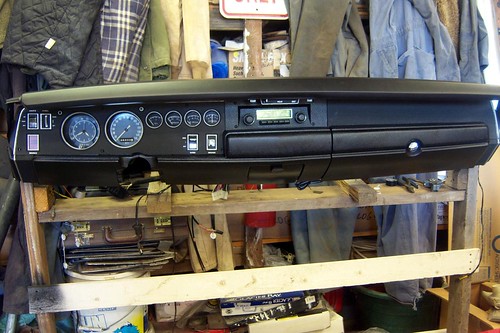
First, dash overall. new PG Classics dash pad, new PG Classics radio bezel purchased from Mopar Ed, gauges and heater controls restored with Performance Car Graphics kit, everything else was restored and hand painted by me.
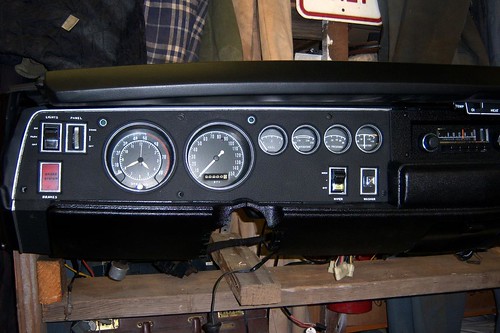
A close-up of the instrument panel area
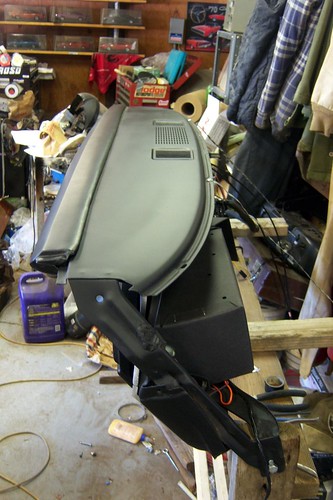
Side view
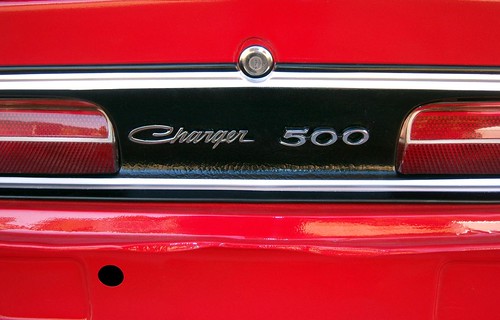
Next, emboldened by Murray's success on his tail light panel, I tried to restore my own. I started over three times before I ended up with the look I was after. Found the "chrome" paint I liked best, painted the black first, then masked off all but the shiny strip with super detail 3m 1/2" wide precision tape.
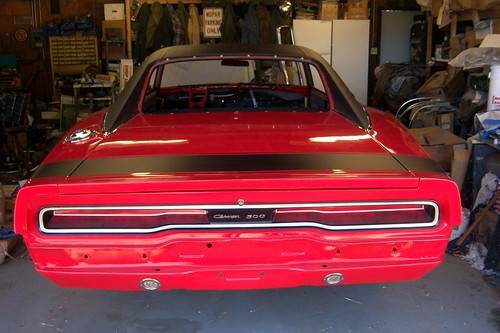
The 500 emblem I restored, the Charger emblem is new from AMD via Mopar Ed.
Here are some over all pics for effect.
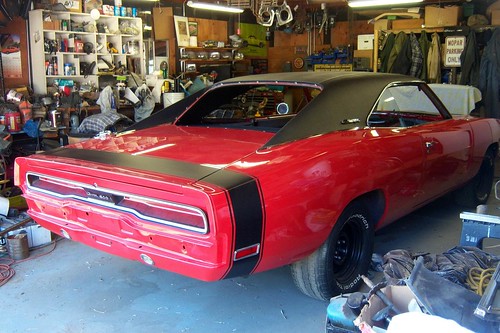
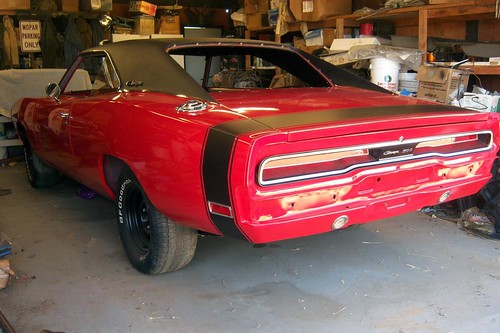
More to come. Stay tuned
Posted in 2004-present | RESTORATION | Reassembly | body | interior | trim | link to this page | | Comments (1)
June 11, 2011
Fuel cap Father's Day!
A lot of things have been coming together for my Charger lately.In addition to the smoking deal on an NOS antenna base mentioned in the previous post, my order from Mopar Ed came in this week, which consisted of my new PG Classics dash pad, radio bezel, and a pair of nicer quarter windows, a set of '70 AM radio knobs.
Today while we were down in Mopar Ed's office picking up my parts, my wife and kids announced that Ed had a Father's Day surprise for me, and that she and my kids had all chipped in to buy it for me. Then Ed handed me a box containing this (which I promptly installed when I got home)
All I can do is thank Jesus for such a wonderful week, and a wonderful family!
Now I have all the needed pieces, and as soon as I get time, I can complete the assembly of my dash and get it in.
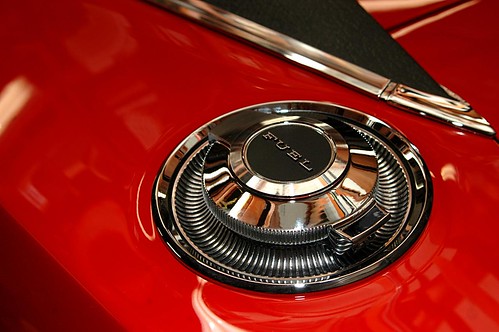
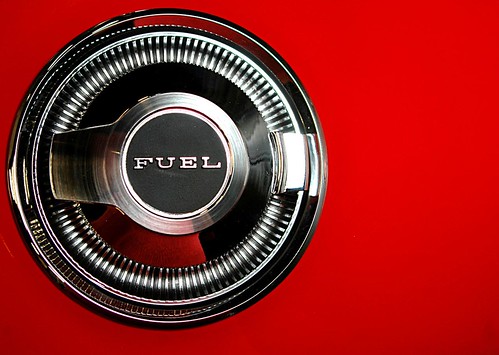
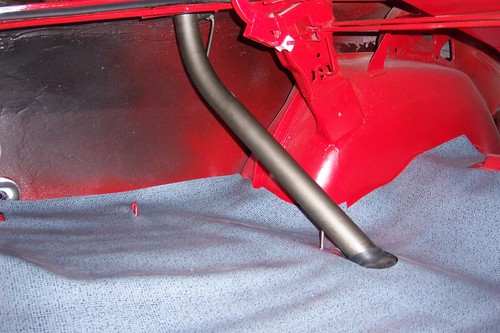
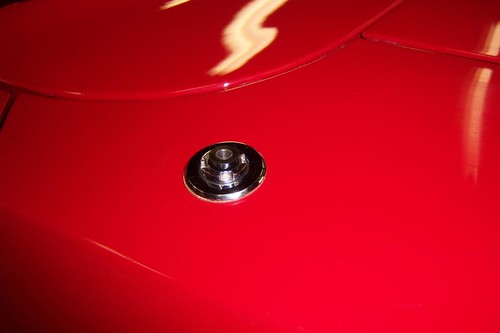
The beautiful fuel cap assembly pictured above attaches through the quarter panel and associated gaskets into the fuel filler tube, so it was necessary to refurbish the filler tube and install the trunk gasket for it at the same time as I installed the fuel cap.
Posted in 2004-present | RESTORATION | Reassembly | body | trim | link to this page | | Comments (0)
June 10, 2011
Filling in holes
Recently my family and I attended the Fremont Mopar Alley Mopar Rally car show, and I met a really nice guy and his wife who own a beautiful '69 Charger. While talking with them, I found out that they had some leftovers from restoring their car. One of those items was a NOS antenna base, nut, and bezel. He made me an extremely good deal, so I purchased it. My son, my nephew and I installed it in the car and routed the antenna coax. It looks really good, just like it's supposed to, and gives a finished look to the fender.
My friend and regular parts supplier, Mopar Ed, gave me an excellent deal on a pair of used quarter windows that were in considerably better shape than my originals. My son and I had previously installed all the hardware, so it was a simple matter for my nephew Jordan and I to install and adjust the windows themselves. It sure is fun, seeing some of the big holes start to be filled on my Charger.
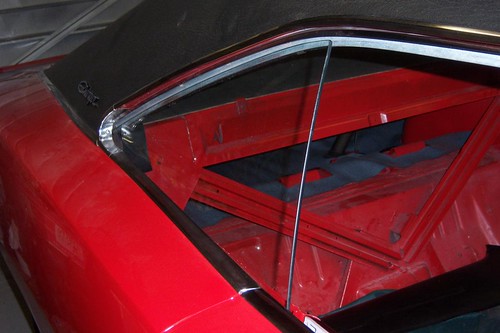
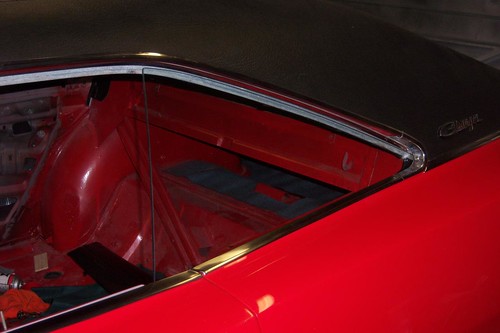
Posted in 2004-present | RESTORATION | Reassembly | body | glass | wiring | link to this page | | Comments (0)
June 03, 2011
A long-awaited day
A bit more progress to report. A long awaited day.
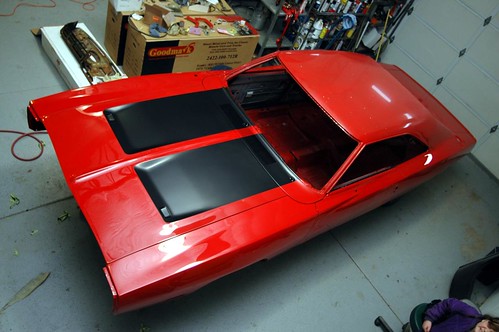
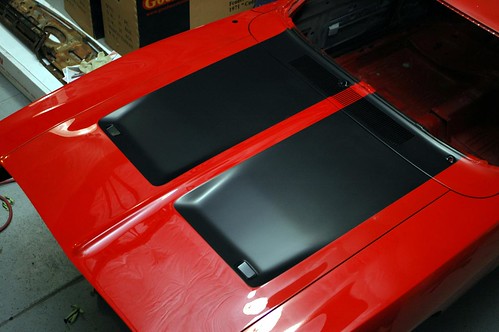
My son and I installed the new matte black tail-stripe from Performance Car Graphics.
Weather was iffy, so we just pulled it out enough to photograph the stripe work.
Tail stripe, passenger side:
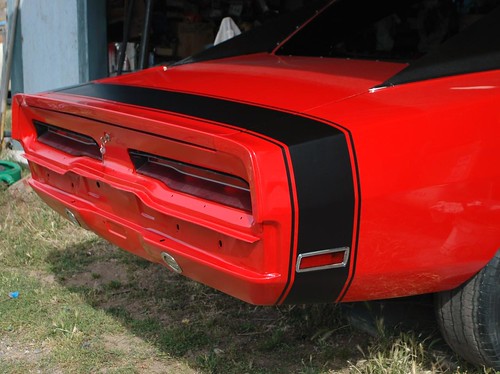
Deck lid with tail stripe:
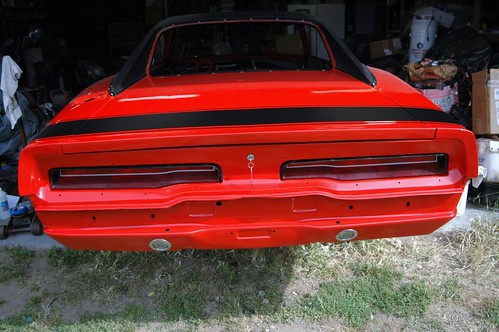
Tail stripe, driver's side close-up
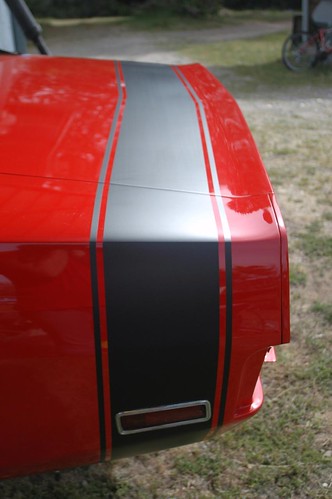
Tail stripe, driver's side looking backward
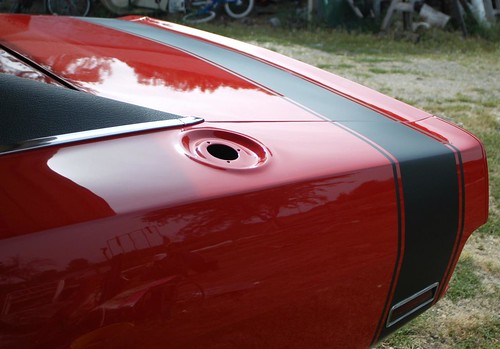
I had to re-order a driver's side section, when I put it on at first I messed up badly. The other two pieces went on fine (tried different method) PCG will sell individual parts. So when it arrived, we put it on slowly and gradually, and it went fine. Looks even better in person, if I do say so myself.
Tolley
Posted in 2004-present | RESTORATION | Reassembly | body | primer and paint | trim | link to this page | | Comments (0)
June 02, 2011
Headliner complete
A bit more tweaking and time have helped my headliner a lot. I have the rest of the seat belt retainers, the visors changed to black (used to be tan) and installed, the mirror that a fellow Charger owner hooked me up with restored and installed.
I am really pleased with the way the headliner is looking now. I learned a lot, and praise Jesus for the patience and His nudge in the right direction when I wasn't sure what to do.
Here are some pictures.
Sun visors and mirror:
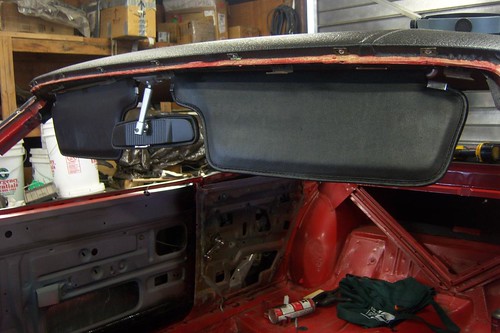
Sun visors:
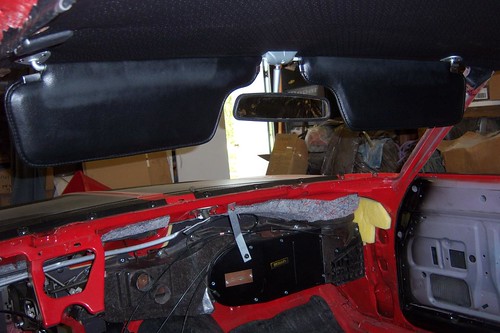
Headliner looking better:
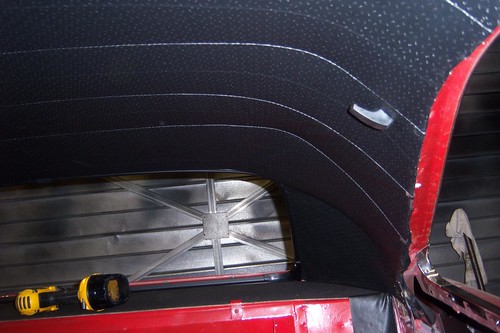
Headliner sail panel area, driver's side:
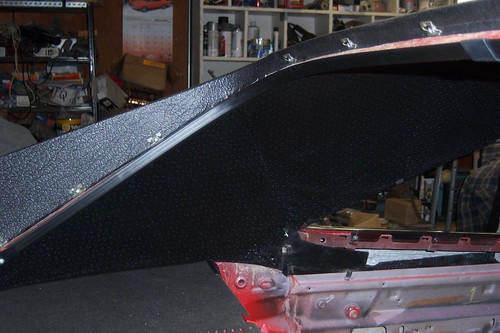
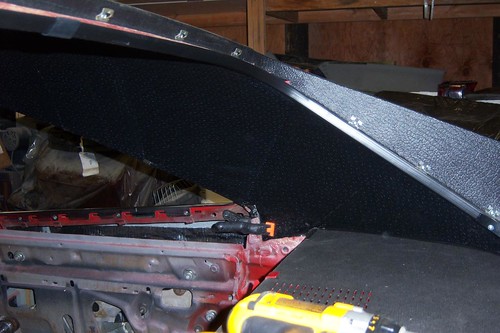
Headliner sail panel area, passenger side:
Posted in 2004-present | RESTORATION | Reassembly | interior | trim | link to this page | | Comments (0)
May 15, 2011
Decals
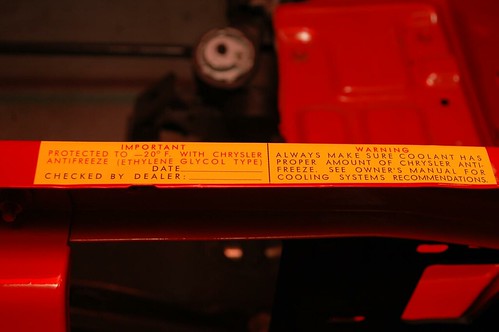
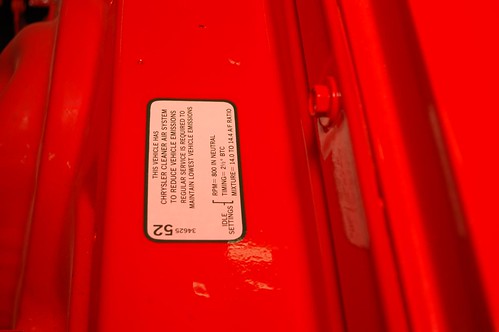
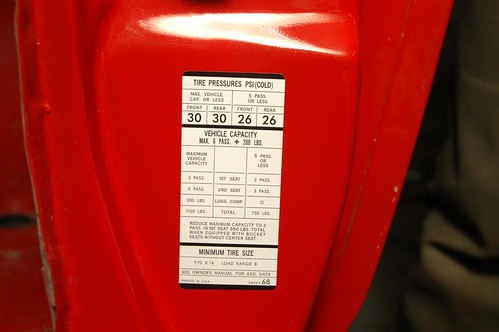
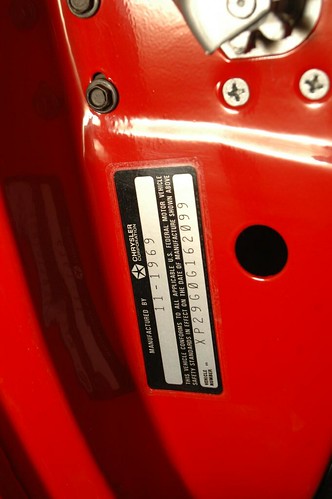
One of the steps I have been very excited to be able to perform was purchasing and installing the various authentic reproduction decals that go around the car. I purchased most of the decals from Performance Car Graphics, and I have to say the quality and service were outstanding. I ordered my reproduction VIN decal from ECS Automotive Concepts , and my dealings with them could not have been better. They were fantastic and fast. I also purchased from Performance Car Graphics a matte black tail stripe and air cleaner decal, which have not yet been installed.
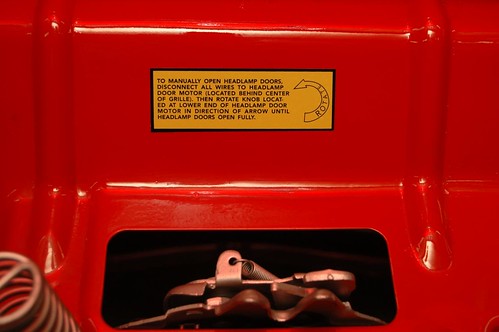
Headlight door motor decal
Antifreeze decal
Emissions decal
Tire inflation decal
VIN decal
Jack instructions
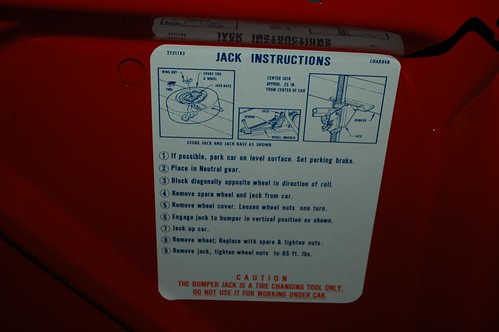
Posted in 2004-present | RESTORATION | Reassembly | body | trim | link to this page | | Comments (0)
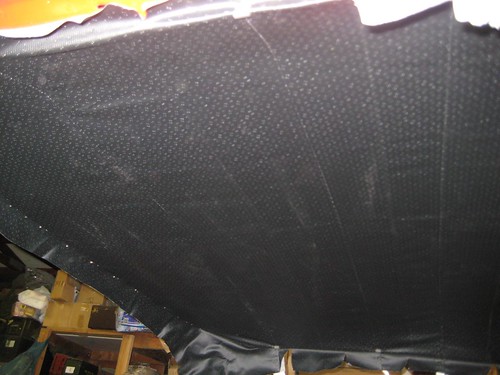
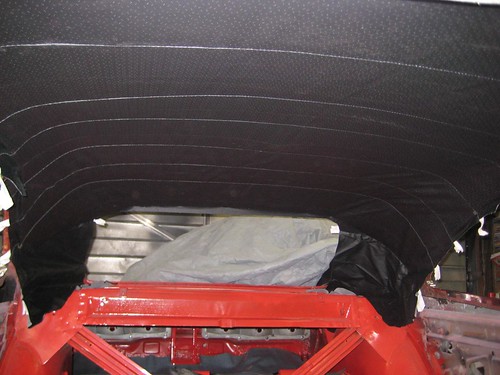
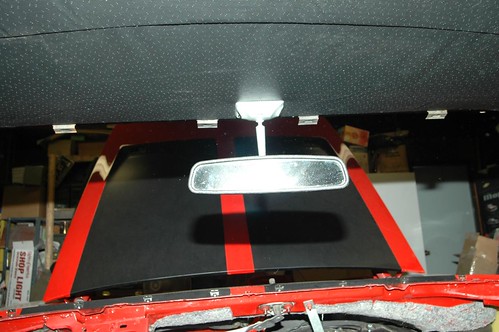
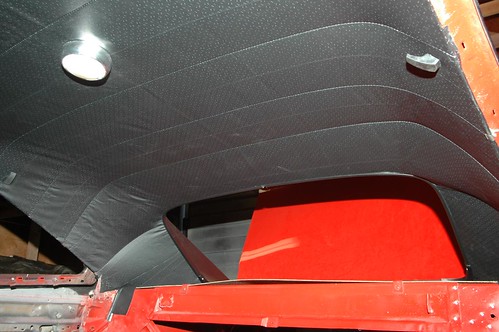
Headliner installation!
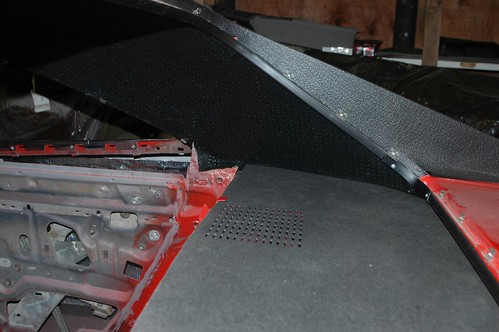
After reading everything I could find on the subject for months, thinking, and praying about it, I decided to attempt to install my own headliner. I'm sure my upholstery guy would have done a fantastic job for not too much money, but I really wanted to try it to see what it was all about. My son and I worked on this for three nights, and so far I am happy with the results. The headliner is in, the accessories are going on, I have worked the majority of the wrinkles out, and everything I read says it will only get better with time (and some attention from a steam tool of some kind).
The following pictures are taken in order over the course of those three days.
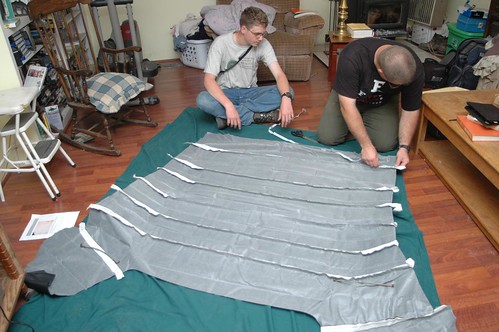
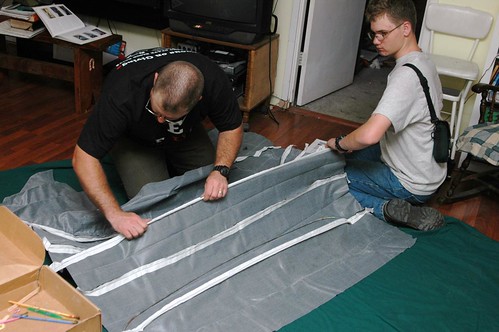
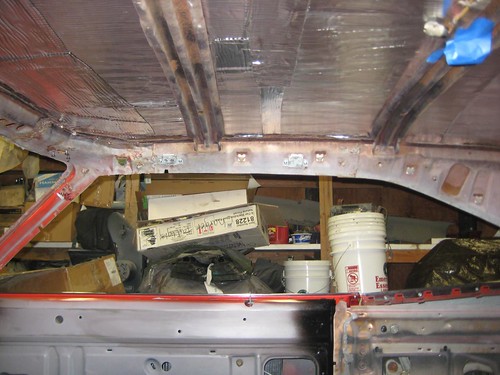

Posted in 2004-present | RESTORATION | Reassembly | interior | trim | link to this page | | Comments (1)
May 07, 2011
Heater box rebuilt and installed
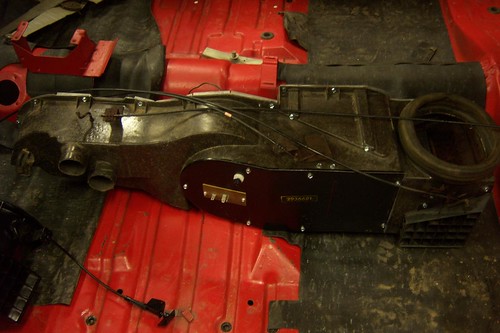
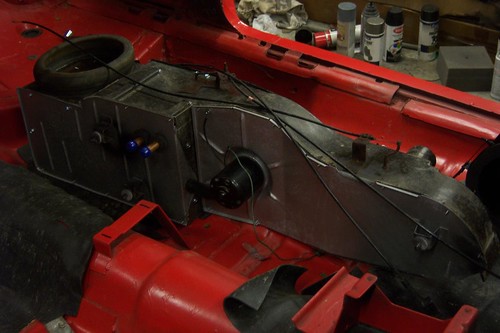
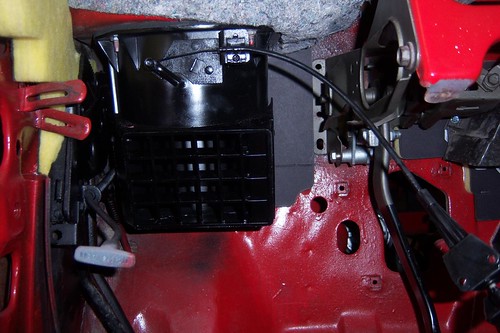
One of the things that needed to happen inside the car before the dash and some other things could go in was that I needed to thoroughly go through my heater box and get it installed. I ordered a complete seal and gasket kit from Restorations By Rick, and it was excellent. Everything fit perfectly, and the instructions left very little to the imagination. My son and I stripped all the parts, sanded, painted, replaced the heater core with a new one, and replaced all the seals using the kit. Once this was complete, we reinstalled the heater box and driver's side vent assembly, which we had also cleaned and detailed. Although we repainted all the metal parts, you may notice that the original Mopar part number stamp is still visible on the front panel. Since that spot was in good shape, I covered it with clear tape, used a razor knife to outline it, and then repainted the front panel. When I pulled the tape off, the effect was pretty good.
heater box rebuilt, front
heater box rebuilt, rear
driver's vent installed
heater box, installed
Posted in 2004-present | RESTORATION | Reassembly | interior | link to this page | | Comments (0)
April 15, 2011
Some progress to report
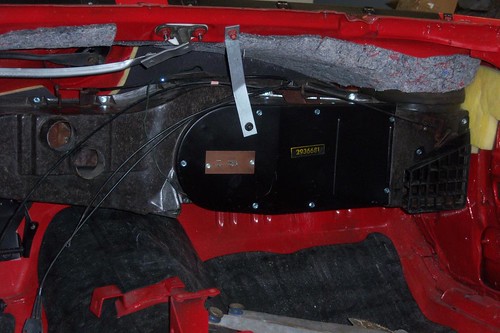
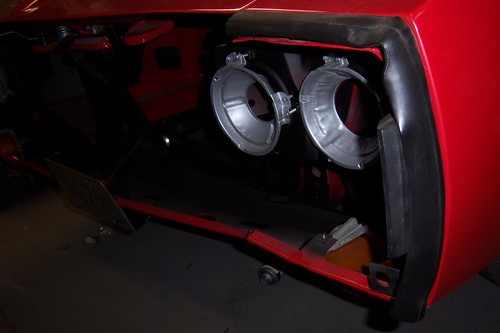
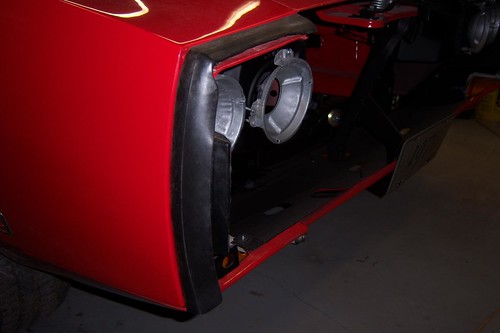
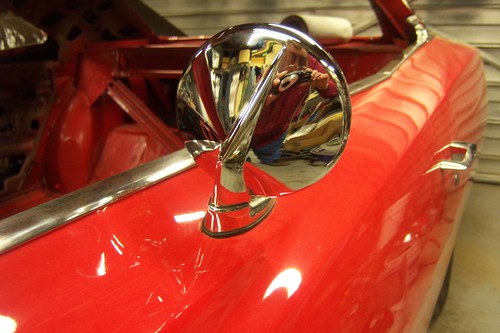
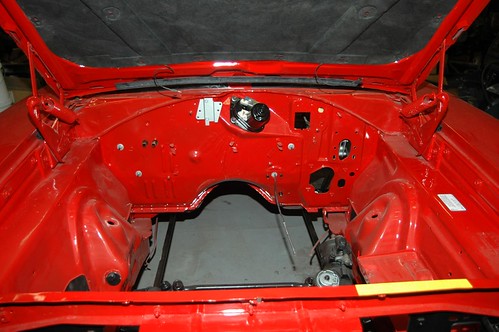
I have not had a lot of time to work on my Charger lately. I've been working on a lot of other things instead. But I have had a few moments now and then to get a few fun things done on the Charger. I installed my new reproduction fender-to-bumper seals; I installed a new PG Classics driver's side remote mirror (which seems very nice); and I blasted and detailed my wiper motor and voltage regulator bracket and got them painted and installed.
Fender gasket, driver's side:
Fender gasket, passenger side:
Mirror:
Firewall with details:
Posted in 2004-present | RESTORATION | Reassembly | body | link to this page | | Comments (0)
February 21, 2011
Trim and detail work
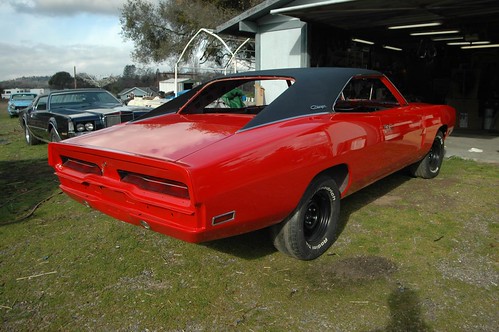
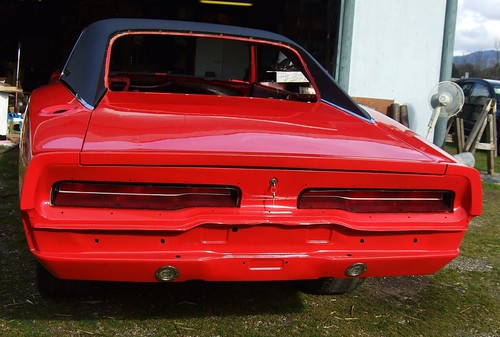
Work has been continuing full-speed on my Charger. The sorts of detail work that make up the phase I'm in right now require a large number of hours for a relatively small difference on the car, but I realize that attention to these details will add up to a terrific final product. The most time-consuming part of the project in this phase was straightening, sanding, and polishing the stainless steel trim that surrounds the border of the vinyl top. The materials I had read online gave tips for smoothing out dents, then sanding the pieces with progressively finer grits of sandpaper, and then buffing the pieces, all prior to installation. I am still learning, but so far I am happy with the results.
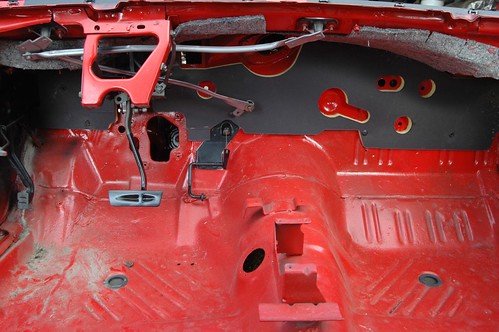
I have also been polishing the plastic lenses and have been able to now install a number of them. The firewall is also coming together nicely, with the brake pedal assembly and wiper pivots rebuilt and detailed. Next should be the heater box.
This morning my wife asked me to push the car outside the garage so that she could take a fresh round of pictures. Here are some shots that show what I've been doing lately on the Charger.
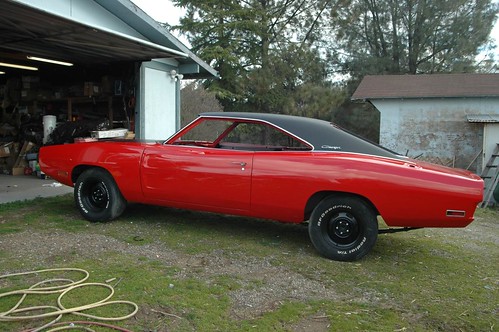
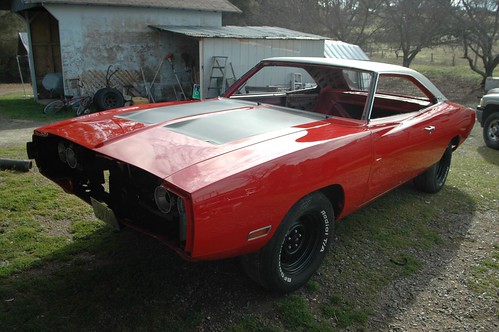
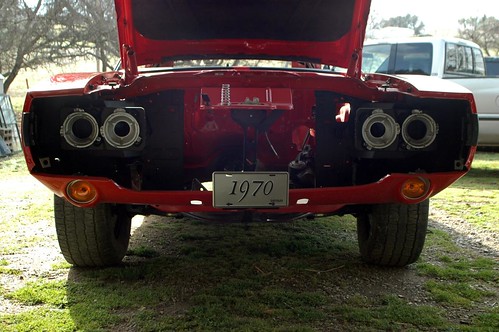
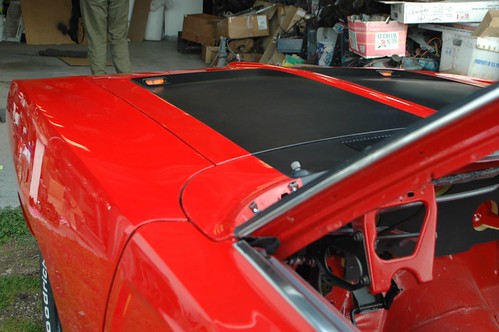
Posted in 2004-present | RESTORATION | Reassembly | body | interior | primer and paint | trim | link to this page | | Comments (2)
February 06, 2011
Vinyl Top
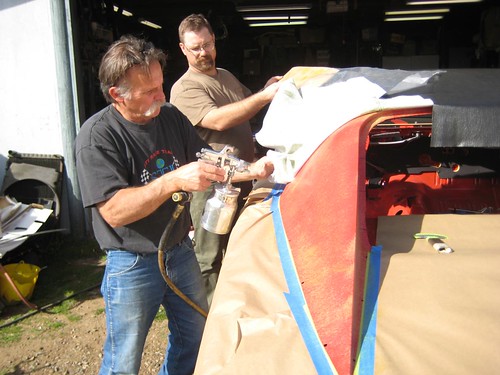
One of the things I have really been looking forward to is getting my new Legendary black vinyl top installed on the Charger. I contacted a local businessman, George Sgambellone, owner and operator of Mariposa Auto Trim, about installing my top. He was willing to come to my house and put the top on, showing me step-by-step how he was doing everything. The top looks outstanding, took only a few hours, and his rates were EXTREMELY reasonable. I have decided to place an image of his business card here in this post in case any people in my area need this sort of work done. I highly recommend George.
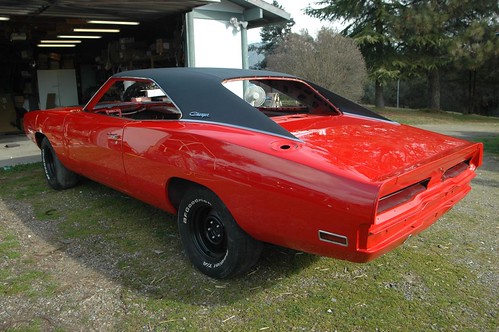
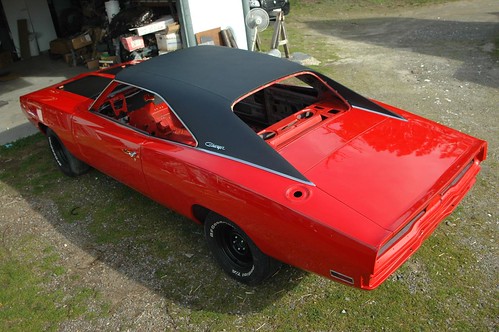
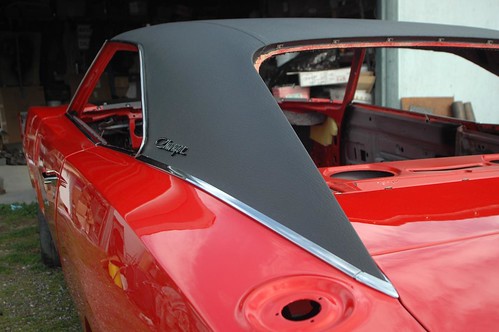
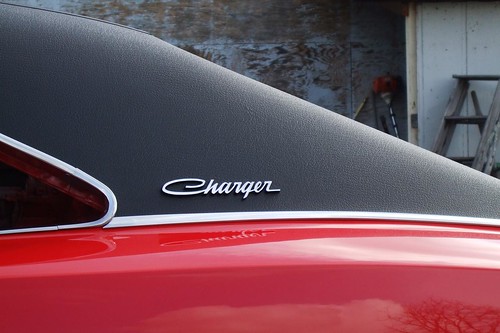
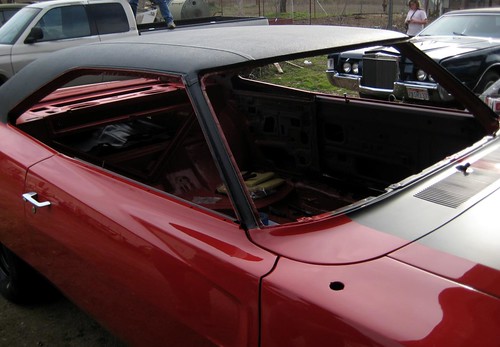
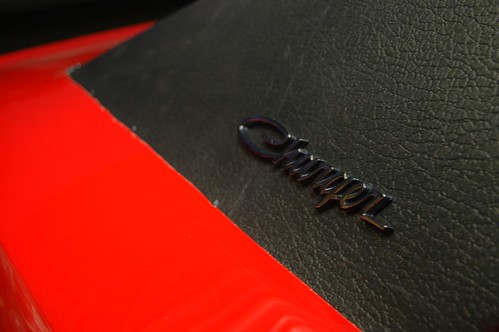
Here are a progression of pictures from the vinyl top installation. The first image shows George and myself working together. The next set are of the top after it was installed and the car was still outside. Then a couple detail shots after the car was safely back in the garage. I was very happy to finally be able to install the new Charger logos that my wife and kids got me for Christmas, and the new check moldings. As soon as I have the rest of the stainless trim polished, I will install that, hopefully over the next few weeks.
I did also install all of the windshield molding clips for the windshield and rear window.

Posted in 2004-present | RESTORATION | Reassembly | body | trim | link to this page | | Comments (0)
January 23, 2011
Front valance and blackening
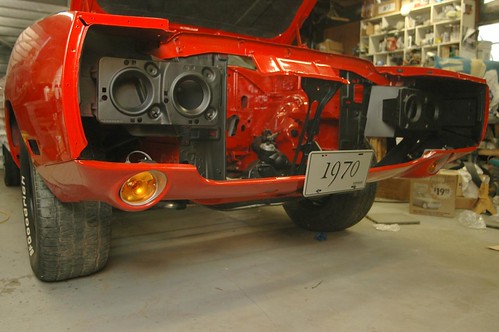
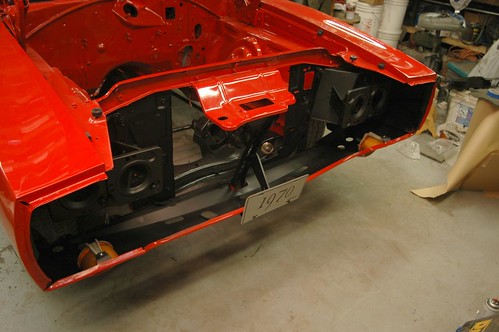
Didn't have much time this week to work on the car until today, but my son and I did reinstall the front valance and mask everything off, carefully, to black out the area behind the grill and bumper. Also, I wanted to see what my new parking light lenses would look like installed, so we put those together and installed them with new hardware in the valance. I think it all came out well and looks really cool.
Posted in 2004-present | RESTORATION | Reassembly | body | primer and paint | link to this page | | Comments (0)
January 17, 2011
Reassembly begins
It is wonderful to finally be at the reassembly stage. Boxes, envelopes, containers of new and restored parts, will now be freed from their captivity to adorn my Charger.
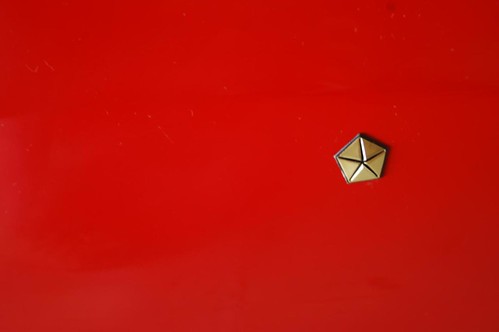
The very first part I installed on my newly repainted Charger was the passenger side fender emblem, the symbol of Mopar, the pentastar.
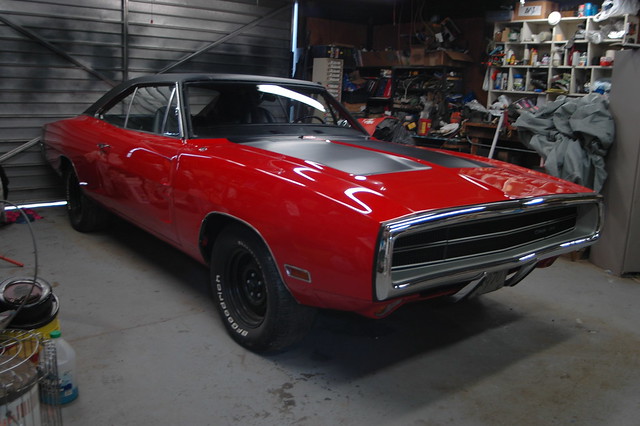
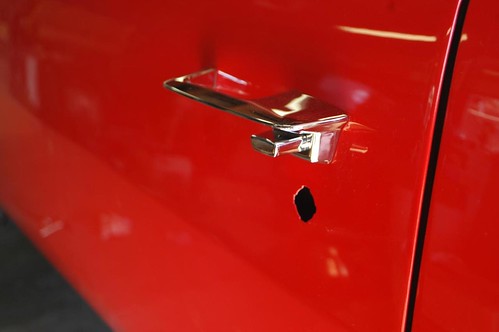
Next I installed my new reproduction outside door handles, to encourage people to not put their hands all over the paint when they want to open the door and look inside. They sure look nice to me.
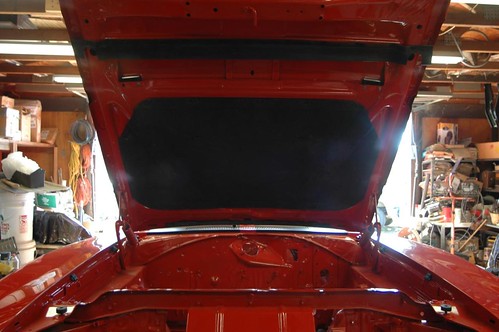
Here's a shot under the hood, with new weatherstripping, bumpers, and hood insulation, with new clips.
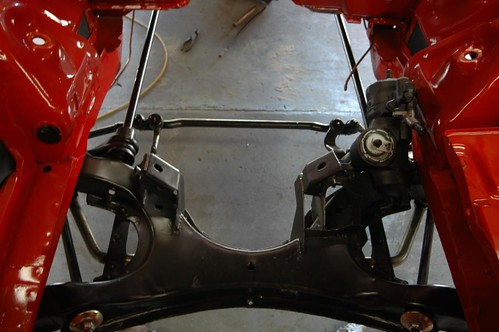
With help from my brother-in-law, son, and nephew, we jacked up the assembled K-member and bolted the front suspension in. I installed the .96-inch torsion bars with new seals and clips, and began to assemble the brakes. These are 11.75-inch Cordoba brakes, and will do the job very nicely, I'm sure. The rotors are used, but have been turned. All other parts, including bearings, seals, calipers, and hardware are all new.
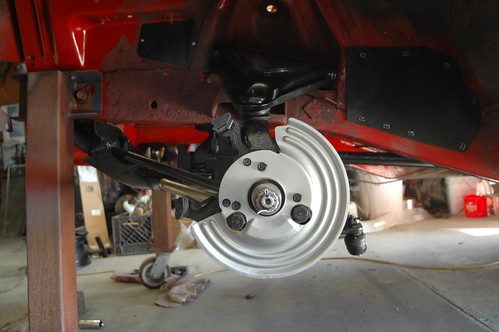
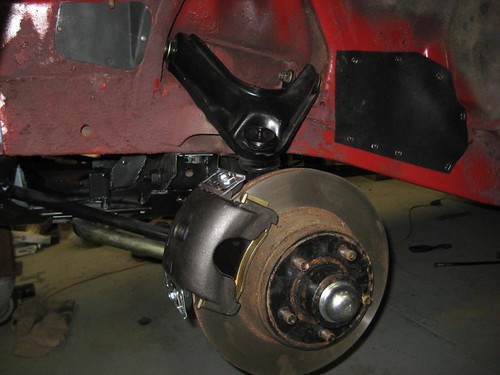
After installing the front suspension, my son and nephew were itching to put something else on the car, so I let them install the new body plugs.
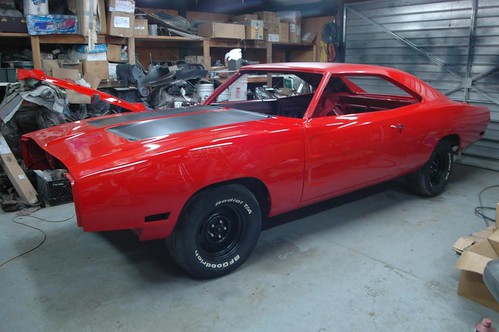
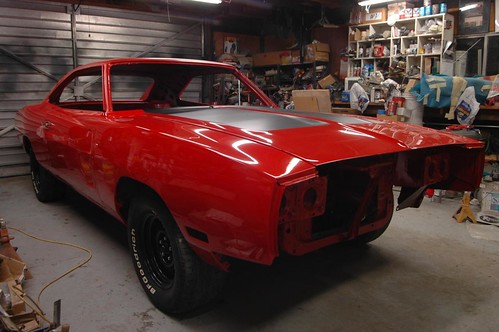
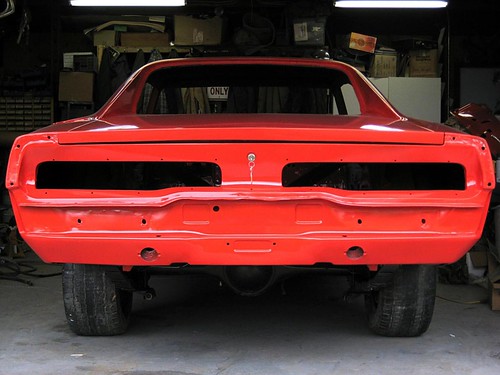
I really appreciated the use of Mopar Ed's dollies for the front end of my car, and wanted to free them up to return to him as soon as possible. The most fun way to do that was to get the car sitting on its tires again. I remounted my old BFGs on the newly painted rims, and installed them with new chrome lug nuts. At some future time, I will install the stainless steel red-line dog-dish hubcaps, to see if I like that look as much as I think I will. I really like the look of the car sitting on its tires. To me it looks more like a car than a "project" this way. I think this combination looks really sharp, and is the look I have been hoping to achieve.
Posted in 2004-present | RESTORATION | Reassembly | Reassembly | body | primer and paint | link to this page | | Comments (1)
January 15, 2011
Happiness in the garage!
Today was to be the day! Mopar Ed said if we could give him a little while to finish buffing and detailing a few areas, we could bring the Charger home today. Here are some views from inside his shop. My family and I were stunned with how beautiful the car was, how great a job Ed and his team did, and how totally cool the colors looked together in real life, after imagining them or seeing examples on paper for all these years.
Here is my buddy, the famous Mopar Ed, doing some last-minute dusting prior to taking some pictures for his records and his Facebook page. I cannot recommend Ed's work highly enough. I encourage all my Mopar buddies to give Ed a holler for your Mopar parts or painting needs. His shop pretty much does it all.

Here are a few more pictures of the car outside at Ed's and on the trailer preparing to come home:
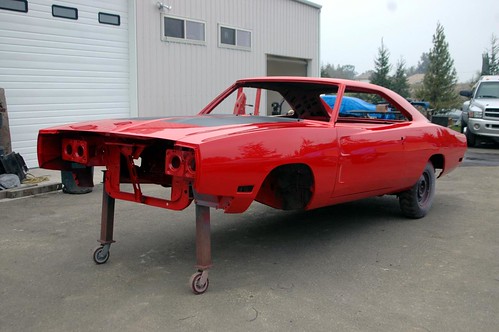
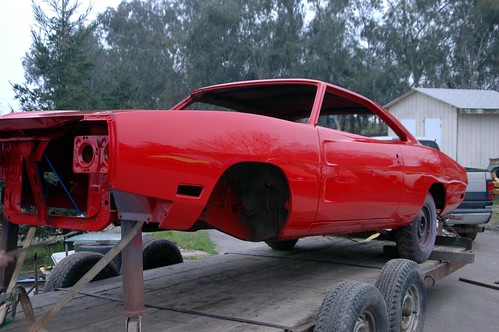
AT LONG LAST, with the help of some wonderful friends and family, here is my Charger, beautifully painted and safely unloaded in my own garage. The boxes you see in the background of one of these photos are full of parts, new and/or restored, waiting their turns to complete my Charger's restoration, inside and out.
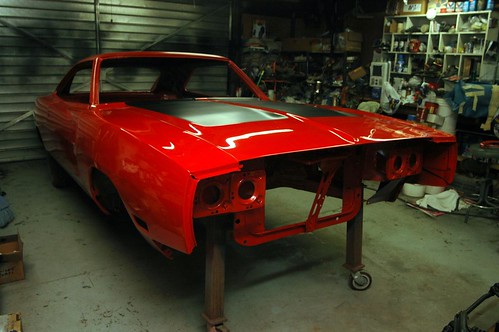
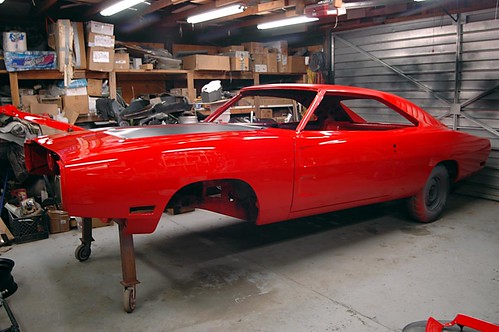
We've been home for about three hours as of this writing, and I've already run outside six or eight times just to look and let it sink in.
Posted in 2004-present | RESTORATION | body | primer and paint | link to this page | | Comments (1)
January 14, 2011
Wheels
In preparation for the arrival of the Charger, I sandblasted these "cop wheels". They are a Mopar item from the mid-1980s, usually found on Diplomats and Grand Furys. They are nice, stout, ventilated 15x7.5" wheels with great backspacing, making tire selection a breeze. After sandblasting, I coated them with etching primer and then three coats of satin black. These will be set aside until needed.
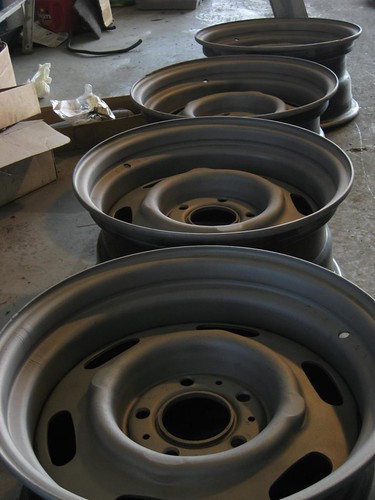
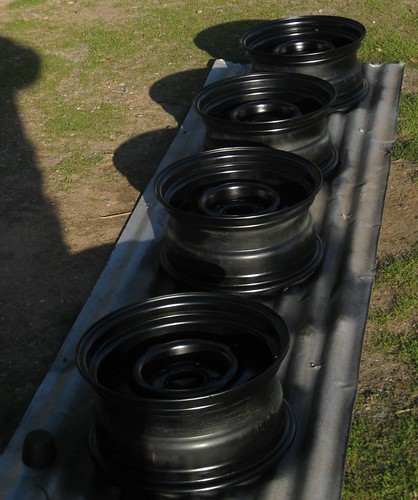
Posted in 2004-present | RESTORATION | primer and paint | sandblasting | suspension, brakes, tires, and wheels | link to this page | | Comments (0)
January 08, 2011
RED update
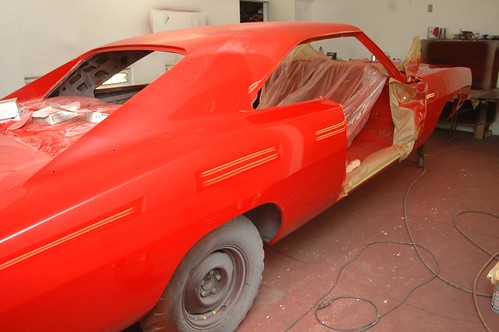
We took our first road trip down to see the car. Mopar Ed and his team continue to work on my Charger, as time allows, and things are really starting to look sharp. They are in the process of "cutting and buffing" the paint. The paint has a luster in person that is hard to capture in these photos; however, the shiny paint catches reflections in a frustrating way. (This last is according to my wife, the photographer.)
Perhaps in a week, the car may be reassembled and ready to come home. We will update this page as soon as we have new information.
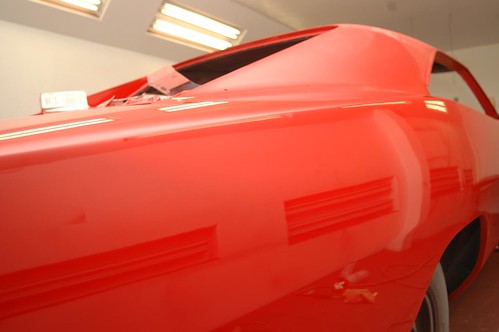

(This is me, laying hands on the red paint for the first time. Hard to tell, but I am definitely smiling. This is a happy moment.)
Posted in 2004-present | RESTORATION | body | primer and paint | link to this page | | Comments (0)
January 07, 2011
Front suspension coming back together
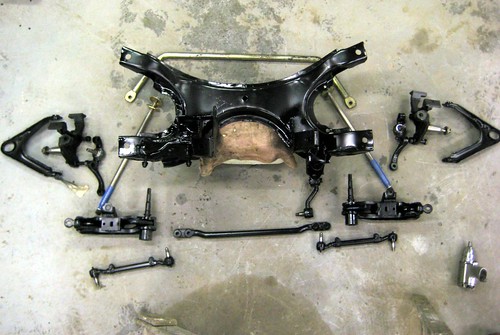
Now that everything for the front end has been painted with the Eastwood's Extreme Chassis Black, it's finally time to reassemble everything. Here are all the parts laid out, prior to bushing, ball joints, etc being installed.
Here is the final product ready for installation when my car comes home from paint.
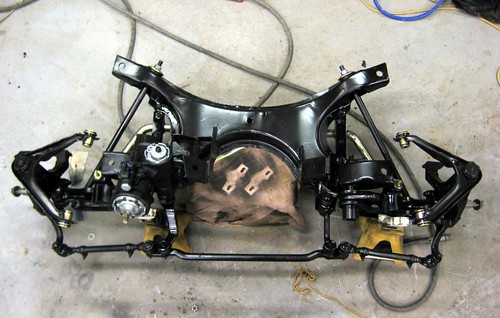
The upper control arm bushings are polyurethane; the lower control arm bushings are stock rubber replacements. I had read too many people having problems with the lower control arm bushings loosening up and/or squeaking with the polyurethane ones. All new ball joints and boots are installed. The tie rod ends and sleeves are stock for C-bodies, which are much beefier than the stock B-body units that my Charger came with. The original strut rods were bent, I realized after I took them out, so these are new steel heavy-duty units from PST with polyurethane bushings. The steering box is a police-car steering box from a Dodge Diplomat police car. Once the K-member and torsion bars are reinstalled, upper control arms bolted in, I will install the dust shields and rotors with new bearings and seals, allowing me to put the front wheels back on, at long last.
Posted in 2004-present | RESTORATION | suspension, brakes, tires, and wheels | link to this page | | Comments (0)
December 27, 2010
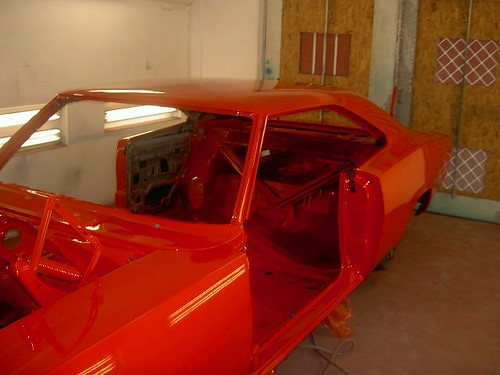
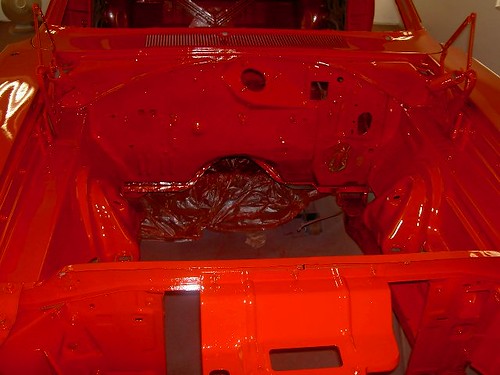
RED!
I knew that Mopar Ed was getting very close to painting my car, but today I got an email from him with the following pictures. Needless to say, I am very, very happy.
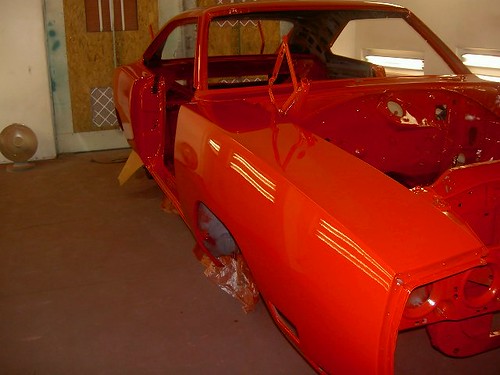
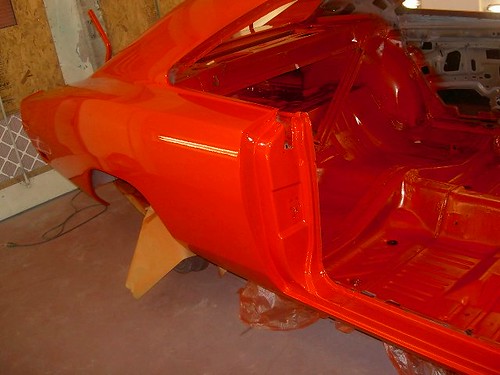
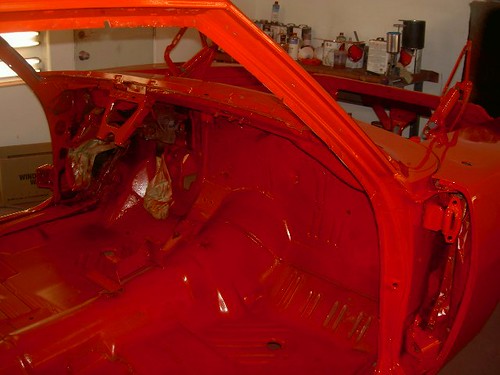
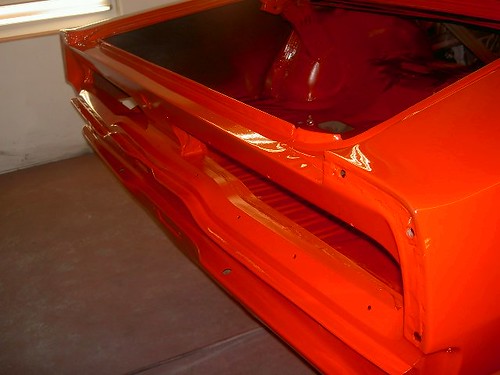
Posted in 2004-present | RESTORATION | body | primer and paint | link to this page | | Comments (1)
December 22, 2010
Visit to Mopar Ed
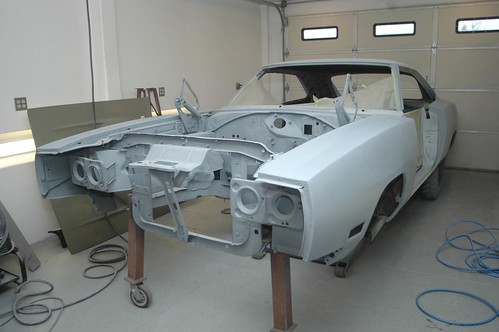
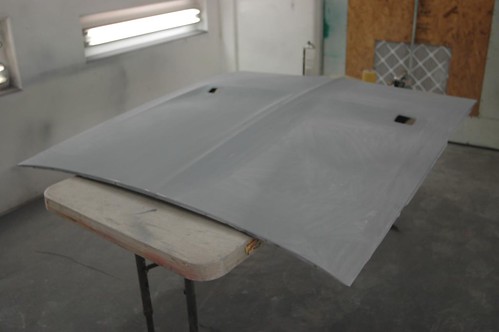
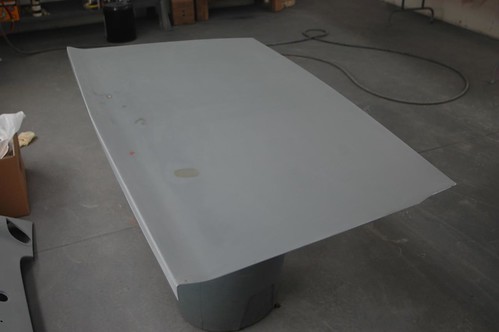
Mopar Ed had contacted me and said that he was just about done on the remaining body work on my Charger. He wanted some input from me about a couple of things, so we made the short trip down to his shop, and I was very pleased with the work that he and his team had done on the Charger. Once they finish up this current round, the car will move to paint.
Despite my best efforts, there was still a little bodywork for them to do on the rear quarters and hood, but they sure look great now.
Posted in 2004-present | RESTORATION | body | primer and paint | sanding | link to this page | | Comments (0)
December 10, 2010
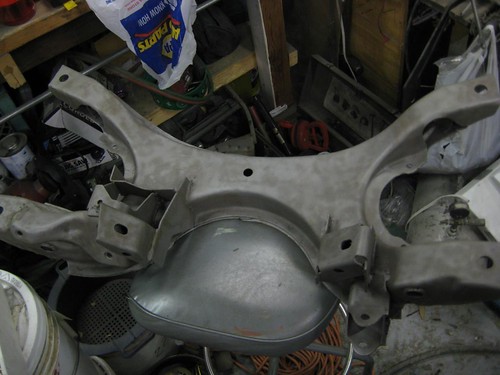
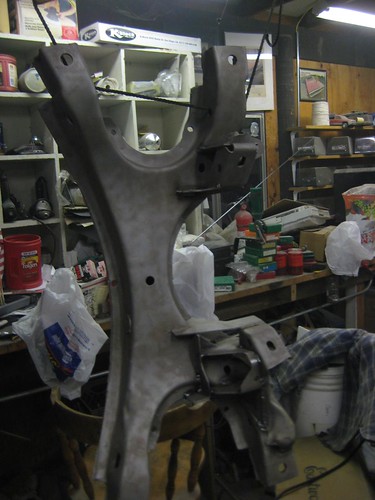
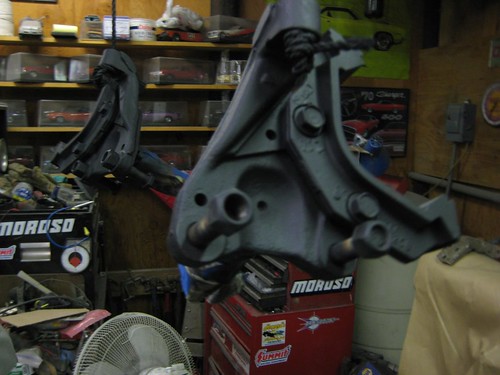
Refinishing suspension
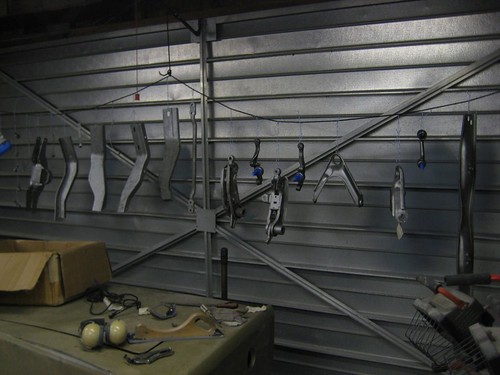
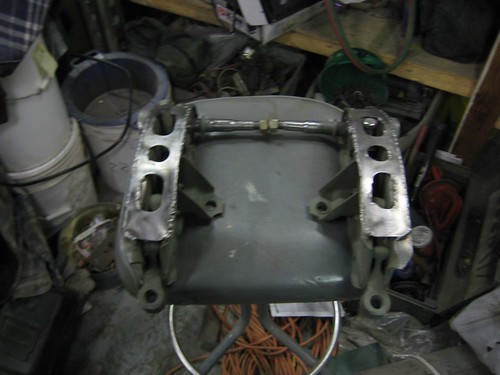
While my Charger is away at the paint shop, in addition to spending some excellent time getting some work done on my son's '67 Plymouth Satellite, I took this time to sandblast, prime, and paint the front-end suspension parts that I will use when my Charger goes back together. Also, while I was at it, I did the same procedure to the bumper brackets and a few other metal parts of the car that usually aren't seen. After sandblasting, all the parts were primed with self-etching primer, then primed again with conventional 2K primer because I learned that you aren't supposed to apply Eastwood's Extreme Chassis Black over self-etching primer. I am not sure why, but I'll take their word for it.
I did take the time to carefully inspect and reinforce some of the components. On the K-member I added new welds and improved some existing welds, and boxed in the steering box mount to eliminate flex that is common in that area. I also installed a set of reinforcement plates on the lower control arms that i ordered from Mancini Racing. Everything I read said that if you're going to increase the size of the front sway bar, which I am, you really need to box in the lower control arms.
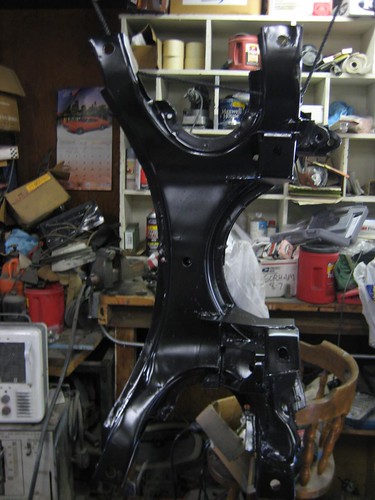
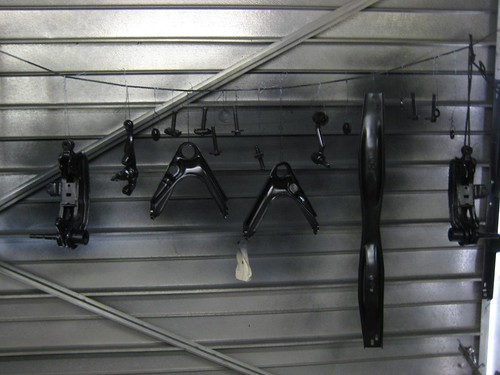
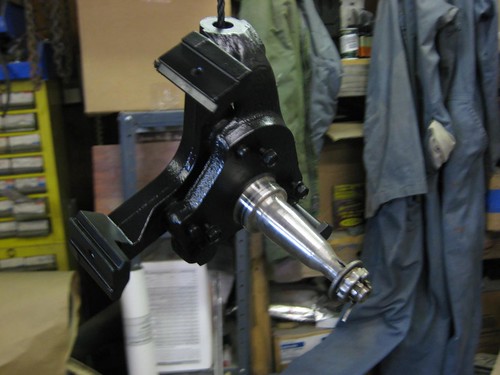
Posted in 2004-present | RESTORATION | primer and paint | sandblasting | suspension, brakes, tires, and wheels | link to this page | | Comments (0)
November 12, 2010
Special Thanks to Howard!
I am LONG overdue in giving proper thanks to a mentor, teacher, guide and friend who I have seen countless times, spoken to on the phone, spent hours and hours listening to, but never actually met.
When my good friend the "metal wizard" Frank moved away I was just beginning some very serious work on my Charger. I was feeling lost, and unsure how I would be able to proceed. I went online in search of some more books, or preferably some videos to help me along as I continued to learn body work.
Well, praise the Lord that I found Howard Holland's "Backyard Autobody" instructional DVD's. Right away in a very personable, and down to earth way, Howard's teaching reenforced what my friend Frank had been showing me, and being able to go over and over the DVD's helped immensely. Getting one of Howard's DVD's (there are currently three volumes) is more than just buying some good practical instruction, Howard himself is available via telephone or email to help you through any questions you may have. The only warning I have to offer though is, when you start talking to Howard on the phone, sit down and get comfortable because your not talking to some generic "tech help line" you are about to make a friend with someone who is as interested in your success as you are!
Howard teaches more than "just" hammer and dolly work, but goes into panel replacement, patch fabrication, filler uses (pro's and con's), priming and painting too! In fact it was my having watched Howard talking about, and demonstrating the use and benefits of single stage Urethane paints that allowed me to so easily accept Mopar Ed's suggestion that we go that route on my Charger's upcoming paint job.
I simply can't recommend highly enough that anyone wanting to learn the ropes in the auto-body universe consider giving Howard's videos a try. You may be amazed by what you can learn to do yourself.... and don't be surprised if the phone rings and it is Howard asking you how your project is going!
I get nothing from Howard for recommending him; he does not even know I am posting this, but I do so in hopes that some of you might get your projects a little further down the road (or back on the road!) through the unique kind of help he has to offer.If you want to you can click on his logo below to go to his website.

Posted in 2004-present | RESTORATION | body | primer and paint | rust & rust repair | sanding | link to this page | | Comments (0)
November 11, 2010
Seeing RED... very soon!
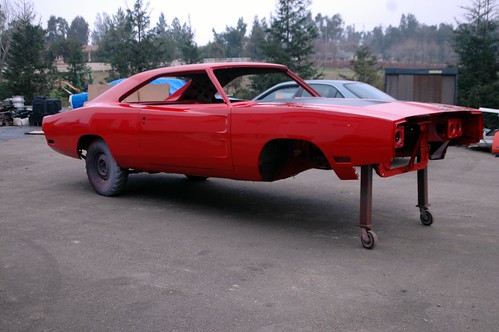
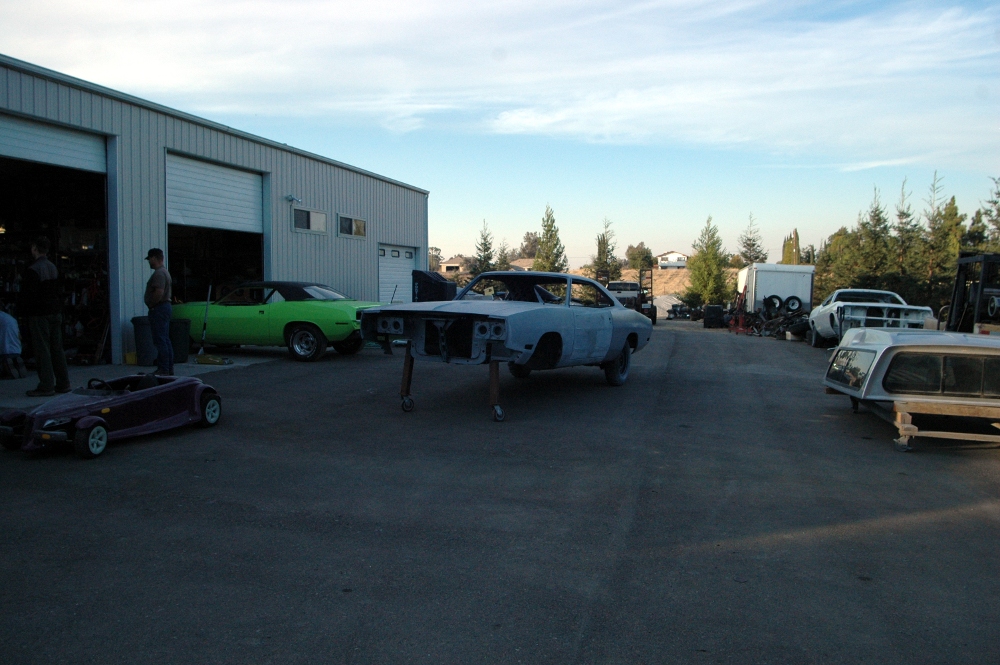
Well today was a really monumental day in the "life" of my Charger, and in my life too. A couple weeks ago on Halloween day, I had Ed, the owner and operator of E-Body Parts and Restoration come to my house and look my Charger over. He agreed to come and inspect my body work to ascertain if I was ready to hand it over to him for painting. He rubbed the car over quite a while, pointed out a few things I'd overlooked, and told me "Very good work, especially if this is your first time, that's really great. If you fix those things, I'll have space in my shop to get your car in in Mid November" This was a pleasant surprise, I had not expected him to have time so soon. Well, needless to say I worked every available moment to get the things done that he had noticed. Well today being Veterans Day, I was off work, so I drove down to his shop (a bit over one hour away) and picked up a pair of casters that bolted to my frame at the front bumper mounts so that my car could roll. Then loaded it up for a trip to FE5 heaven.
Here is the car loaded and ready to go in front of my garage.
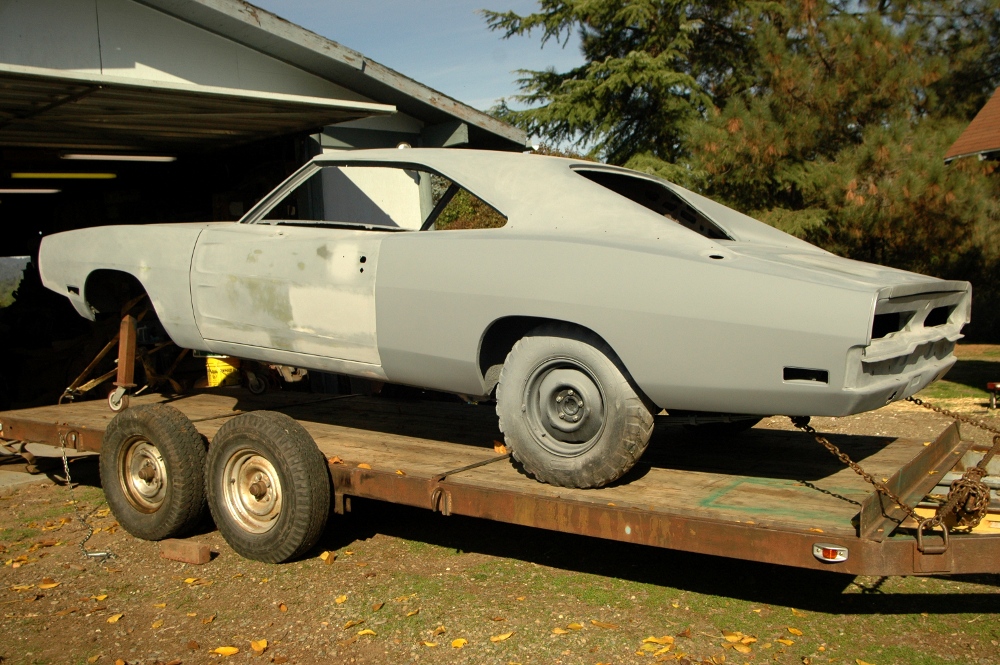
Here we are after having unloaded the car at Ed's shop,
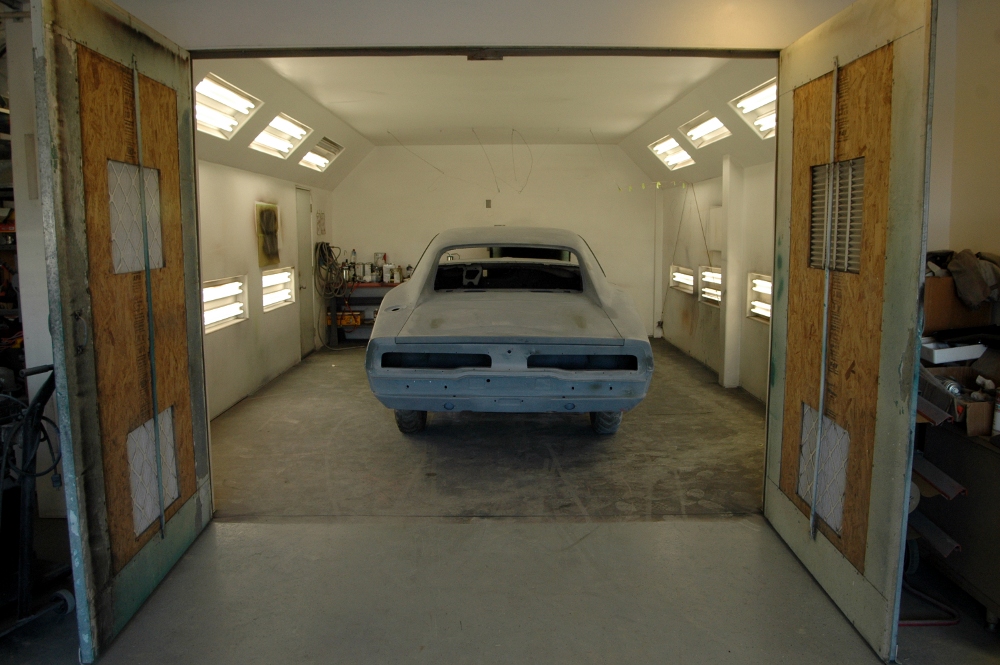
Here is the car snug in the paint booth!
Ed and his staff will shoot the car one more time in primer, block the body out, fix any minor things I still missed, then he will disassemble the car, paint everything then put it all back together. He promised he'd try to take pictures, but added that my wife and I are welcome to stop by and check things out anytime.
His shop is really amazing! He must have had more than a dozen awesome Mopars inside, with dozens more outside. I will update my Charger web page and this thread as things progress rapidly from here.
Posted in 2004-present | RESTORATION | body | primer and paint | link to this page | | Comments (0)
August 15, 2010
NOPE!
The previous time I updated my page last fall, I had hoped that I was done priming and was on my last go-around with block sanding. I wasn't there yet! Really things are going quite well, but the doors (especially the passenger side door) still had some issues to resolve. When using my longest Dura-Block (about 24") I found some unhappiness that had somehow escaped detection in my previous attempts. After many nights of re-working the doors, I am now confident that things can resume.
I have reprimed the reworked areas, and am eager to begin blocking them again. You really can't tell much difference from the pictures, so I'm not posting new ones yet. I do have some good news to report however, I have spoken to a guy I trust who owns a Mopar restoration shop nearby (about 45 minutes away) and he is willing (and more than able) to paint my Charger when I'm done sanding!
One of the reasons for the lack of progress lately has been how busy we've been as a family. Since spring we've been helping an elderly lady by cleaning up her property. Her late husband (who died about 20 years ago) was a mechanic, collector, and accumulator of lots and lots of stuff. Well she figured it was time to sell the place, so my family and I volunteered to help out. It was fun, and rewarding, but most of all, a lot of work! We sorted and hauled a bit over 90,000 lbs of scrap metal off her place to a scrap yard about 1 hour from there (each way). We hauled off several tons of trash (not included in the 90,000lb figure), over 125 tires (also not included in the 90,000lb figure), lots of cars, appliances, and assorted scrap metal. I did get a '67 Plymouth Belvedere which sadly had been mostly crushed but still had a few salvageable parts for my son's '67 Satellite, a '74 Dart Sport, and a '63 Dodge Dart GT both in decent shape. Some of these funds have given a boost to my "Charger paint job fund" and I hope and pray that before the close of 2010 my car will be very very RED! Please stay tuned.
Posted in 2004-present | RESTORATION | body | primer and paint | sanding | link to this page | | Comments (0)
November 22, 2009
Third time's the charm...?
When you mention bodywork, especially block sanding, to most people, they imagine and/or describe something that goes on and on and on, seemingly with no end in sight. While I am still enjoying seeing my Charger get better and better with each stage of progress, I am looking forward to that final block-sanding in the sky when I can sand the entire car and see nothing but primer. Then I should know I'm done. Will I get that this time? I hope to know the answer to that in the next six weeks or so. This next round of blocking will be done with 600-grit paper, and things keep looking better and better. Stay tuned.
Posted in 2004-present | RESTORATION | body | primer and paint | sanding | link to this page | | Comments (1)
November 17, 2009
Second block sanding all done
The second block sanding was done with 320-grit paper on Durablock sanding blocks in varying sizes and shapes. It is gratifying that there were fewer things that needed attention than the last time, and some areas, like the hood, are "there".
Posted in 2004-present | RESTORATION | body | primer and paint | sanding | link to this page | | Comments (0)
August 17, 2009
Second round of 2K primer
The work continues. The application of the primer went well. I didn't repeat some of the mistakes I made last time, though I did make a couple of new mistakes. The good thing about the primer is that you end up sanding off your mistakes. It is very gratifying to see the panels coming out straighter and straighter. The next round of block sanding will begin shortly. While it was 150 grit last time, this time we'll be using 320 grit and we will be avoiding cutting down to bare metal. I'm not anticipating a problem with any severe high spots, but time and work will tell if I'm right.
Here's a slide show of a walkaround of the car with the second round of primer on it.
Posted in 2004-present | RESTORATION | body | primer and paint | sanding | link to this page | | Comments (1)
Just before the second round of 2K primer
Well, my son and I finally finished the first round of block sanding on my Charger. After blowing the car off really well with compressed air and using a tack cloth on the body, I covered bare metal areas with self-etching primer. Then, after letting it dry for a day or two, I blew the car off with air again, washed it down with wax and grease remover, and tacked it off again one final time, in preparation for the second application of 2K primer.
Here's a slideshow of a walkaround of the car just before I started spraying. The various highs and lows exposed during block sanding are now much more level than before and are about to be covered up again.
Posted in 2004-present | RESTORATION | body | primer and paint | sanding | sheet-metal replacement | link to this page | | Comments (0)
July 29, 2009
Dividing the work, multiplying the fun
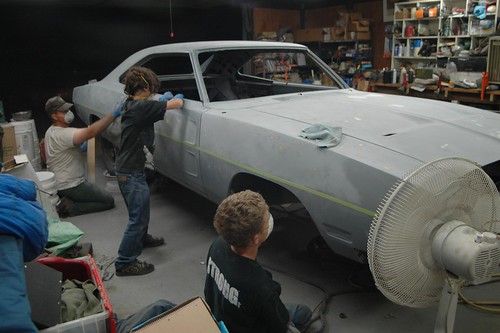
We recently had the treat of having my niece and nephew over at our house for a couple of days. While they were here, my son and I took my nephew out to the garage and showed him how much fun it is to sand on my Charger. The boys both did a really good job, and it was fun to teach them some of the things I've learned the hard way - not to mention it was really great for me to see that side of the car being sanded much more rapidly than when I'm working alone. Thank you, kids!
Posted in 2004-present | Family Helpers | RESTORATION | body | primer and paint | sanding | link to this page | | Comments (0)
June 03, 2009
Block Sanding 101
This summer, with our Bible study on vacation until fall, I find myself with some extra time on some evenings. My son and I have embarked on a project to get the block sanding moving at a quicker pace: I am teaching him what I have learned, and he is being a HUGE help. We are having a lot of fun together. We're making rapid progress on completing our first go-round of the car, and I anticipate during August putting on the next layers of 2K primer, and blocking the car out again, but then with 320-grit paper (we are using 150-grit on our first pass).
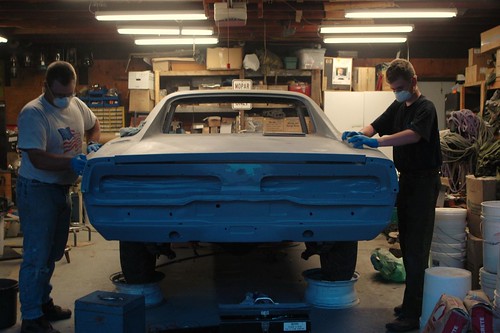
Not only is it wonderful to spend time with my son and get things done, but an added bonus is seeing his growing enthusiasm for about the upcoming restoration of his 1967 Satellite. (You can see a picture of his car here.) Working on my Charger together is excellent training for him, because when we're done with my car, his is next and he will be doing much of the work on that project.
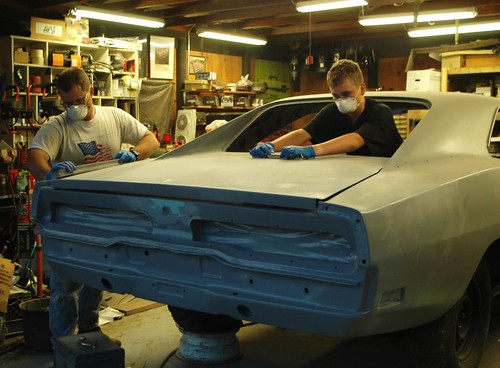
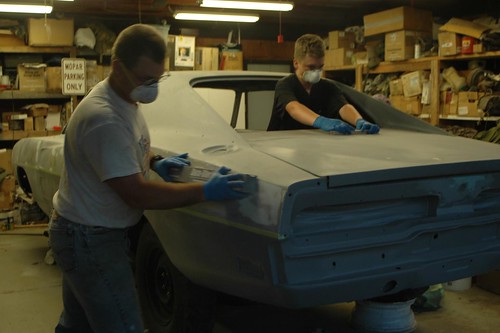
Posted in 2004-present | Family Helpers | RESTORATION | body | primer and paint | sanding | link to this page | | Comments (0)
March 01, 2009
Block sanding.
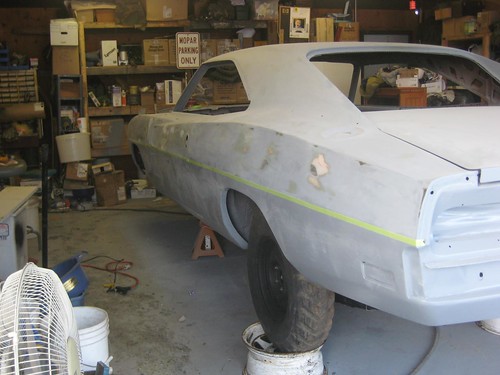
With the car perfectly stable, and all my fears of it falling down gone, I happily got back to work. I am using a series of Dura-Block sanding blocks of various sizes and shapes. The blocking out itself goes fairly quickly. The green tape line that is visible down the car is of course protecting the body line. The tape allows me to sand to but not over the body line I worked so hard to perfect in the body work phase of my Charger's restoration.
From what I have read and what my buddy Howard Holland told me, on the initial block-sanding, I didn't have to worry too much about seeing small patches of metal show, because I'm in the coarse leveling phase. When I'm done with this round of block sanding, and I've dealt with anything that is far too high or low, I will shoot more 2K primer and block it out again with finer paper, and be more concerned about not cutting as deep from that point on.
So far, the blocking out of the Charger has been a lot of fun, and I'm really enjoying seeing the car's body get straighter and smoother with each pass.
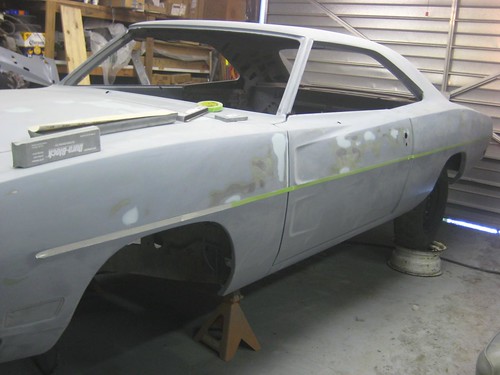
Posted in 2004-present | RESTORATION | body | sanding | link to this page | | Comments (0)
February 17, 2009
Getting my rear-end in gear
The way my entire Charger was sitting on jack-stands made it easy for me to prime. However, I noticed when block-sanding the car that the whole Charger would start to sway. This made me very nervous. I kept having terrible visions of my now-pristine quarter panels and fenders slamming on the ground. I decided I needed to stabilize the car better.
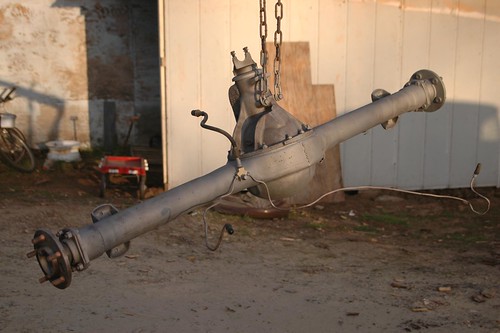
Since I had everything ready to go on the rear end, I decided I would put it under the car and put some junky tires on the car. The photos below chronicle the sequence I went through in this part of the project. One of the neatest things was, this was the first time that I was able to start emptying some boxes that had held new parts.
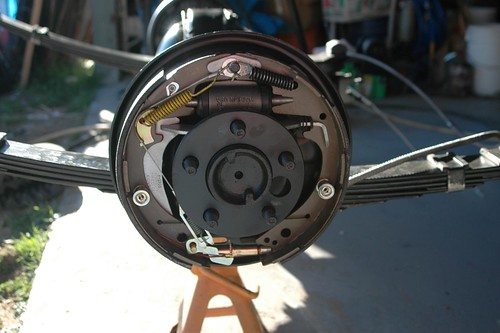
These first two pictures show the rear end stripped of its original 10-inch brake parts, with the axles put back in place. With it hanging from my engine hoist, I had just completed sandblasting the entire rear end.
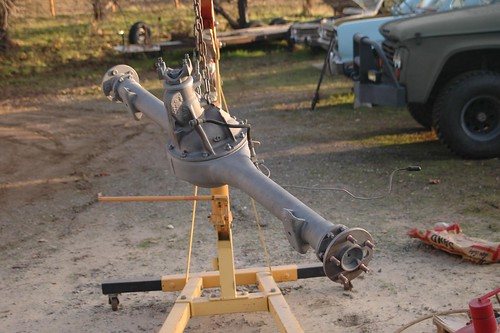
These two photos are of the assembled and painted rear end, with the 11-inch heavy-duty brake hardware, the Mopar Performance OEM-style 440/Hemi leaf springs, all-new bushings, new hard brake lines, and the new rubber brake line. The gears in the 489-cased third member are 3:55's with the large 440 yoke. All that is ready to be rolled under the car.

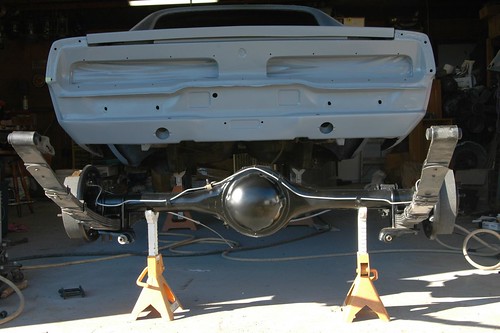
In this photo, you can see everything in the new 11-inch rear brake system has been replaced: wheel cylinders, all the springs, self-adjuster parts, brake linings, everything new and shiny.
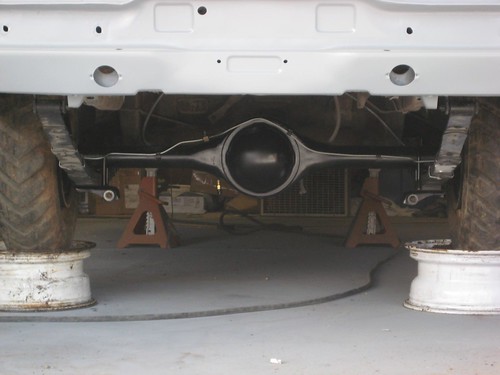
Here the rear end is all bolted in. The tires are tall, skinny 7.00-15 Bobcat tractor tires that I had from past projects. They allow plenty of room for me to work around the wheel wells, and I won't care if they get paint all over them. With the rear end in place and my stoutest jack-stands moved as far forward on the frame as I can get them, my Charger is now rock-solid, and I'll feel a lot better working those panels over as I block things out.
Posted in 2004-present | RESTORATION | sandblasting | suspension, brakes, tires, and wheels | link to this page | | Comments (1)
December 14, 2008
2K Primer
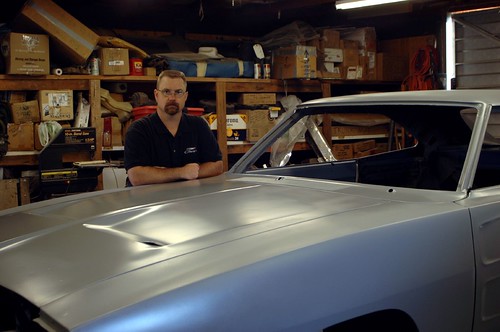
Here I am admiring the beautiful lines of my Dodge Charger. I happen to have been wearing my Charger-logo polo shirt while my wife was taking photos of the 2K primer job on the car, and she asked me to pose. (I am smiling.) All those boxes on the shelves in the background are full of parts to go on/in my Charger once the final paint job is done.
Well, finally I was able to get my 2K primer on my Charger. I am a year and a half or more behind where I thought I would be, but I spent that time learning better ways to straighten and perfect the body of the Charger. I am glad that I waited, as things are looking fairly good now, with three coats of the high-build primer on the car. I have begun the blocking-out process, and so far it is a lot of fun. Once the blocking-out is done, another several coats of primer will go on, and the car will be blocked out again. Hopefully by that point the body will be ready for paint. However, experience has shown me not to get in a rush, and to take time to do it right no matter how long (or how many tries) it takes.
Posted in 2004-present | RESTORATION | body | primer and paint | link to this page | | Comments (0)
October 28, 2008
Removing the suspension
The following series of pictures shows my Charger starting out on jackstands with the tires and wheels removed, displaying, hopefully for the last time, its sad stock ten-inch drum brakes. I wanted to remove as many of these parts as possible prior to priming and painting.
Upgrading the brakes is not the only thing I have in mind for this phase of my project. When this goes back together, I will install Hemi .960 front torsion bars and stock XHD 440/Hemi leaf springs. I have all new polygraphite bushings to install throughout, a firm-feel steering box, 12-inch front rotors from a Chrysler Cordoba riding on disc-brake spindles from a '73 Valiant, and 11" HD drums out back. I will also upgrade to a 1 1/8" diameter front sway bar.
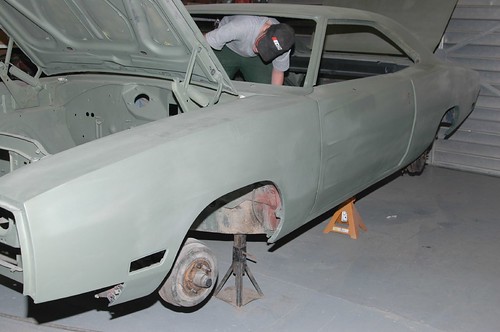
My son, just completing the removal of the steering column.
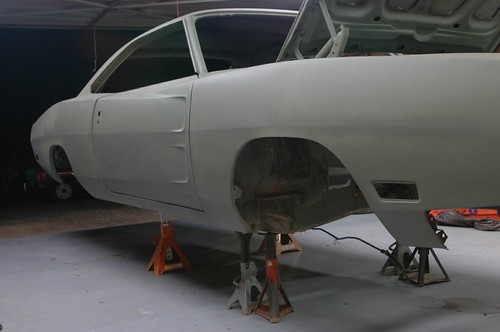
This picture, in addition to showing the absence of the suspension, shows fairly well what I have been doing these last months on my car. I have been working very hard to get my body lines straight and appropriately crisp. I think they show fairly well in this photo.
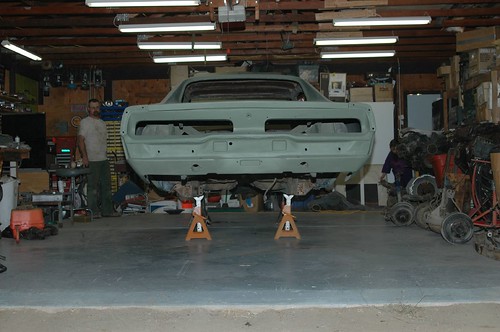
Rear view of the car; rear-end, springs and shackles all had to go as well.
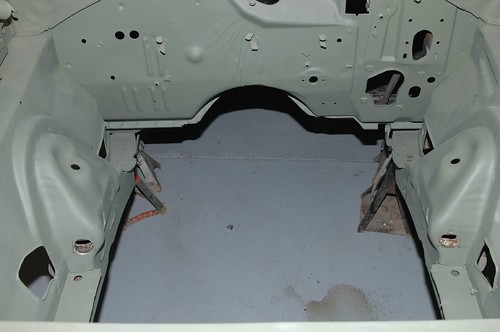
Having the engine bay this clear should make it extremely easy to get the primer and paint everywhere I need them to be, prior to reinstalling the restored and upgraded front suspension and K-member.
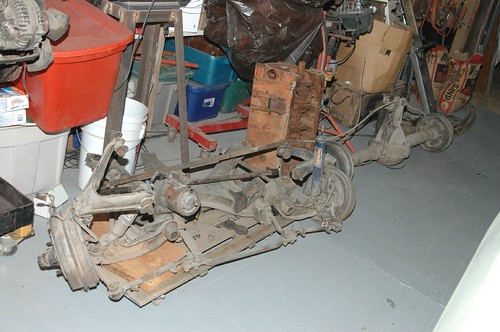
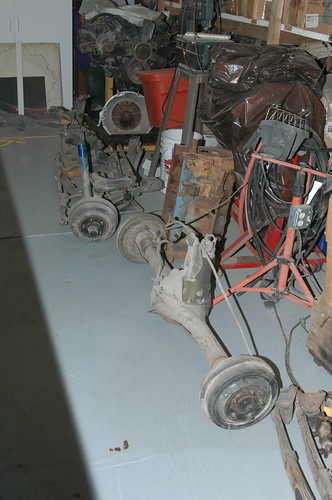
It is really something I thought I would never see, looking at this pile of parts in the side of my garage. It will be a lot of fun this winter to disassemble, clean, restore, and upgrade all of these assemblies prior to installation, after the paint goes on.
Posted in 2004-present | RESTORATION | body | disassembly | suspension, brakes, tires, and wheels | link to this page | | Comments (1)
One last sandblasting chore
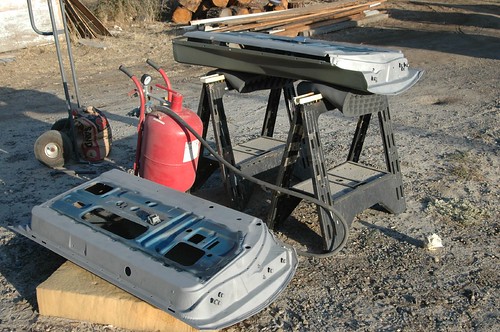
As the day to put primer on my Charger draws near, I realized I had neglected to strip the old paint and minor surface rust, etc., off the inner part of my doors. I had used a wire wheel on my grinder to remove all the paint from the door jamb area of the car body itself, but wanted a good fresh start on the doors. My son and I removed the doors, gutted the latches and window regulators etc., and set them outside for sandblasting. The red tank-looking object between the doors in the first photo is my inexpensive but very serviceable sandblaster.
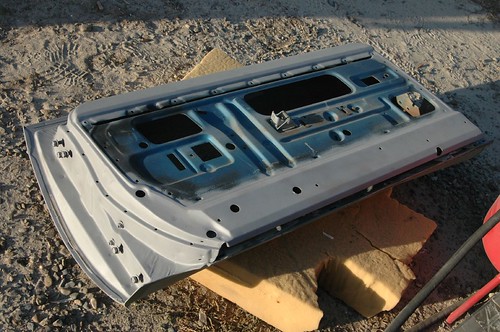
This is a closeup of the areas I sandblasted. I protected the outside edge of the door, which already has primer on it, with a heavy layer of masking tape prior to sandblasting. I was very pleased with the results. All the rust, all the paint, all the years of glue, etc., are gone. After this, the doors were taken inside the garage and etching primer was applied to all the bare metal.
Posted in 2004-present | RESTORATION | body | disassembly | sandblasting | sanding | link to this page | | Comments (0)
June 20, 2008
Homecoming!
Nine months ago, my family and my Charger left the home we'd been renting for a long time. My inlaws graciously agreed to allow me to not only store but work on my Charger while we were staying with them, which we did while we waited for our new home to become available. In January, we were finally able to move into our house. We've been continuing renovations, unpacking boxes, etc.. Finally, a few weeks ago, nearly exactly a year from the day we first laid eyes on the house we would eventually buy, the garage was ready to receive my Charger. In the slideshow below you will see a series of photos starting with the Charger in the garage at my inlaws', progressing through to the point at which it finally is resting in my wonderful 26'x26' garage. A friend and I redid the electrical setup in the garage; now there are plenty of outlets for power tools, air compressors, etc., and 24 4' fluorescent bulbs in 12 fixtures. Work can continue around the clock!
In the near future, we will be adding more detail and hopefully some new progress pictures.
Posted in 2004-present | RESTORATION | link to this page | | Comments (1)
October 26, 2007
Fall Colors
With the coming of fall, many people look forward to the changing colors of the leaves. I have been looking forward to seeing my Charger change colors for what seems like a very long time. With all of the coarse bodywork done, it was finally time to put a base coat of etching primer on my rolling shell. Very soon, I hope to be adding two or three coats of black 2K primer, and to begin the blocking-out process. That should keep me busy for a very long time. Please enjoy the slideshow "walkaround" of my Charger in its new green glory. Hopefully soon we will be posting pictures of a newly-blackened Charger. Stay tuned.
Posted in 2004-present | RESTORATION | body | sheet-metal replacement | link to this page | | Comments (1)
Beware teens with torches
For many years, I have lamented the fact that back in 1987, some ignorant teenager took a torch to my lower radiator support, supposedly to make room for a larger radiator. That ignorant teenager was me. When I was seventeen, I thought it would be a great idea to put this big monster radiator I found in my Charger -- not that the one I had ever overheated, but it was bigger, so it would have to be better, right? Well, after making clearance for the taller radiator, I realized for some other reasons that escape me now that it wouldn't work, so I reinstalled the old radiator, and comforted myself with the notion that nobody would ever really see that jagged edge way down there.
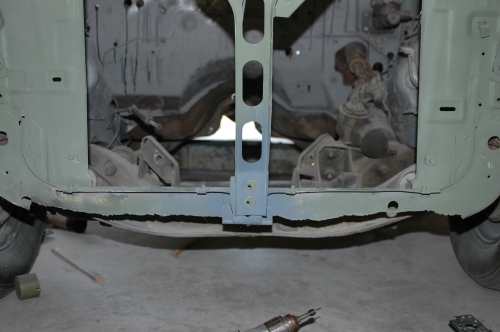
Recently, my son and I were scavenging some parts from a wrecking yard for his 1967 Plymouth Satellite. I had recently been perusing the sheet-metal parts catalogs and discovered that '67 to '70 B-bodies all used the same lower radiator support. As it turned out, the donor car had a good one, and we were able to get it very inexpensively.
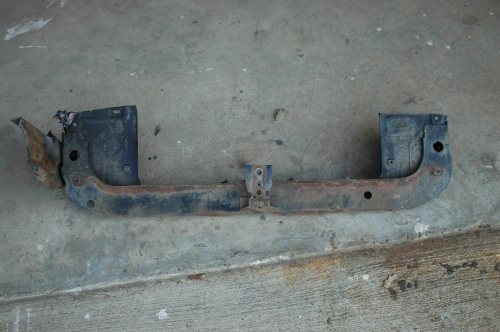
Now the replacement I had long thought would never happen was literally a few spot welds away from reality. The next couple of pictures show the front end of my Charger, with the old defiled part removed, and it sitting next to the cleaned and straightened replacement.
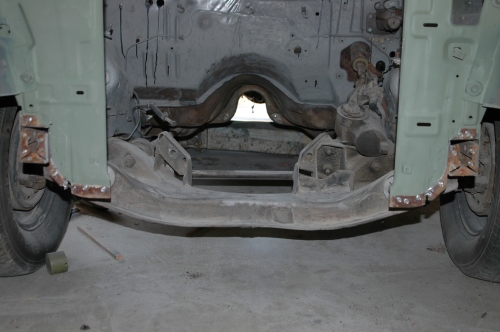
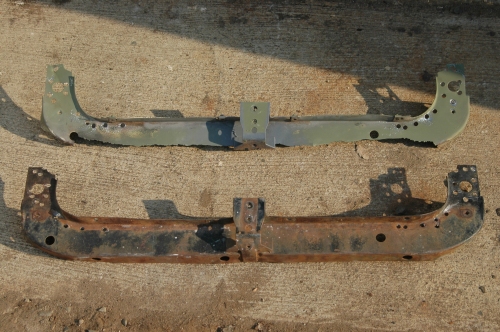
And here's the "new" support, installed, primed, and ready for paint.
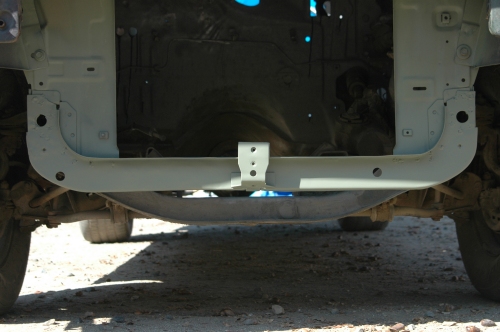
Posted in 2004-present | RESTORATION | body | sheet-metal replacement | link to this page | | Comments (0)
August 24, 2007
Moving Day
The last few months I have been incredibly busy, along with the rest of my family, getting ready to move out of the house we've been renting for the last fifteen years. One of the monumental tasks we faced was safely relocating my beloved Charger to a temporary home in my inlaws' insulated 3-bay garage. I hope to be able to continue some work there this fall, while we wait to discover whether the Lord wants us to buy a house of our own, or rent again. In either case, I am thankful for the loan of the safe storage space, and that I can continue to use that if we end up settling in a place without a garage.
Towing this car through my small town was the first time I had shown it off publicly since well before I began my restoration. Ever since the day I moved it, I have had people in town asking me if I happen to have been the one "towing that Charger" through town, wondering where I "picked it up". It was fun to explain to them that I've had this car for over twenty years, and about my plans to complete its restoration.
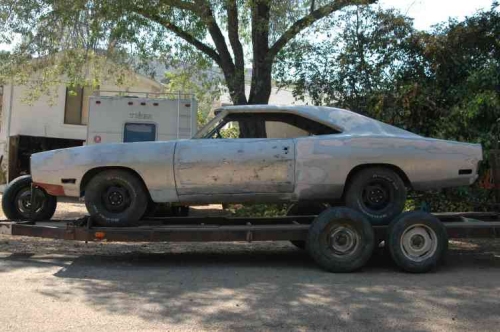
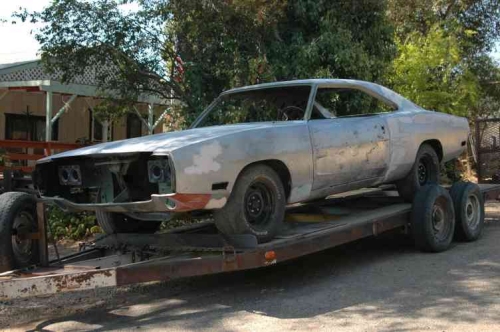
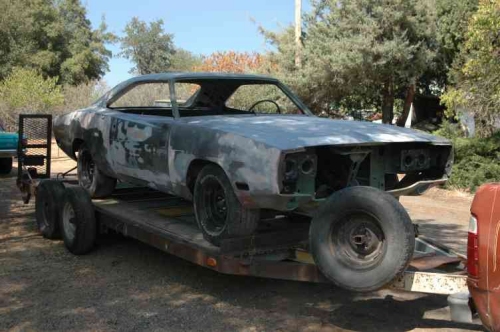
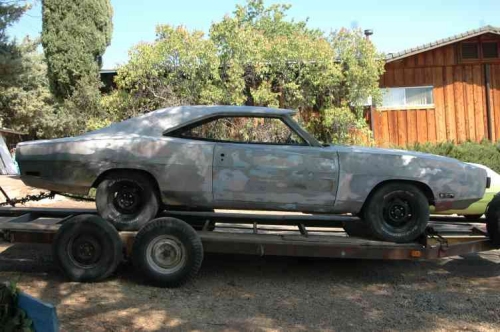
Posted in 2004-present | RESTORATION | link to this page | | Comments (0)
July 01, 2007
The Return of the Wizard
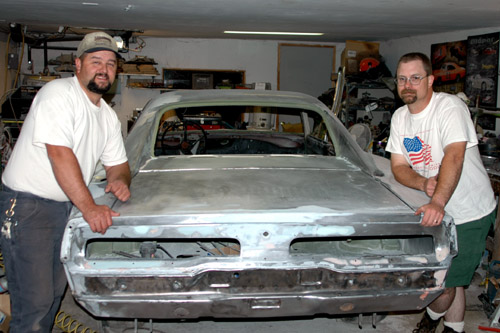
My great friend, brother in Christ, and "metal mentor", Frank, returned for a visit from his new home in Montana. In the several hours we spent visiting, he took a walk around my Charger and showed me where I've been making the rookie error of oversanding my filler, causing unevenness where the filler and the bare metal come together. With a pen marking the highs and lows, he indicated the areas that still needed work (there were lots). However, he did find one area that was done correctly, by chance, and had a nice indistinct feathered edge. Now that he's shown me what it all ought to look like, things have been progressing rapidly, and I think in the right direction.
I realized all over again how much I leaned on Frank when he was here, and it was great to see him. With his nudge in the right direction, there's a good chance my car might even be primered and/or painted before he sees it in person again.
Posted in 2004-present | RESTORATION | body | sheet-metal replacement | link to this page | | Comments (1)
June 23, 2007
Steering column restored
One of the things I've looked forward to for a long time was the disassembly, thorough cleaning, and reassembly of my steering column components. Many of these were sandblasted, as noted in a previous entry. I also used a brand-new ignition switch and a brand-new ignition lock cylinder and keys (keyed to match the new door locks I bought). My turn-signal switch is a used one, but it is not burned, it's in good shape, and it still has the automatic cancelling tabs intact.
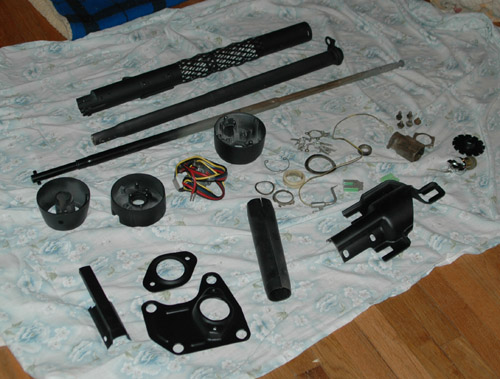
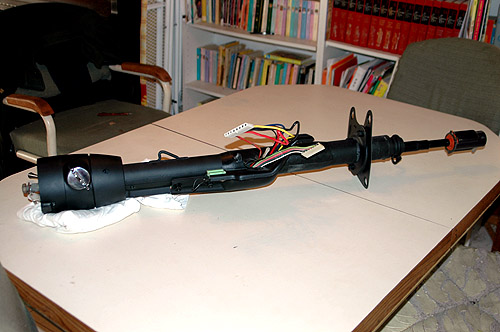
Now that it has been restored and each component has been tested, I will package this away, waiting for that wonderful day when my car has been painted and reassembly is underway.
Posted in 2004-present | RESTORATION | interior | wiring | link to this page | | Comments (3)
April 28, 2007
360-degree view
Well, I'm not done smoothing out the body yet, but I wanted to clean the shop, and it was a nice opportunity to roll the car outside and get some pictures with a wider view than I can get inside my small garage. I temporarily installed a complete steering column from a '69 Charger so that I could steer the car in and out of the garage more easily, since, once I am done restoring my '70 column, it will stay put away until the car is being reassembled.
The slideshow below somewhat approximates what a walk-around of my car would be like in its current state of restoration.
Posted in 2004-present | RESTORATION | sheet-metal replacement | link to this page | | Comments (0)
November 11, 2006
Grille restored!
One of the things that can set off a '70 Charger no matter how beautifully painted the body is, how shiny the bumpers are, or how clean the interior is, is the grille. If the grille looks tired and old, cracked, deteriorated, I think it affects the way the entire car is perceived. I have spent a great deal of time repairing, cleaning, masking, and painting my grille, the headlight doors, and the Charger 500 emblems. I am very happy with the end result I achieved. As good as these pictures are, I don't think they do the grille justice. The paints I purchased from Totally Auto were excellent. I had my doubts as my first coat of silver was going on; it sort of looked blotchy. But as it dried and multiple coats were applied, it really did take on a nice even smooth finish everywhere I used it. Besides having the grille very clean, spending hours masking with high-quality masking tape seemed to be the key to getting a good final product. The grille will soon be packaged safely and stored in the attic until needed during reassembly, but first I want to show it off to some of my local Mopar buddies.
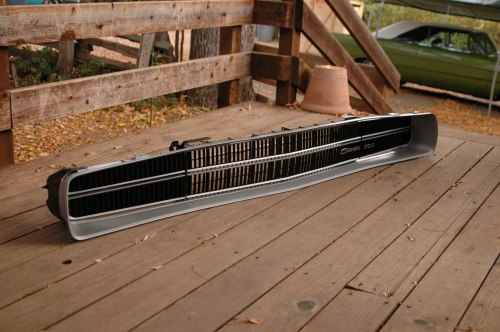
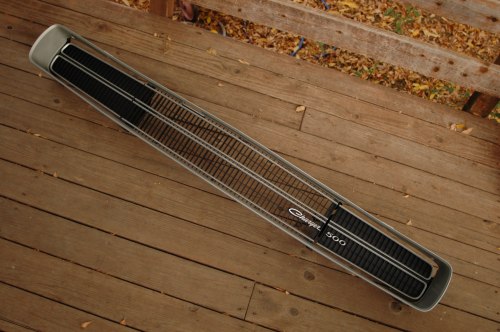
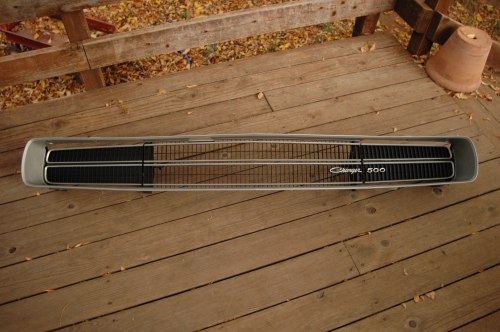
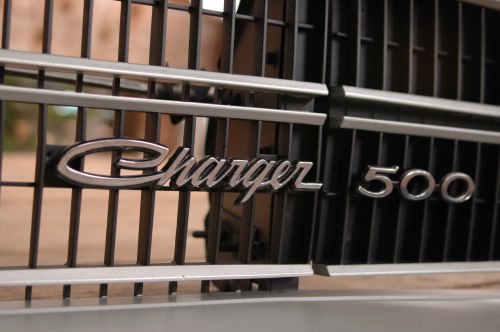
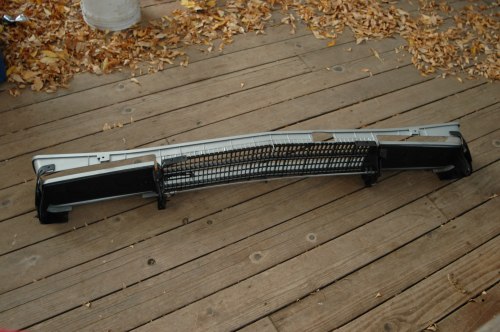
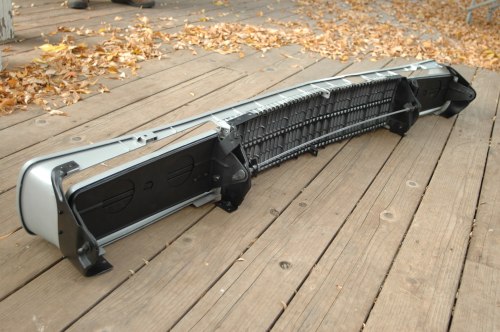
Posted in 2004-present | RESTORATION | body | trim | link to this page | | Comments (3)
Body pieces back in place
Here are a few updated snapshots of the body of the Charger coming back together a little bit more. The hood is now back on the car and on its hinges. A lot of attention has been paid to keeping all my gaps between the fender/cowl/doors etc even. It sure looks better than it did when it was last together. In these pictures, the trunk lid is not actually attached to its hinges; it's just sitting on some foam shims temporarily. My focus continues to be on smoothing out the body work as best I can, moving toward the eventual priming day, when I can then begin to really perfect the final finish of the car before painting.
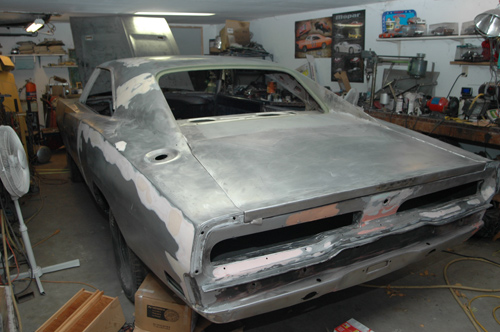
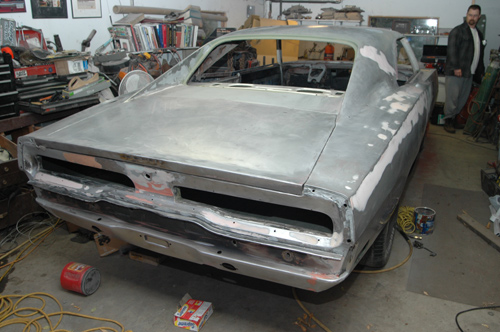
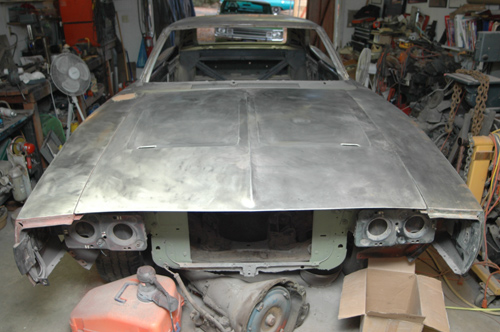
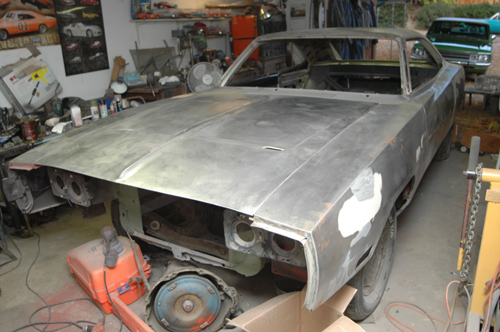
Posted in 2004-present | RESTORATION | body | sheet-metal replacement | link to this page | | Comments (0)
October 20, 2006
Sub-frame connectors
One of the things it seems virtually all Mopar people agree with is that there are many huge benefits to stiffening up our old Mopar muscle cars. One of the best ways to do this has proven to be attaching what are called sub-frame connectors, which tie in the front and rear frames of the car. This relieves stress from the sheet metal during hard launches and extreme handling situations. There are numerous brands of these available, ready-made to go into a wide assortment of cars. However, I found a number of people who had fabricated their own quite successfully. I decided to take that approach and save some money. The material I used was 2x2 square tubing with a 1/8"-thick wall. The plates that attach to the forward frame were 1/4" thick 2"x4 1/2". The gussets for the rear were 1/16" mild steel.
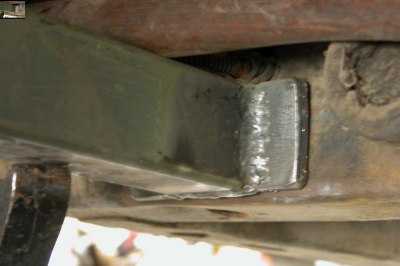
The first thing I did was weld the 4 1/2"-wide pads onto the front edge of each tube. The front subframe was cleaned with a wire wheel prior to welding, and the whole piece was fitted approximately in place in order to mark the angle at which the rear would have to be cut to meet the rear subframe.
I cut the rear of the tubes so that the bottom of the frame would be flush with the tube. This resulted in the tube being brought up exactly to the bottom of the rear floorpan. I did not want to cut into the floorpan, as I have seen some do on A- and E-body cars. This junction was completely welded off on both sides prior to being plated.
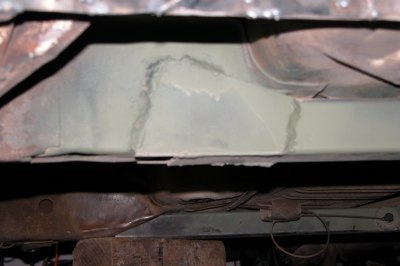
This is the finished view of the rear, with the plates welded over the top of the joint of frame and subframe connector, which was also welded. Each side of the subframe connector had one of these plates, and each plate was welded on all four sides.
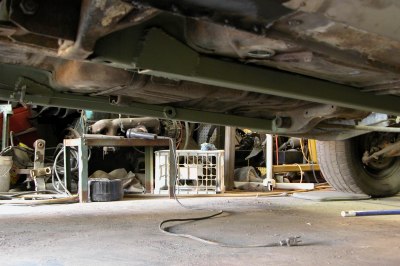
Here are both bars in place, painted with etching primer, as seen from the passenger side.
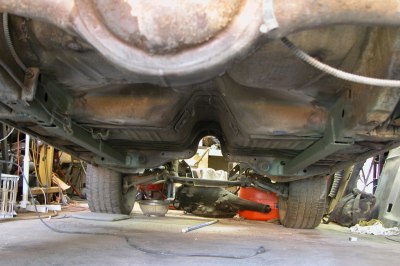
Both bars viewed from the rear.
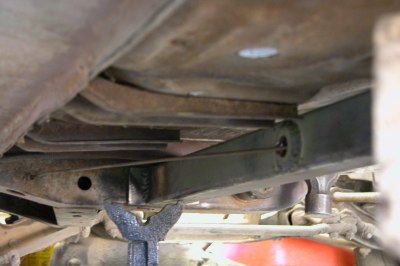
The only thing that prevented this from being a super-easy job was the fact that on the driver's side, the parking brake cable passed directly through the space where the subframe connector needed to be. After marking the location on the tubing where the cable would need to go through, I drilled large 3/4" holes on either side. Realizing that this could possibly weaken the subframe connector on that side, I chose to weld heavy washers on the outside of the hole on each side. I took a drill with a 5/16" bit at the same angle the cable would pass through the tubing and made a smooth, angled channel for the cable. I was very pleased with how well it turned out, and can't wait for the day when I can realize the benefit that these bars will provide.
Posted in 2004-present | RESTORATION | body | suspension, brakes, tires, and wheels | link to this page | | Comments (0)
October 19, 2006
Restoration of hood hinges and springs
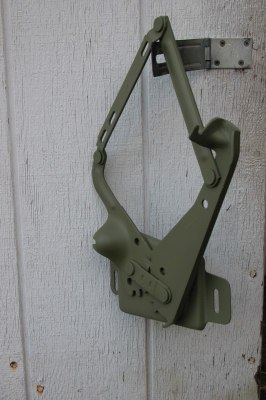
Using my 4 1/2" grinder with a cup-style wire wheel, I removed all the original finish from my hood hinge. Since these had functioned fine on the car before it was disassembled, no real refurbishing was needed. However, I wanted them to be ready for new paint, and after they were totally stripped they were given multiple coats of self-etching primer.
Some people recommend using a coil-spring compressor, reversed, to stretch hood springs for paint removal and repainting. I found that this surplus Mopar bumper jack did a great job and was easier to use.
Posted in 2004-present | RESTORATION | body | link to this page | | Comments (0)
October 18, 2006
Hubcaps
Some friends whom I have helped with some Charger items and issues over the last couple of years graciously gave me this set of four period-correct dog-dish-style hubcaps. These will look really great in the center of my police wheels. I have not yet decided if I will paint the wheels black, to complement but contrast with the car body color, or paint them body color. I have seen it done both ways, and like both.
a closer view of one of the hubcaps.
Posted in 2004-present | RESTORATION | suspension, brakes, tires, and wheels | link to this page | | Comments (0)
October 15, 2006
Front valance ready to go
One of the many things accomplished by my family members for me during one of our several "sanding parties" was getting the majority of the original finish sanded off of this front valance. The front valance was in really good shape, and needed very little hammer-and-dolly work after removing the rest of the finish, prior to being primed with self-etching primer. This piece will now be set aside, awaiting further reassembly of the car.
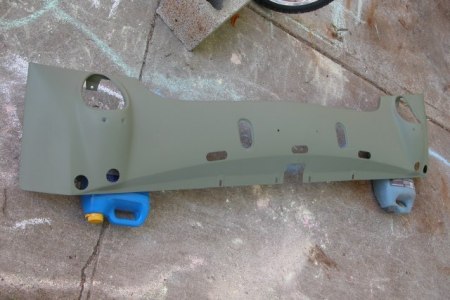
Posted in 2004-present | RESTORATION | body | link to this page | | Comments (0)
October 05, 2006
Restoring the grille
I was really happy when I was able to get this grille some time ago, as documented earlier. It was in vastly better condition than my original grille, but it had one flaw: one of the vertical fins was missing a section. I used Plastifix to repair it. The major steps in the process are shown below. Warning to people planning to use this product: It smells really strong, and may have your family really disgruntled if you use it in the dining room. Trust me on this, I know.
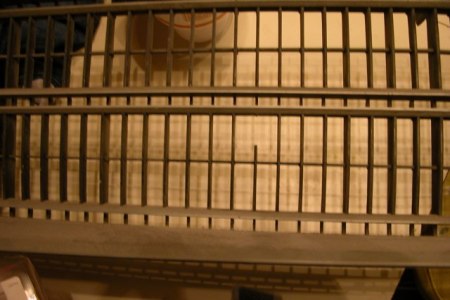
This was the trouble spot I was going to try to fix.
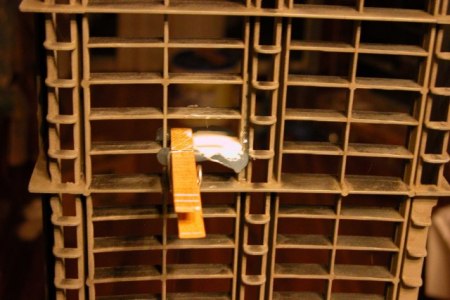
After using the soft molding block provided to make a mold off of a neighboring good fin, I clothespinned the mold into position and filled the mold with the liquid plastic repair material. This took six or so hours before it was really hard enough to take the mold off.
After trimming, sanding, and filing the new plastic to meet the shape and contour of the other fins, a quick shot of flat black was applied just to test how well my new piece would blend in. Visitors to whom I have shown my grille in person cannot find the repaired fin until I show them which one it is, and even I have a bit of trouble finding it sometimes.
The next step for my grille (or is it grill?) will be to take it outside, clean it, buff it up with a Scotch-Brite pad, and repaint it using correct paints I purchased from Totally Auto. Stay tuned for completed grille pictures soon.
Posted in 2004-present | RESTORATION | body | trim | link to this page | | Comments (0)
August 20, 2006
August 2006: Steering wheel, seats, and air cleaner restored
This has been an inspiring and productive month for my Charger project. Through God's grace, some good eBay fortune, and the generosity of several friends, my air cleaner, steering wheel, and seats are all restored and ready to be packed away awaiting their turn going back into my Charger as I reassemble it.
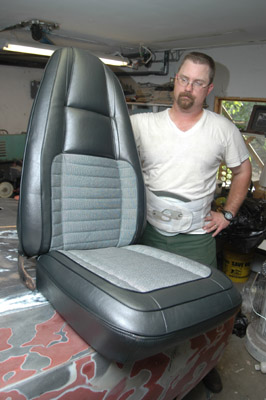
Here I am, posing proudly with one of my newly-restored front seats. The story of how these came out so nicely is really rather amazing and has had me praising the Lord for several days now. Earlier this year, I purchased a nice set of seat covers for my car in charcoal vinyl with salt-and-pepper cloth inserts. Then just a couple of weeks ago I happened to see one day in our very small town a 1969 Roadrunner in primer on a tow-dolly in front of our local greasy spoon burger joint. We parked my wife's 1972 Dart next to it, and I proceeded to look around the car hoping to attract the attention of the owner so I could talk to him. When he came out, I realized I had met him a couple of years before at the DMV, and we had promised to contact each other and never did. He told me the sad news: he was moving away in about three weeks. After a visit to his house and some lengthy Mopar-infused conversation, he told me he was an upholsterer by trade and had specialized in Mopars for 35 years. A short time later this fellow Mopar enthusiast decided to do a tremendous favor for me. For a very small fee, not even enough to cover materials really, he made time in his busy packing schedule to completely redo my seats, stripping them down to the frames, rebuilding the seat foams where needed, and covering them with my seat covers. The final result was stunning to say the least, and these pictures do not do them justice. Thank you Larry!
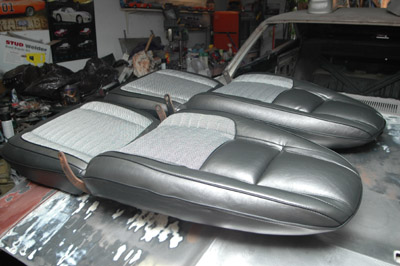
Here are both bucket seats, which will soon be put in storage. Before that, I will refinish the hinge covers and seat tracks and have them ready for eventual installation, the same time as the seats.
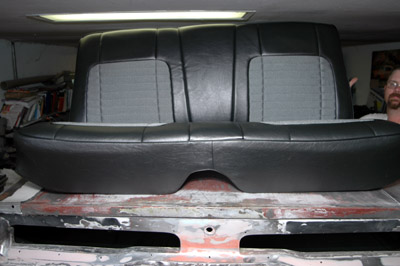
After so many years of seeing my poor, neglected, cracked, mouse-eaten, duct-taped, sometimes-covered-usually-not backseat, I have to pinch myself when I look at this perfect restoration to perhaps better-than-new condition. This really motivates me to get that car painted so I can start putting it together!
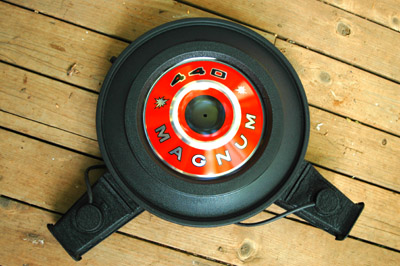
This air cleaner is a piece of the puzzle I have been in search of for a long time. After searching and searching eBay for years, being constantly disappointed by the high prices these air cleaner assemblies go for, I happened upon one that had been described incorrectly as a Chevy air cleaner. I could tell from the photos that indeed it was the exact Mopar housing I needed. Thanks to the error of the person listing the item I was able to get it for about 1/3 the going Mopar-air-cleaner rate. I guess the Chevy folks knew it wasn't theirs and the Mopar guys hadn't found it. The housing was perfectly straight. After cleaning it, I stripped the original remaining wrinkle finish, which was mostly gone anyhow, and then recoated the entire assembly with a proper coat of Krylon wrinkle paint. I purchased the pie-pan also on eBay, and it is an original NOS, which I bought for less than the price of many of the more commonly available reproduction pie-pans. This has been safely packed up in a padded box and will be stored until needed later on in the restoration of my Charger.
It took the generosity of a couple of friends to bring this steering wheel together for my car. The wheel itself came from my longtime friend James, and the wheel center, a 1970-only item, came from my friend Jude, a fellow Charger enthusiast. So for the cost of a little elbow grease and some vinyl dye for the wheel center, I now have a crack-free very original-looking steering wheel to go with the rest of my new interior stuff.
--------
Posted in 2004-present | RESTORATION | engine | interior | link to this page | | Comments (0)
July 15, 2006
July 2006: Sheet metal replacement continues
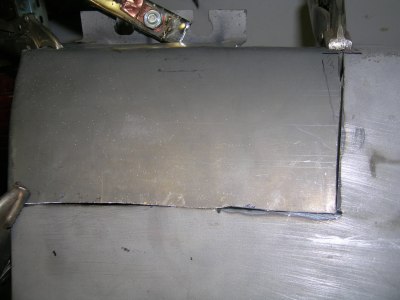
The driver's side fender I acquired for my car was in excellent condition as it had no collision damage in its life. However, the car had sat since the 1980's and the lower portion of the fender behind the brace was thoroughly rusted out. Using a patch panel I purchased from Auto Body Specialties, I have repaired the fender by welding in new metal after completely cutting out the rusty metal. The welds were sealed with waterproof metal body filler, and then a skim coat of filler and glazing putty were applied to get the contour just right. I have coated the back of the fender with Eastwood's rust encapsulator, and hope to soon be re-mounting it on the car, following the same exacting alignment procedures I followed previously on the passenger side.
--------
Posted in 2004-present | RESTORATION | body | sheet-metal replacement | link to this page | | Comments (0)
June 30, 2006
June 2006: Body coming back together
After cutting out everything that was bad, replacing it with metal that was new, and doing rust-prevention treatment on parts, it is tremendously exciting and rewarding to begin reassembling the car. I am especially excited to see the body lines crisp and beautifully aligned, better than they ever have been in the 20+ years I've owned this car.
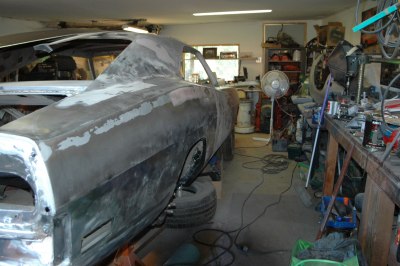
The welded seam on the newly replaced quarter panel needed to be sealed inside and out with waterproof metal body filler (I learned about how important this was from an outstanding set of how-to DVDs I purchased when my metal wizard friend moved away. I highly recommend the Howard's Backyard Auto Body series for anyone who plans to do any body work, any paint prep, any priming or painting, and isn't sure exactly how to proceed). With a heavy layer of metal filler on the inside, and a solid-but-thin layer on the outside, the quarter panel only required minor traditional filler to smooth out imperfections along the seam. It now feels and looks very good. I can't wait until the day comes to start laying some primer on this thing.
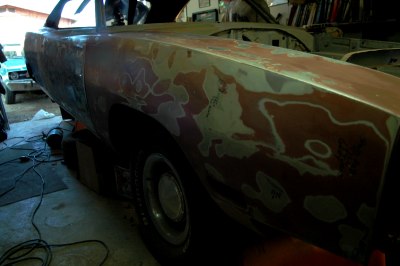
Before installing the passenger fender, I primed all bare metal beneath it with etching primer. The backside of the fender itself was treated with a good coat of Eastwood's rust encapsulator, the same as I used on the floors in the earlier sections. After adjusting all the adjustable portions of the fender-mounting arrangement, the body lines are crisp, the door gap is even, and now only some minor sanding on the fender will be required prior to priming. Eventually, the entire underside of the fender/wheel-well area will be underbody coated, once I know for sure that I'm not taking the fender back off for any reason.
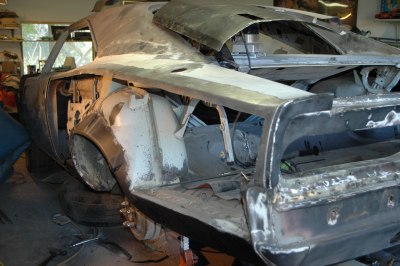
This is the driver's rear quarter opening, all trimmed and prepped for installation of the new quarter, which has also been trimmed to fit the opening. Starting with a technique a friend shared with me of laying the new metal over the old metal and cutting them both at the same time, I improvised (and I think improved) the process by using my Sawzall to make most of the cut, using the cutting wheel on the grinder only to get the sawblades a place to start. This went much smoother, was easier for me to control, and was vastly less expensive than using six or eight cutting wheels as we did on the other side.
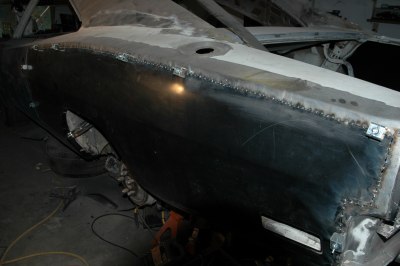
On the driver's side, the welding process was the same as for the passenger side -- slowly tacking the gap between the car and its new piece, keeping heat to a minimum. Pictured here are the special clamps I purchased from Eastwood's, which I mentioned in the write-up on the passenger side but did not have a picture of. These little gems really work, and keep the panels aligned while maintaining a small gap for good Mig penetration.
--------
Posted in 2004-present | RESTORATION | body | sheet-metal replacement | link to this page | | Comments (0)
June 07, 2006
"Sanding Party"
I have been home from work for almost a month with a couple of herniated disks in my lower back.
My wife, sensing that I was rather frustrated at not making my usual amount of progress preparing my car, did something really nice. She organized my two kids and asked for instructions and safety equipment; then they set to work continuing the sanding work on my car!
My daughter is 6, my son is 10 and he helps me regularly, but twice now in these last two weeks the whole crew cheerfully assembled in the garage for what they call a "sanding Daddy's Charger party".
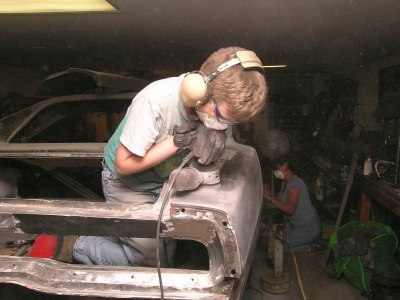
My 10-year-old son taking old paint off of the passenger rear quarter. He generally has a lot of fun helping me, and always learns quite a bit. It is wonderful to be able to share this with him. By the time we go to do his car, he'll be a pro.
My daughter Claire is always enthusiastic about lending her dad a hand. Her trademark "thumbs-up" gesture says it all.
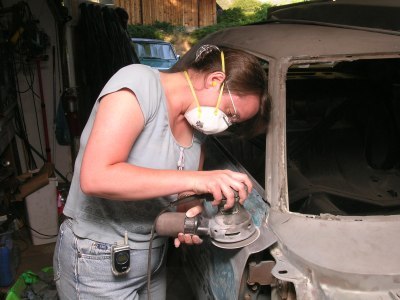
Thanks to my lovely wife Rachel, not only for her hard work on the car and in our home, but for sensing my discouragement at being injured and rallying the troops to keep my restoration moving forward. It has been very fun for both of us to see my wife becoming more and more interested in not only my car's restoration, but in her appreciation of Mopars in general.
--------
Posted in 2004-present | RESTORATION | sanding | link to this page | | Comments (0)
March 11, 2006
Spring 2006: Seeing Results
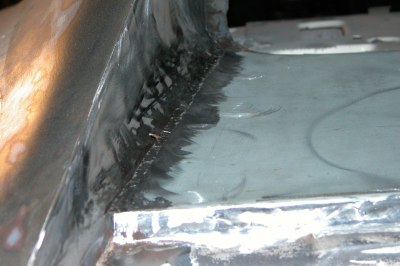
The driver's side sail panel area was one of the first areas on the car that I realized had extensive rust. Now all the metal in that area is brand new and is awaiting only some very fine filler work to smooth over where the welds have been ground down smoothly. The welding process was done slowly to minimize warping, and a bit tedious, but the results should be well worth it.
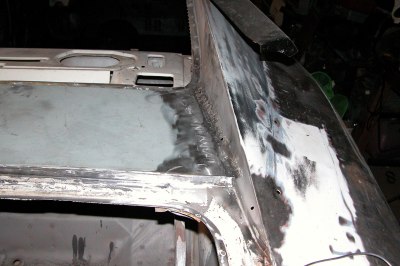
The passenger side had significant rust, though not as serious as the driver's side. However, it too now gleams with new shiny metal. The rear-window opening has been rebuilt and will do a much better job sealing out the rain than it used to.
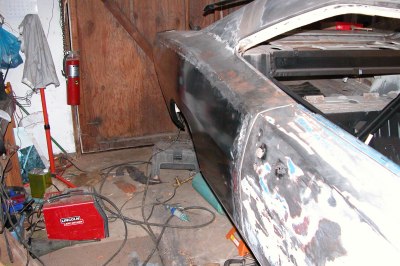
The tack-welding process is nearly complete! Hopefully my metal wizard buddy will be able to help me do the final smoothing on this quarter panel, as we have recently learned that due to a new job he'll be moving away. BUMMER! (for more reasons than that).
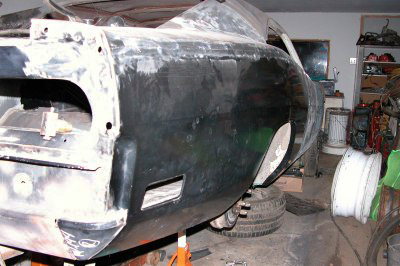
There was quite a bit of hand-forming that had to be done in the area of the recess for the bumper. This was handled extremely well by my very helpful metal wizard. Using the quarter panel extension piece as a guide, he obtained the correct alignment, and as this picture shows, the welding over most of the panel is finished, awaiting only final smoothing. I am very happy to have this worst part of my car become one of the nicest.
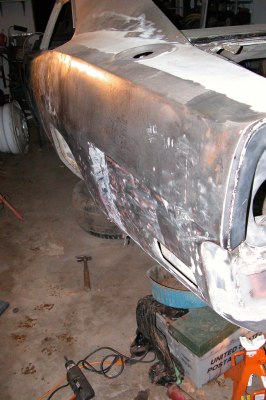
With my metal work coach leaving, I am moving aggressively to attack the driver's side quarter next. This picture is the quarter before I started drilling spot welds and separating the panels, which I now have completed. When my buddy shows me where to cut, I'll have another picture, with another gaping hole in the side of my car. Stay tuned.
--------
Posted in 2004-present | RESTORATION | body | rust & rust repair | sanding | sheet-metal replacement | link to this page | | Comments (0)
March 10, 2006
Instrument bezel
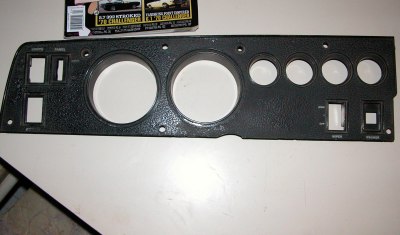
When one of my fellow 70 Charger Registry members was viewing my page, he noticed that I had not yet located a clean, restorable '70 Charger instrument bezel. For those who are unaware, in 1970, Chrysler moved the hazard switch to the steering column, along with the ignition switch and a steering-wheel lock mechanism. Well, this left no need for the hazard switch and its corresponding rectangular hole in the bezel. Thus, coming to the rescue, my new buddy Mike offered to sell me one that he had recently purchased on eBay, at his own cost. What a guy! I hope to eventually get my dash plastic rechromed and looking really good, now that I've got this sound piece.
--------
Posted in 2004-present | RESTORATION | interior | link to this page | | Comments (0)
January 10, 2006
Rear quarter panel installation
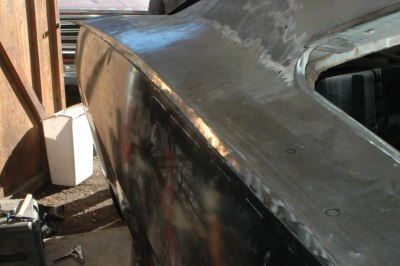
It was finally time to cover up the gaping hole in the side of my car. While paying very close attention to the alignment of the main body lines, and also focusing on the wheel opening and bottom flanged edge alignment, we carefully figured out how much of the reproduction quarter panel would have to be cut off and discarded. A friend of mine, James, who has worked in the automotive restoration field for a number of years, gave us a suggestion which saved us a lot of grief. We were puzzling over how to get the new piece and the opening it would fill trimmed as precisely as they would need to be. His suggestion was to overlap the pieces by as much as possible, and then using a 4" grinder with the thinnest available cut-off wheel, cut both the new panel and the car at the same time. To maintain our alignment, we used a number of cleco temporary clamping devices, which I purchased from Eastwood's.
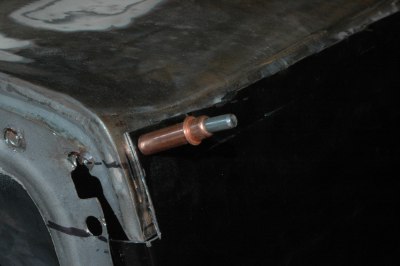
For those who are wondering, this is a Cleco, purchased in a kit with special pliers to install and remove them, these are a reusable temporary clamping device. First you drill a small hole through both items to be held. Then squeeze the Cleco with the pliers, slide it into the hole, and release. When you're ready to remove it, simply grab it with the special pliers, squeeze, and slide it out of the hole. If you're going to be doing a lot of metal replacement and welding or fabrication work, a set of these is really handy. I bought these at Eastwood's, although I understand they are available elsewhere.
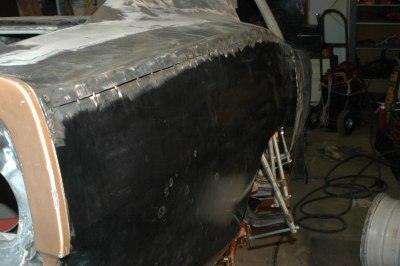
Using Eastwood's intergrip panel clamps, the new panel was held in place for tacking, which we did very carefully, putting a tack only every twelve inches or so initially, in order to avoid overheating the material. Once the edges were well-tacked after several passes, we glued all the lower flanged edges with panel-bonding adhesive, also purchased from Eastwood's. The rear quarter was now in its final resting position. The body lines lined up very nicely, and it would just be up to me to patiently continue the tack-welding and smoothing process until we had a seamless welded bond.
EDIT, OCTOBER 2010
While trimming the wheel lips to the proper dimensions (the after-market quarter panels had an excessively wide wheel lip), I discovered that the panel bonding adhesive, for whatever reason, had not bonded the quarter panel to the wheel house in many places. I removed the panel bonding adhesive, which wasn't that difficult, and drilled holes, then spot-welded the two pieces together just like we did on the driver's side from the beginning. Not sure what the failure was, but I'm glad to have discovered it before getting everything painted.
Posted in 2004-present | RESTORATION | body | rust & rust repair | sheet-metal replacement | link to this page | | Comments (0)
October 01, 2005
October 2005: sheet-metal work resumes
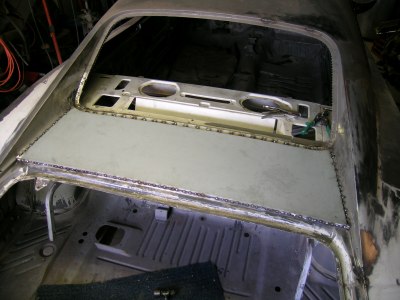
With all the metal prep work done, and the new piece formed and fitted, it was finally time to weld in the piece that would complete the rear-window opening and cover the expanse between the window and the trunk. To get this right, we temporarily reinstalled the deck lid, in order to match the slight crown the original piece had. Carefully tacked in place so as to avoid warping, the piece looked great when it was finally pinned down.
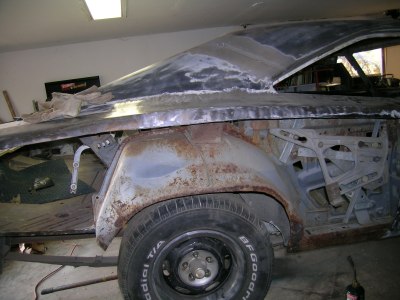
Even though I've been looking forward to this moment for years, I had to swallow hard, grit my teeth, and just go with it when my buddy put his cutoff wheel into the quarter panel. The passenger side had more extensive rust and much more previous body damage (hidden by up to half an inch of filler), so it was decided that full replacement was best.
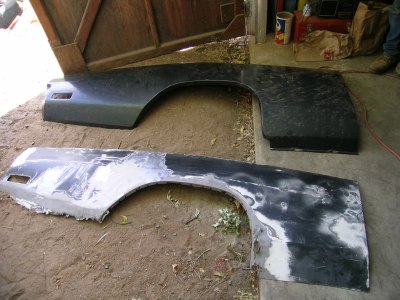
Out with the old, in with the new, so they say. Here's the veteran quarter panel lying next to its replacement.
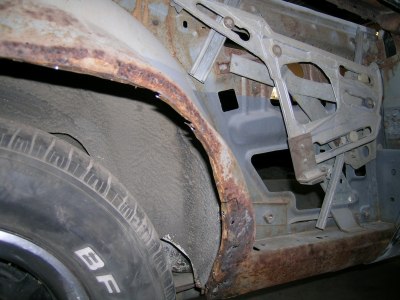
One more reason we totally removed the passenger-side quarter panel was to get at the inner fender rust on the forward edge of this piece. Only total replacement of all defective material will be good enough to achieve the results we are hoping for.
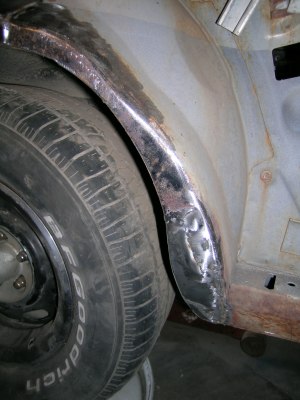
My buddy, the metal wizard, never ceases to amaze me. This was a case in point. He used some of the complex compound curvature left over from the sail panel repair pieces to fabricate an identical steel replacement section for the rusted area in the previous picture. Once welded in and ground off smooth, it was truly amazing how well he had matched the original shape.
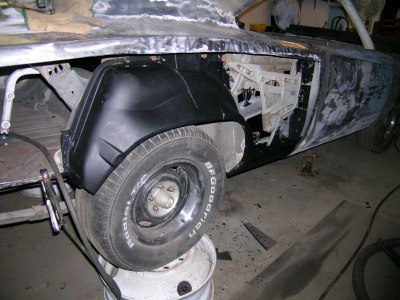
To help prevent any future problems, the inner fender, inner rocker panel, and several other areas which are impossible to access under ordinary circumstances, were given a generous coating of the same rust encapsulator used on the floor.
--------
Posted in 2004-present | RESTORATION | body | rust & rust repair | sheet-metal replacement | link to this page | | Comments (0)
May 25, 2005
Rebuilding the Wiring Harness
One major source of heartburn when I drove my Charger all those years was my temperamental electrical system. Once the wiring was all removed and I could inspect it properly, it was a mystery that the car had worked at all without burning itself to the ground. All of the bad splices, bad connections, improperly done repairs, and modifications made this wiring harness a real challenge to restore. My future enjoyment would require a fully functional, safe, and reliable electrical system. Armed with over a dozen salvaged Mopar harnesses and a reproduction '70 Charger factory service manual, I replaced every bad wire, connector, bulb, and switch with good originals. Now the entire harness, headlights to tail lights, has been rebuilt to match the diagrams in the manual, and is ready to be stored.
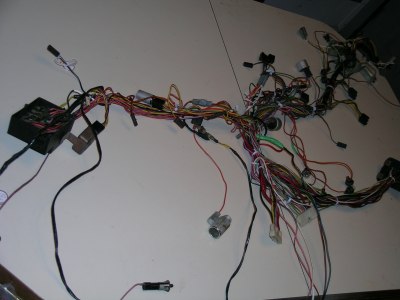
This is the dash harness, the most extensive part of the wiring harness. I have rebuilt it, and it is ready for re-wrapping.
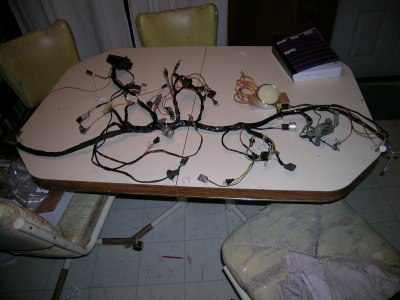
The dash harness, now re-wrapped, replicating factory routing of all wires, is now ready to be stored until reinstallation at a future time.
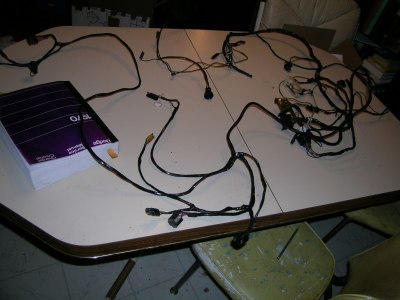
The engine compartment harness, with Mopar electronic ignition conversion seamlessly grafted in for a factory appearance, all re-wrapped and ready for storage. The addition of electronic ignition is the only electrical deviation from stock.
--------
Posted in 2004-present | RESTORATION | wiring | link to this page | | Comments (1)
May 20, 2005
Interesting historical find
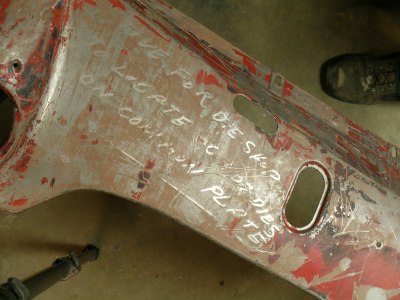
You never know what cool historical things might turn up when you're restoring a car. I found this writing underneath the original primer on my front valance. The writing says, "SAVE FOR DIE SHOP TO LOCATE 06 AND 07 DIES ON COMMON PLATE". It is interesting to think that this part of my car was once used seemingly to help recalibrate equipment that would in turn make parts of other '70 Chargers. You can click this link to view the picture in a larger size.
--------
Posted in 2004-present | RESTORATION | sandblasting | link to this page | | Comments (0)
Sandblasting: results
I only sandblasted the sturdy, mostly-non-exterior parts of the car. My goal was to remove any rust, old paint, grease, oil, etc., and have a nice surface ready for primer and a good coat of Eastwood's rust encapsulator, where needed. More delicate exterior sheet metal is being stripped of its layers of paint, primer, and filler by chemical stripper and/or lots of power- and hand-sanding. The hand-sanding is where my kids "get" to help a lot (they really do enjoy it).
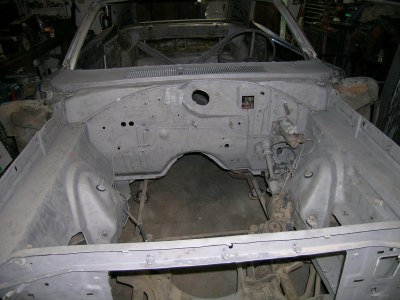
All blasted and clean, the engine compartment now looks so nice, I can just imagine the layers of glossy paint that will one day adorn it.
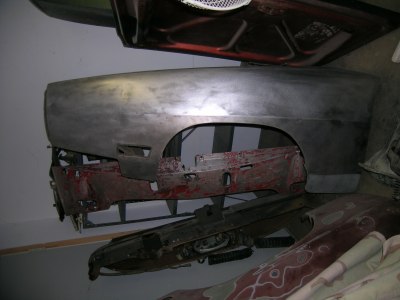
Several treatments with chemical stripper and a few hours of sanding have got my driver's side fender down to its original shiny self. After I smooth a couple of dings and installing a steel rust-repair panel for the area behind the tire, this fender will be primed with etching primer, awaiting the day of final painting.
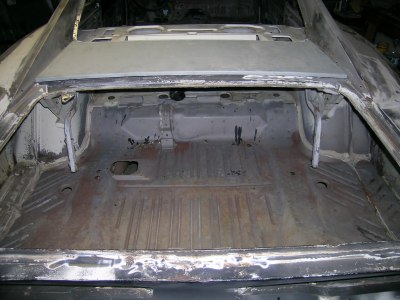
My trunk was remarkably solid, and will not need replacement. A couple of minor pinholes will be welded up before the trunk floor is treated with Eastwood's Rust Encapsulator and preventative treatment.
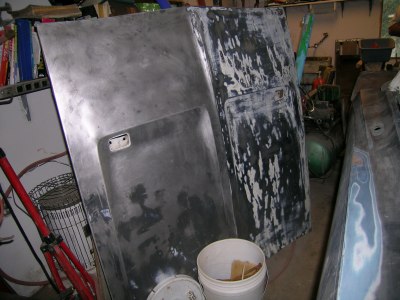
The hood had an amazing number of layers of finish on it, but after many rounds with the stripper, and much sanding, the bare metal is finally showing itself.
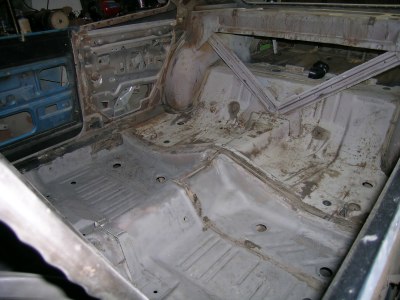
The floorpan
--------
Posted in 2004-present | RESTORATION | sandblasting | link to this page | | Comments (1)
Sandblasting: setup
For the sandblasting phase of my Charger's restoration, I constructed a 20x20 enclosure, with a huge tarp over a steel frame, and another tarp on the floor to aid in sand recovery. Using up to 3 air compressors simultaneously gave me enough air to keep the blasting going strong.
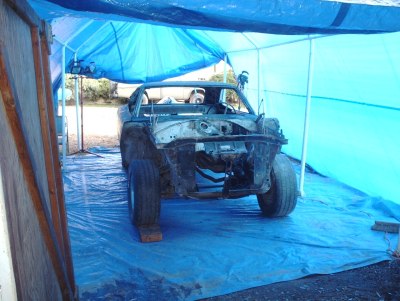
A front view of the stripped Charger, ready for sandblasting
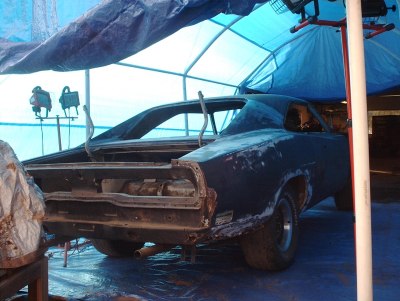
Rear view
--------
Posted in 2004-present | RESTORATION | sandblasting | link to this page | | Comments (1)
March 10, 2005
Sail panels
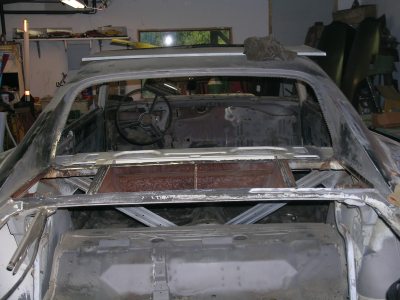
The next time my friend and I work on the Charger, we will start out by replacing the flat panel that lives between the sail panels. Test fitting the Charger Specialties piece indicates that once our surface preparation is complete, it should be a perfect fit. I highly recommend this company if you happen to need the sheet metal pieces they offer.
--------
Posted in RESTORATION | body | rust & rust repair | sheet-metal replacement | link to this page | | Comments (0)
Passenger-side sail panel, repaired
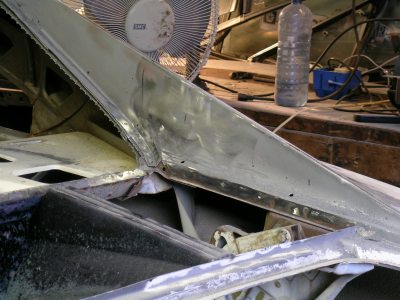
The passenger side has much less rust and only a tiny 3" x 1.5" piece of the repair section was needed. The welding, grinding, and sanding went so well on this side that absolutely no filler will be needed at all.
--------
Posted in 2004-present | RESTORATION | body | rust & rust repair | sheet-metal replacement | link to this page | | Comments (1)
Sail-panel and window tray repair: complete
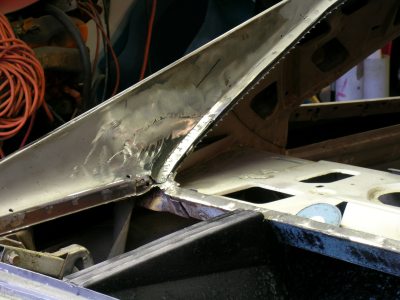
The final product: welded, ground, and high-speed sanded, looks stunning. Little or no filler will be required on the weld seam area. You will never know how great a job my friend did once this is covered up with a vinyl top again, so I'm glad I have pictures.
--------
Posted in 2004-present | RESTORATION | body | rust & rust repair | sheet-metal replacement | link to this page | | Comments (0)
Sail panel repair: ready to weld
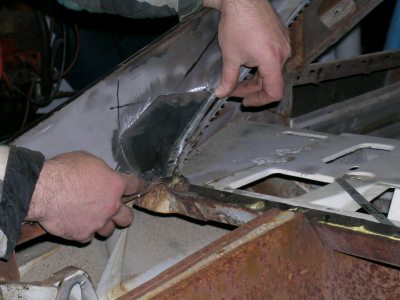
After the rusted material was removed, only a relatively small section of each of the repair panels I'd purchased from Charger Specialties was needed. The fit and form of the pieces was quite good, and required no exceptional massaging for a nice fit. Here, the trimmed and fitted repair piece is shown in place, ready for welding.
--------
Posted in 2004-present | RESTORATION | body | rust & rust repair | sheet-metal replacement | link to this page | | Comments (0)
Sail-panel and window tray repair
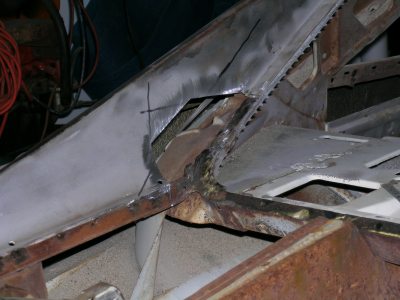
(just as a reminder, a few entries before this one in the 'sheet-metal replacement' category, you'll find a shot of the rust in this area as we initially uncovered it.)
At long last, the exciting day arrived and my metal-wizard friend brought all his welding and fabricating equipment over to my garage. First step was to remove the large flat panel covering the area between the rear window and the trunk lid. Next the rusted-out areas of the sail panels had to be removed. The driver's side was much worse than the passenger side, so we started there.
--------
Posted in 2004-present | RESTORATION | body | rust & rust repair | sheet-metal replacement | link to this page | | Comments (0)
Grille
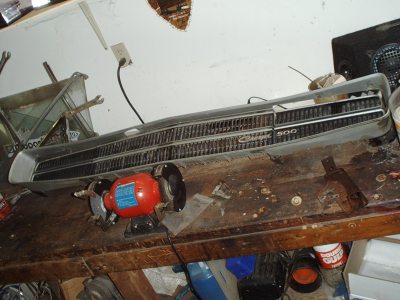
Another item I had been searching for for decades was an intact 70 Charger grille. I have come across very few over the years, many in worse shape than my original. Recently I was able to acquire this very nice Charger 500 grille. After a few years of seeing them go for unbelievable sums on eBay, I am delighted to finally have one of my own. Currently a company called Premiere Plastics is considering using this grille as a pattern for a future reproduction '70 Charger grille. Stay tuned on that.
--------
Posted in 2004-present | RESTORATION | trim | link to this page | | Comments (1)
500 finish trim
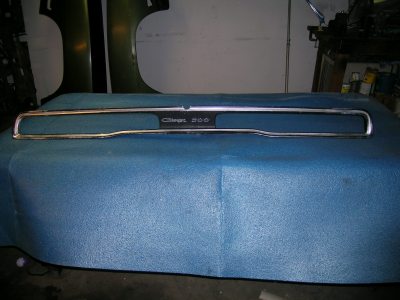
When I got my charger back in 1986, the finish trim that surrounds the taillights was crinkled up almost into a little ball in the trunk. I did a fairly decent job of getting it smoothed out, but never really good enough to ever be put on my finished car. I was delighted to come across this very straight original trim piece. Once repainted, it will really help set off those distinctive Charger taillights.
--------
Posted in 2004-present | RESTORATION | trim | link to this page | | Comments (0)
Refurbished center console: closer view
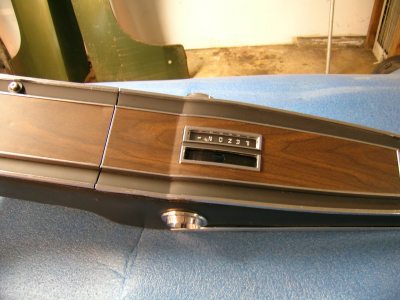
This closer view shows the corrected door alignment and the repainted border, the polished chrome bezels, and the new wood grain in place. I bought the wood grain kit from Performance Car Graphics. The kit was inexpensive and easy to use if you follow their detailed instructions.
--------
Posted in 2004-present | RESTORATION | interior | link to this page | | Comments (0)
Refurbished center console: closest
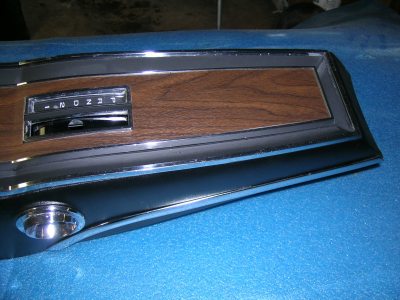
In this close-up, the grain and texture of the woodgrain material is evident. I also purchased a new filler piece for where the automatic transmission shift lever goes through. The look is complete and ready to go.
--------
Posted in 2004-present | RESTORATION | interior | link to this page | | Comments (0)
Refurbished center console
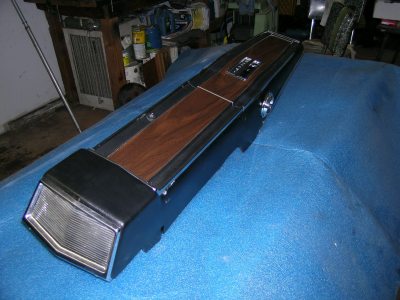
At long last, I had the materials and time to refurbish my center console. I repaired the broken parts of the plastic housing, using epoxy underneath where it doesn't show. The end product of that endeavor is nearly perfect. I refinished the console in black to match the new interior that will be installed one day.
--------
Posted in 2004-present | RESTORATION | body | interior | link to this page | | Comments (0)
Instrument Panel
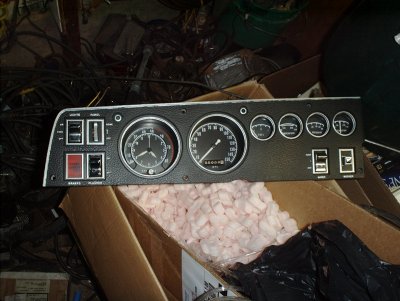
In rebuilding my instrument panel, I took all five or so instrument clusters I have accumulated over the years, set up a 5-volt tester, and selected the gauges with the best function. Then I used a kit from Performance Car Graphics to resurface the gauges once I had repainted them a flat black color. I do not have an unbroken 1970 cluster bezel, so I used one from a '69. Thus the panel I currently plan to put in my car has a dash-mounted hazard lights switch; if I find a 1970 bezel, I will install it and delete the hazard switch as would be proper. The bezel was repainted and relettered by hand, and detailing took me about a day and a half. I think the results will be very nice for my weekend cruiser of the future.
--------
Posted in 2004-present | RESTORATION | interior | link to this page | | Comments (0)
Prior to removal of
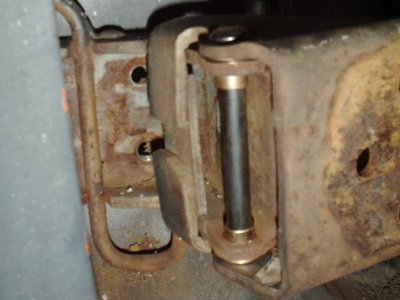
Prior to removal of the original quarter panels, it was deemed necessary that the doors be properly aligned. This required the rebuilding of the hinges. The upper door hinges seem to come from the factory with replaceable bronze bushings, so rebuilding them is easy. The lower hinges did not originally have bronze bushings; this allowed the steel of the hinge and the pin to wear against each other, causing an unacceptable amount of slop. By disassembling the hinge and making some changes, I was able to install bronze bushings in the factory hinge, restoring a nice, tight, smooth fit.
--------
Posted in 2004-present | RESTORATION | body | link to this page | | Comments (0)
New fenders
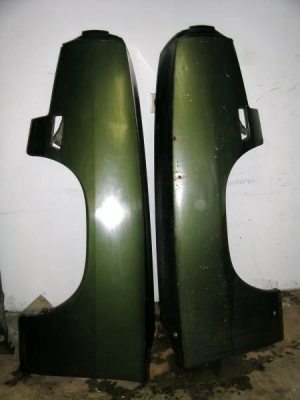
I was very happy to recently come by a pair of fenders for my Charger. I especially needed the driver's side fender, but both are better than my originals. These came off of a car that reportedly had been sitting since the early 80's. This means they have relatively little damage.
--------
Posted in 2004-present | RESTORATION | body | link to this page | | Comments (0)
September 10, 2004
Rear valance quarters
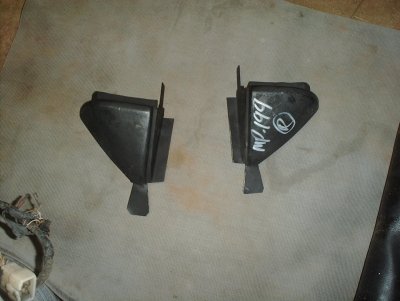
Finishing off my current inventory of rust repair parts is this pair of rear valance corners. The passenger side rear valance corner is badly rusted, and once fitted, these will nicely tie in the new quarter panels with the rear valance, which had been replaced previously.
--------
Posted in 2004-present | RESTORATION | body | disassembly | rust & rust repair | sheet-metal replacement | link to this page | | Comments (0)
Trunk floor extension
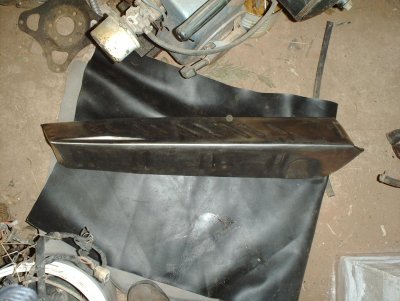
On the passenger side where the rear quarter panel was more severely rusted, the trunk floor extension was rusted out as well, where it met the quarter panel. This piece purchased from Auto Body Specialties will give a solid backing for the new quarter panel on that side.
--------
Posted in 2004-present | RESTORATION | body | disassembly | rust & rust repair | sheet-metal replacement | link to this page | | Comments (0)
Rear window channel replacement piece
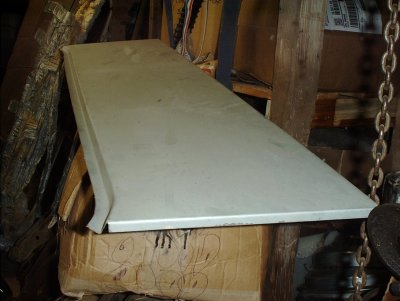
This other piece of metal required to complete the replacement of the rusted portions of the rear window channel was also purchased from Charger Specialties. This too seems to be of excellent workmanship. I will be very happy to have these pieces finally part of my car.
--------
Posted in 2004-present | RESTORATION | body | disassembly | rust & rust repair | sheet-metal replacement | link to this page | | Comments (0)
Window channel replacement pieces
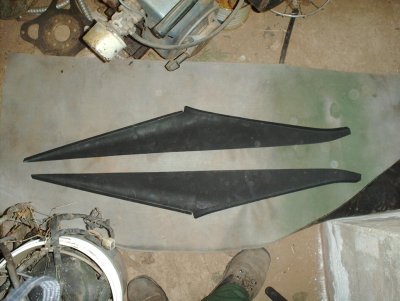
Next I purchased this seemingly very well-made pair of sail panel/rear window channel pieces, made by Charger Specialties in Montana. Not only was I impressed with the parts themselves, but the packing and shipping were very well-thought-out, with my order arriving in a handmade wooden box to keep it safe.
--------
Posted in 2004-present | RESTORATION | body | disassembly | rust & rust repair | sheet-metal replacement | link to this page | | Comments (0)
Replacement quarter panels
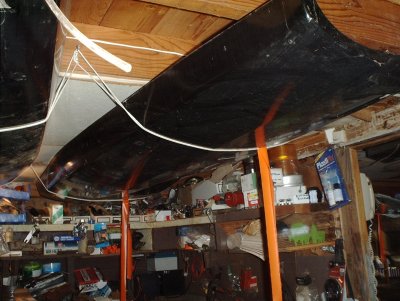
These quarter panels were my first major sheet metal acquisition. They were made by Goodmark Industries. I got a great deal on them on Ebay, which allowed my son and me to have a fun trip together to go get them in the truck. I was impressed with the quality of work on these. The real test will be fitting them to the car later, though. We are considering using an Eastwood Company weldless panel repair process to help make this easier. If anyone reading this has experience with this process, good or bad, I would be interested to hear what you have to say; please feel free to email me about it.
--------
Posted in 2004-present | RESTORATION | body | disassembly | rust & rust repair | sheet-metal replacement | link to this page | | Comments (0)
rust in the window channel
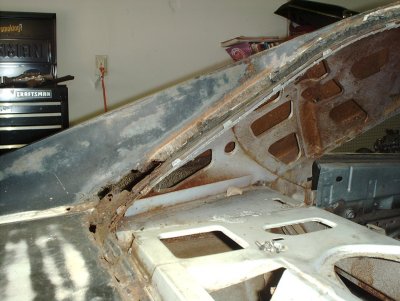
In removing the vinyl top some years ago, I discovered I had a seemingly small patch of rust on the driver's side rear window area. Years later, after removing the rear window and trim, I discovered a fairly large rust hole on the driver's side, with some significant but less extensive rust on the passenger's side corner. The window channel across the bottom was in very poor condition also. I was discouraged upon discovering so much rust on my car, but after looking at various websites and eBay, I have realized that this amount of rust is not only fairly common, but less extensive than a lot of cars that are being restored.
--------
Posted in 2004-present | RESTORATION | body | disassembly | rust & rust repair | link to this page | | Comments (0)
rust in the lower quarter
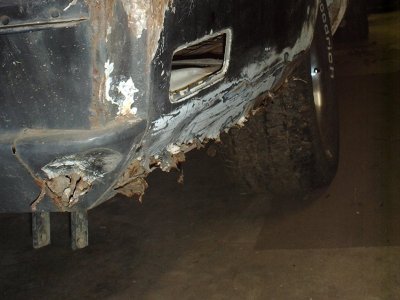
It was astounding to me to discover how much actual decay had taken place in my lower quarter panels. The passenger side was especially bad. I sanded off much of the paint and then used hand tools to pull the metal away to reveal the full extent of the damage. As is visible in this photo, the rear valance corner is rusted through, as is the vertical part of the trunk floor extension behind the lower quarter panel. With the plethora of dents, large and small, this rust helped me to decide that the rear quarters would be replaced rather than reworked.
--------
Posted in 2004-present | RESTORATION | body | disassembly | rust & rust repair | link to this page | | Comments (0)
April 10, 2004
After the glass, the
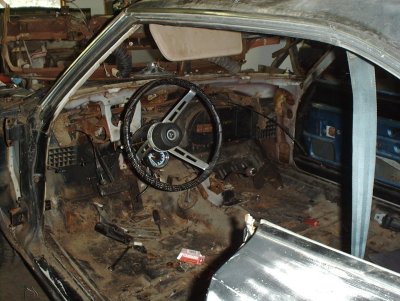
After the glass, the soft parts of the interior were removed and stored. The wiring harnesses were carefully removed. I will rebuild these carefully in order to insure that there will be no electrical problems when the car is reassembled.
--------
Posted in 2004-present | RESTORATION | disassembly | wiring | link to this page | | Comments (0)
Windows out
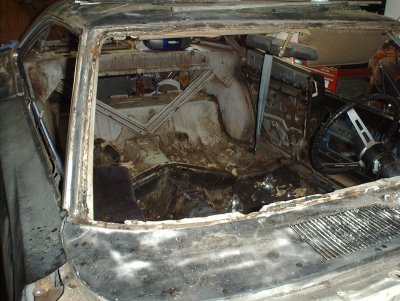
Carefully removing all of the glass from the car was a critical step; with the glass out, I will be able to start doing serious work to the rest of the car without worrying about damaging the fragile 35-year-old glass.
--------
Posted in 2004-present | RESTORATION | disassembly | glass | link to this page | | Comments (0)
Body disassembly
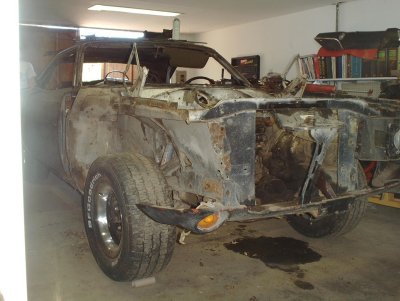
Next, the major body panels were removed, giving me better access to the inner parts of the car, as well as helping me determine what repairs, if any, were needed on the panels themselves.
--------
Posted in 2004-present | RESTORATION | body | disassembly | link to this page | | Comments (0)
Engine compartment, stripped
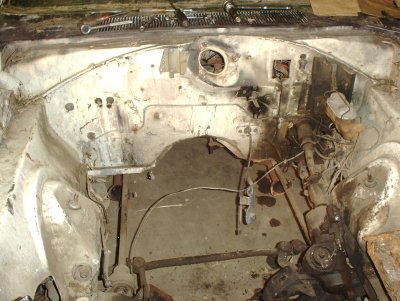
After carefully removing everything that needed to come out immediately, I then labeled and stored all the components. The engine compartment will now wait for the rest of the car to be stripped of paint, grease, and rust.
--------
Posted in 2004-present | RESTORATION | disassembly | link to this page | | Comments (0)
emptying the engine compartment
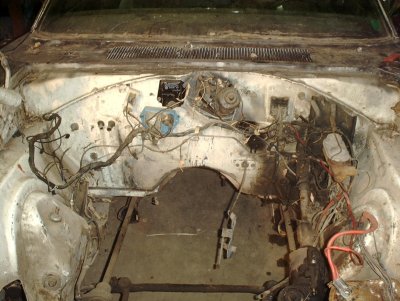
With the engine out of the way, next it was time to carefully gut the engine compartment.
--------
Posted in 2004-present | RESTORATION | disassembly | link to this page | | Comments (0)
view from the front in the shop
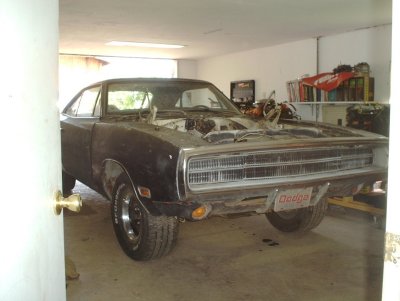
The view from the other end in the garage. There is plenty of room to walk around the car and work. At this point I couldn't wait to get started with further disassembly.
--------
Posted in 2004-present | RESTORATION | disassembly | link to this page | | Comments (0)
in its new home
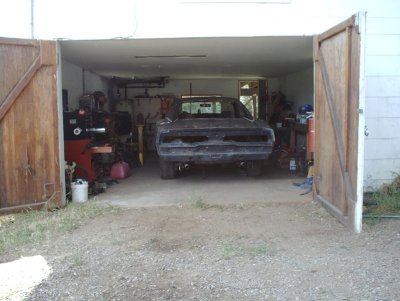
My Charger arrives in its new home (for the next few seasons anyway). Many spare moments will be invested between these walls over the next several years.
--------
Posted in 2004-present | RESTORATION | disassembly | link to this page | | Comments (0)
Engine coming out
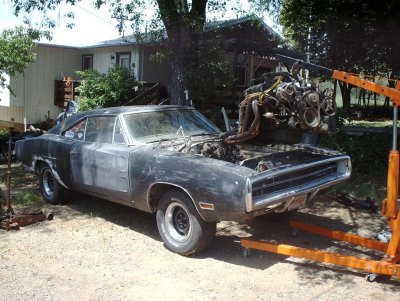
Here's the 440 on the engine hoist, on its way out of the car. It was an odd sight: the engine that had propelled me at nearly 140 mph, dangling in the air.
--------
Posted in 2004-present | RESTORATION | disassembly | link to this page | | Comments (0)
THE BEGINNING
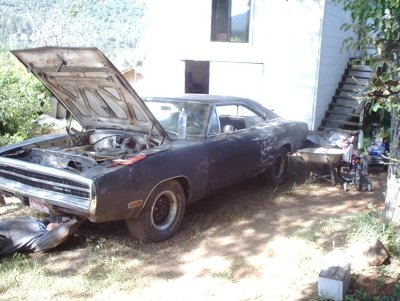
They say the journey of a thousand miles begins with a single step. And so the restoration of my car began with the disconnection of the transmission cooler lines. Within a couple of hours, as the upcoming pictures will show, the 440 engine and 727 transmission were safely out of the car. This was in April of 2004.
--------
Posted in 2004-present | RESTORATION | disassembly | link to this page | | Comments (2)